
Deciphering Digital Emotions: Neural Emoji Prediction for Japanese Sentiment Analysis
What Does Your Tweet Emotion Mean?: Neural Emoji Prediction for Sentiment Analysis
This paper proposes a neural emoji prediction framework for sentiment analysis using a large-scale Japanese Twitter corpus. It introduces an Attention-based Encoder-Decoder model that outperforms traditional CNN and RNN approaches, achieving a 7% improvement in accuracy over baseline methods.
TL;DR
Can an emoji replace a human labeler? This paper demonstrates that emojis are not just decorations but sophisticated emotional markers. By using an Attention-based Encoder-Decoder model on a corpus of 6 million Japanese tweets, the researchers achieved SOTA-level emoji prediction, proving that sequence-aware models can "read" the nuanced sentiment shift in complex social media posts better than standard CNNs.
Background: The "Zero-Shot" Human Labeler
Sentiment analysis has long been bottlenecked by the need for manual data labeling—a process that is expensive and often fails to capture the subtle spectrum of human feeling. Emojis, however, represent a global, non-verbal communication layer where users label themselves. In this study, the authors explore whether we can treat the relationship between tweet text and emojis as a "translation" problem, effectively turning emoji prediction into a proxy for deep sentiment understanding.
The Motivation: Why Japanese Text is Unique
Most emoji research (like the SemEval 2018 Task 2) focuses on English or Spanish. However, Japanese communication often involves:
- Morpheme Analysis Complexity: No spaces between words.
- Cultural Nuance: A tendency to avoid overly blunt emotional expressions (e.g., the sparing use of the ❤️ heart emoji compared to other cultures).
- Paradoxical Structures: Sentences that start positive but end with a negative sentiment shift, which simpler models like CNNs often miss.
Methodology: From Vectors to Attention
1. Proving the Visual Intuition
Before building the classifier, the authors used t-SNE to visualize emoji embeddings (word2vec). The results confirmed that emojis naturally cluster by sentiment: "pure joy" emojis grouped together, while "grief" and "anger" formed distinct clusters.
2. The Model Architecture
While previous SOTA models often used CNNs for text classification, this paper argues for the Encoder-Decoder (Seq2Seq) with Attention.
- Encoder: Uses GRUs to compress the tweet into a context vector.
- Attention Component: Instead of a fixed-length vector, the attention mechanism allows the decoder to "look back" at specific words (e.g., "fun" or "sorry") when predicting the final emoji.
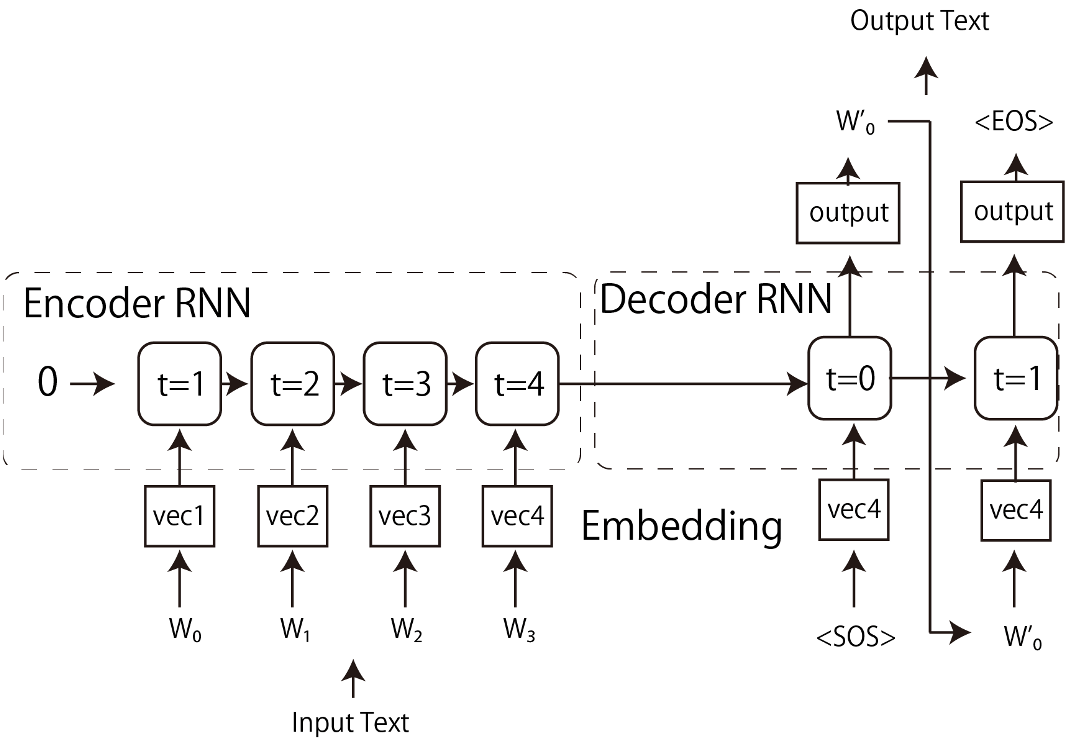 Figure: The Encoder-Decoder schematic used to "translate" text into emotional pictograms.
Experiments & Results
The researchers compared the Encoder-Decoder against a CNN Model and a Logistic Regression baseline across 10 frequently used Japanese emotional emojis.
| Model | Average Accuracy | Average F1-Score |
|---|---|---|
| Logistic Regression | 46% | 0.38 |
| CNN Model | 51% | 0.47 |
| Encoder-Decoder (Attention) | 53% | 0.48 |
Critical Insight: Handling Paradoxes
The CNN model failed significantly on "paradoxical" sentences (sentences containing a pivot, like "It was hard, but ultimately fun"). Because the Encoder-Decoder model considers the time-series/sequence data via GRUs and Attention, it correctly identified the concluding sentiment, whereas the CNN was distracted by the early negative keywords.
 Figure: Examples where the Encoder-Decoder correctly predicted emojis for complex sentences where CNN failed.
Conclusion & Future Look
The paper successfully demonstrates that Japanese emoji prediction is a viable path for automated sentiment labeling. The superiority of the Attention-based model highlights the importance of sequence modeling in social media contexts.
Limitations: The accuracy in Japanese remains slightly lower than English benchmarks, likely due to the extreme noise and slang diversity in Japanese Twitter. Future work could benefit from Transformer architectures (like BERT) or FastText embeddings that better handle subword information in the morphologically rich Japanese language.
Takeaway for Devs: If you are building a recommendation or sentiment engine, stop ignoring the emojis. They are the "ground truth" labels your users are providing for free.