
TweetGlue: Turning the Crowd into Virtual Markers for Robust Social AR
TweetGlue: Leveraging a crowd tracking infrastructure for mobile social augmented reality
TweetGlue is a mobile social augmented reality (AR) system that overlays SNS messages onto live camera views by tracking pedestrians. It utilizes a hybrid approach combining on-device light-weight image analysis with an external Laser Range Scanner (LRS) infrastructure to achieve robust pose estimation in crowded indoor environments.
TL;DR
TweetGlue is an innovative AR framework designed for social interaction in crowded venues like conferences. By combining local mobile vision (face/body detection) with an external "crowd tracking" infrastructure (Laser Range Scanners), it enables accurate overlay of text messages onto the people who posted them. It fundamentally solves the occlusion problem in crowded scenes by treating moving humans as localization landmarks.
The Problem: When People Block the View
In a typical AR setup, a device needs to know its exact pose (location and orientation) to render virtual objects accurately. Standard methods like marker-based tracking (QR codes) or markerless Feature Tracking (SLAM) fail in crowded environments because:
- Occlusion: People naturally block fixed markers or wall features.
- Ambiguity: Social AR requires associating data with moving targets, which standard SLAM doesn't inherently prioritize.
- Sensor Noise: GPS is non-functional indoors; Wi-Fi and compasses are too imprecise for sub-meter AR overlays.
The authors' insight: If the crowd is the problem, make the crowd the solution.
Methodology: The Fusion of Mobile Vision and LRS
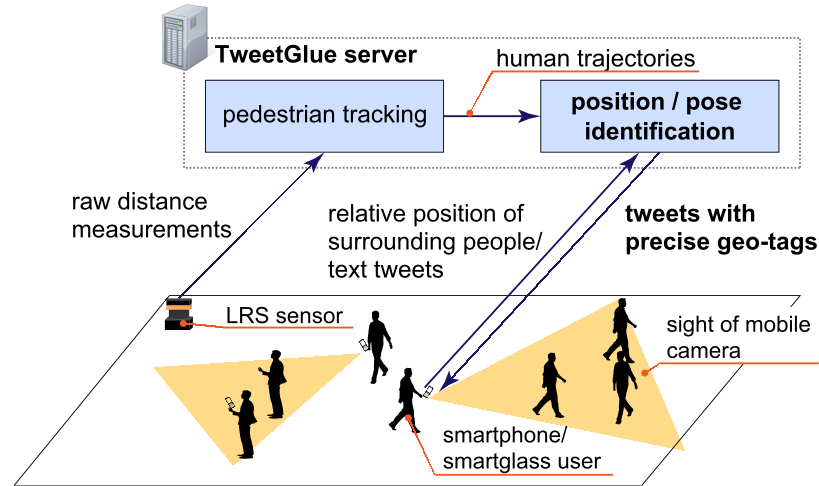
The system architecture splits the heavy lifting between an external server and the mobile client to ensure real-time performance.
1. Pedestrian Tracking (The Global Truth)
External Laser Range Scanners (LRS) are placed in the room. Unlike cameras, LRS sensors are privacy-preserving and highly accurate (centimeter-level). They scan at waist height to track all moving "blobs" in the room, creating a real-time 2D map of human coordinates.
2. Relative Positioning (The Local View)
The mobile device (smartphone or smart glasses) uses light-weight OpenCV algorithms:
- Face Detection: High accuracy within 3 meters when facing the camera.
- Body Detection: More robust at distances beyond 3 meters (up to 9m). By analyzing the size (width/height in pixels) of the detection frames, the app estimates the distance () and relative angle to nearby people.
3. Pose Estimation via Bayesian Matching
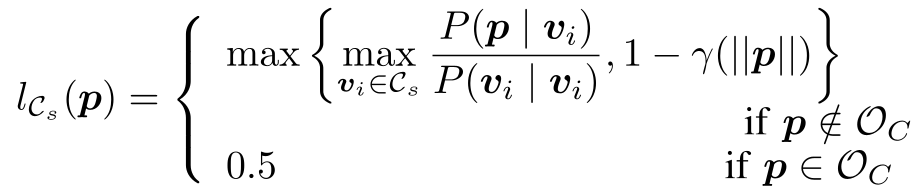
The server receives a set of relative coordinates from the mobile device. It then performs a search: "Where would a person have to stand and which way would they have to face to see the specific arrangement of people tracked by the LRS?" This is calculated using a likelihood function that accounts for image analysis errors and potential occlusions (cells hidden behind people).
Experiments and Results
The researchers tested the system in a simulated environment.
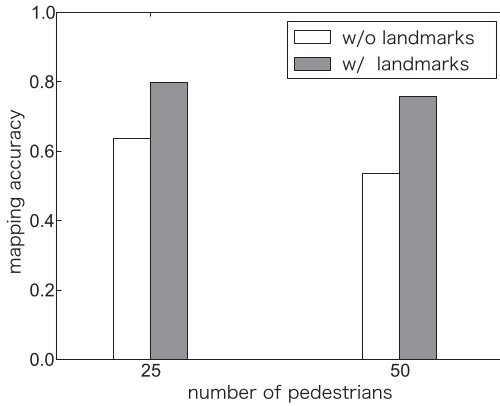
- Mapping Accuracy: The core metric—how many "tweets" were correctly mapped to the physical person. Without landmarks, accuracy was ~50-60%.
- The Landmark Boost: By utilizing fixed objects (like the LRS poles) as additional "visual landmarks," the accuracy jumped to 83%.
- Density Tolerance: The system performs excellently up to 75-100 people in the room. Beyond that, the "occlusion of the occluders" makes it difficult for both the LRS and the mobile camera to see targets clearly.
Critical Analysis & Conclusion
Takeaway
TweetGlue represents a shift from Isolated AR (where the device does everything) to Infrastructure-Assisted AR. By leveraging existing environmental sensors (LRS), mobile devices can offload the "mapping" burden and focus on the "rendering" and "interaction" experience.
Limitations
- Hardware Dependency: It requires pre-installed LRS sensors, limiting it to managed venues.
- Orientation Errors: The paper notes that as distances increase, the size of detection frames changes less significantly, leading to higher distance estimation errors.
- Static Height: The current model assumes a fixed camera height (e.g., 1.5m), which might not accommodate all users or device types (held vs. worn).
Future Outlook
With the rise of 5G and MEC (Multi-access Edge Computing), the "central server" matching logic of TweetGlue could become a standard utility for smart buildings, allowing any AR device to instantly localize itself in a crowd without the need for cumbersome visual calibration.