
#twintera!: Revolutionizing Social Matching and Team Formation via Microblogging
#twintera!: A social matching environment based on microblogging
The article introduces #twintera!, a social matching engine designed to connect microblogging users based on shared interests and expertise. By leveraging Twitter data and social network analysis, it facilitates team formation and informal learning, achieving a categorized recommendation of peers (Specialists, Enthusiasts, Apprentices).
TL;DR
The #twintera! project introduces a sophisticated social matching engine that moves beyond simple follower counts. By analyzing the "DNA" of microblogging behavior—including interest volatility, knowledge levels (Apprentice vs. Specialist), and network topology—it identifies ideal collaborators for informal learning and synergistic team formation.
Problem & Motivation: Beyond the "Follow" Button
Microblogging (primarily Twitter) has evolved into a dynamic ecosystem for sharing ideas, yet users often struggle to find the right people to collaborate with. Current recommendation systems suffer from two major flaws:
- Context Blindness: They suggest "friends of friends" rather than people with shared niche interests.
- Reputation Inflation: Users often use "follow-unfollow" strategies to artificially boost status, masking their true expertise or lack thereof.
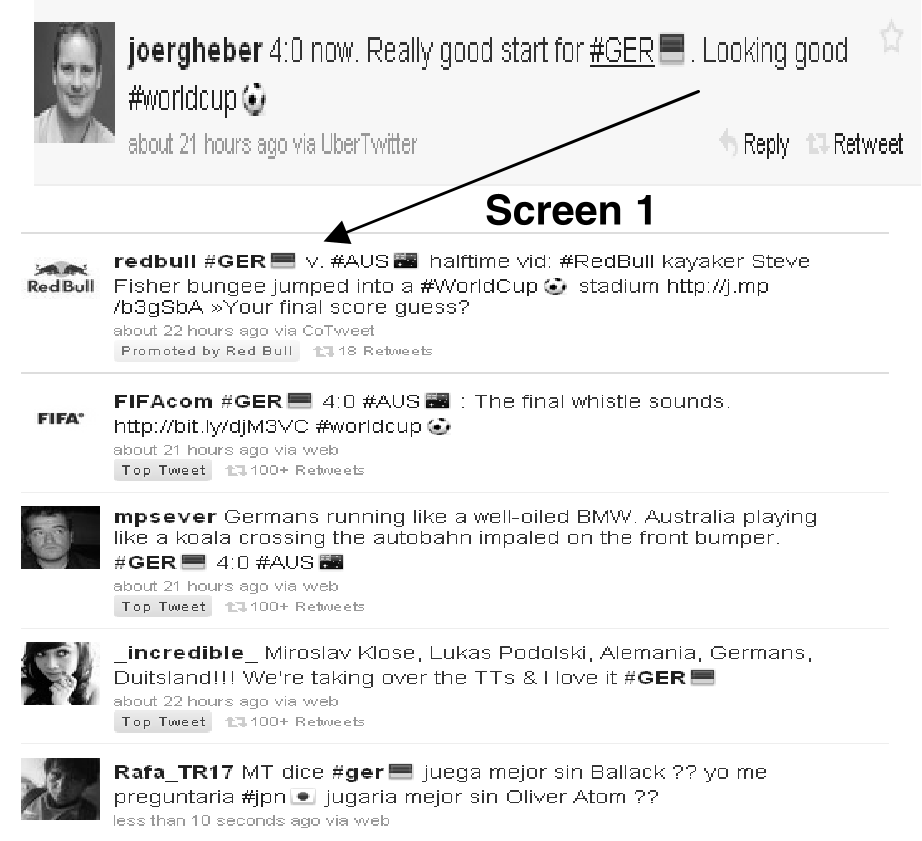
The authors recognize that interests in these environments are volatile and temporary (e.g., a hashtag trending during a football game). Therefore, the goal is to shift focus from the content itself to the quality of the connection.
Methodology: The #twintera! Engine
The #twintera! architecture is divided into three critical modules:
- Data Extraction & Cleaning: Pulling posts and timestamps to build a temporal profile of the user.
- Interest Identification: Using the Natural Language Toolkit (NLTK) to analyze not just tweets, but also the content of external links shared by users.
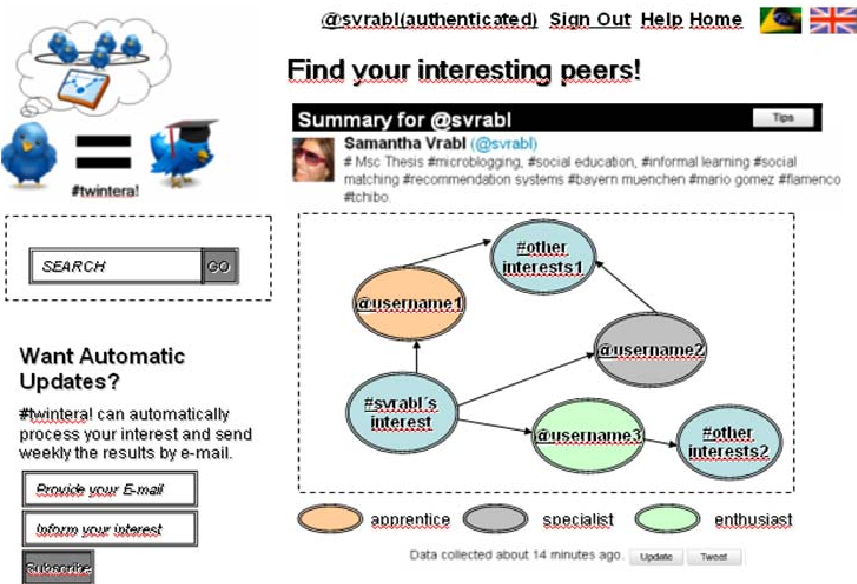
- Expertise Classification: This is the heart of the system. Users are categorized as:
- Specialists: Highly focused, professional, low message volume but high relevance.
- Enthusiasts: High activity, diverse interests, socially well-networked.
- Apprentices: Newcomers showing specific interest but smaller network reach.
The Social Logic
The system uses Pajek to calculate network density and centrality. By analyzing "Fans" (those following you who you don't follow back) vs. "Friends" (reciprocal), the engine can judge the true "authority" of a user in a specific subject area.
Experiments & Results: Visualizing the Match
The output of #twintera! isn't just a list; it’s a Social Map. This map visualizes the user's primary interest and connects them to recommended peers, while also highlighting "Additional Interests." This helps users understand the broader context of who they are about to follow.
To ensure the integrity of the matches, the engine employs a "Strategy Check":
- 24-hour follow check: Monitors if a recommended connection is made.
- 48-hour unfollow check: Detects "churning" behavior used to game the follower count.
Deep Insight & Conclusion
The core contribution of #twintera! is the formalization of Knowledge Indicators. By mapping specific actions (retweets, replies, hashtag frequency) to psychological and professional profiles, the authors provide a framework for "Social Informatics" that can be applied far beyond Twitter.
Limitations & Future Work
While the model is robust, it faces significant hurdles due to Twitter API constraints, which limit the depth of user history that can be crawled. The authors plan to refine these indicators through qualitative experiments to see if the engine truly improves "synergy" in student teams.
Takeaway: In the future of remote work and digital learning, tools like #twintera! will be essential for cutting through the noise of social media to find genuine expertise and collaborative potential.