
Twitch Crowdsourcing: Turning Every Phone Unlock into a Global Contribution
Twitch Crowdsourcing: Crowd Contributions in Short Bursts of Time
The paper introduces "Twitch Crowdsourcing," a novel mobile paradigm that embeds micro-tasks (1-2 seconds) directly into the smartphone unlock screen. By repurposing the habitual "slide-to-unlock" gesture, the system successfully collected over 11,000 volunteer contributions across tasks like urban sensing, image ranking, and knowledge graph verification.
TL;DR
Researchers from UC Santa Cruz and Stanford have solved the "granularity problem" in crowdsourcing by shrinking tasks down to 1.6 seconds. By replacing the smartphone lock screen with a "Twitch"—a lightning-fast micro-contribution—they've turned a mindless habit into a powerful engine for urban sensing and data structuring without increasing the user's cognitive load.
The "Time Threshold" Problem
Most crowdsourcing platforms like Amazon Mechanical Turk or Wikipedia editing assume that contributors have minutes or hours of focused time. However, the reality of modern life is fragmented attention. Psychologists call the small barriers to action "channel factors"; if a task takes even 30 seconds to load or requires shifting focus, most potential volunteers will simply quit.
The authors' insight was simple but profound: humans unlock their phones an average of dozens of times per day, often in "micro-moments" (waiting for an elevator, a walk signal, or coffee). What if the act of unlocking the phone became the contribution?
Methodology: The Twitch Ecosystem
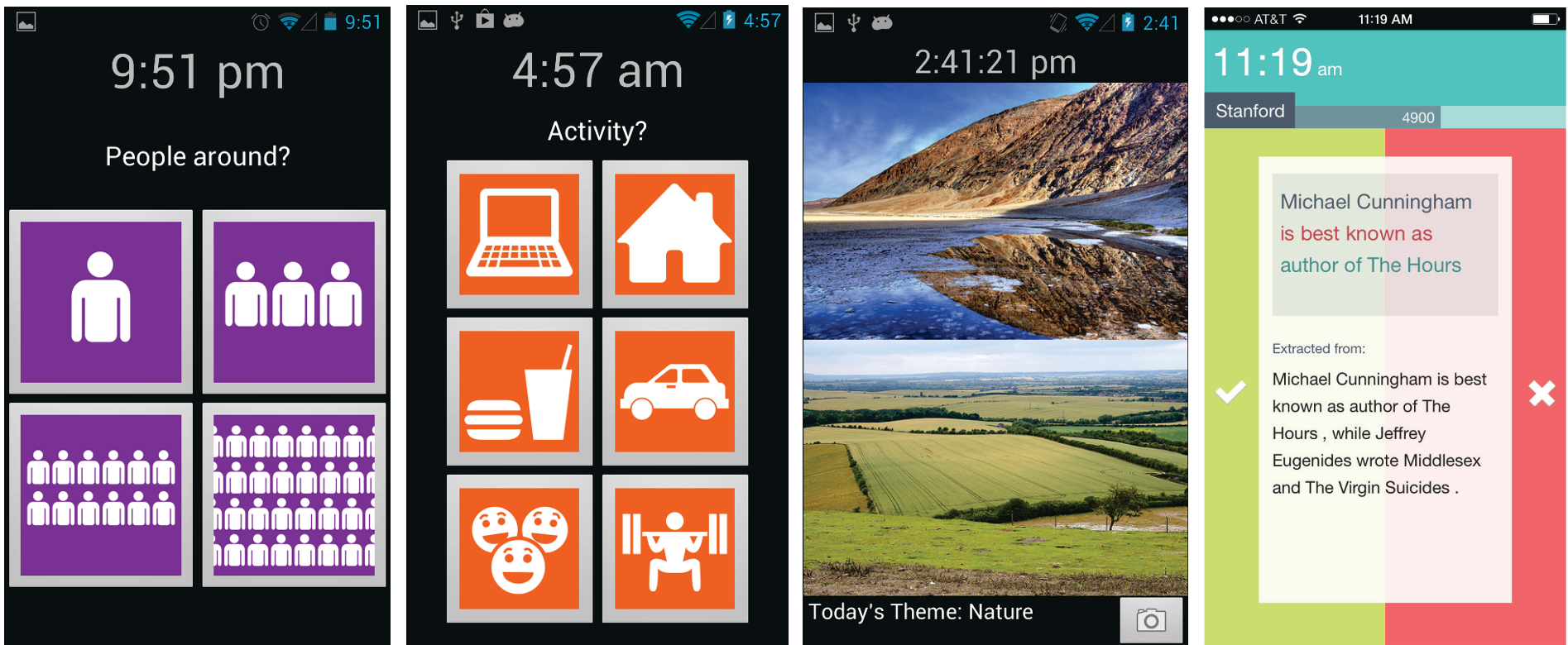
"Twitch" is an Android-based platform that replaces the standard slide-to-unlock screen with one of three diverse applications:
- Census: Captures real-time local human activity (e.g., "How busy is this cafe?").
- Photo Ranking: Asks users to swipe between two stock photos to determine aesthetic quality for designers or CV training sets.
- Structuring the Web: High-speed verification of factual relations extracted from Wikipedia (e.g., "Was X founded in Y?").
The core principle is Availability. Tasks are summoned with a single button press and completed with a single gesture, moving from "Locked" to "Work" to "Unlocked" in less than two seconds.
Proving It Works: Speed and Brain Power
The most critical question: Does this annoy users or slow them down? The researchers conducted a rigorous field experiment comparing Twitch to a standard slide-to-unlock baseline.
1. The Speed Test (Reaction Time)
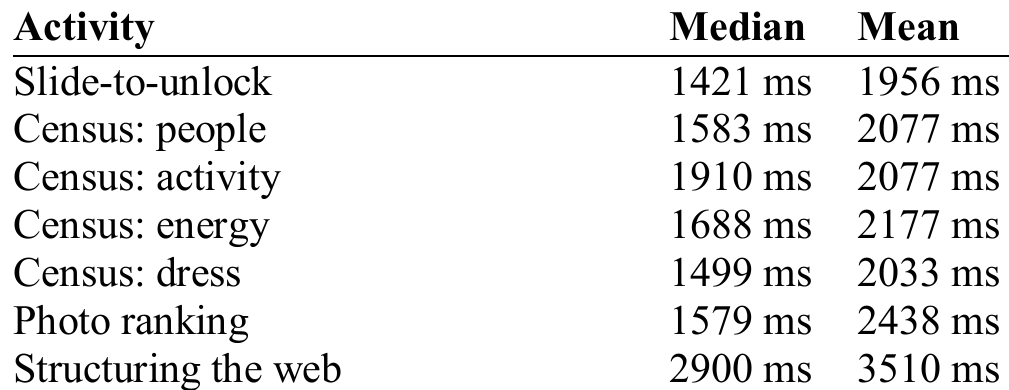
The data from 11,014 unlocks showed that the median Twitch task took only 1.6 seconds. While statistically "slower" by a fraction of a second than a standard unlock (1.4s), the difference is virtually imperceptible to the human user.
2. The Cognitive Load Test
Using a "back-task" experiment (testing 2-back and 3-back working memory), the team measured how much Twitch distracted users. The result was a breakthrough: Twitch activities had no measurable impact on accuracy compared to a standard unlock gesture.
Human-Generated Maps: The Result of 11,000 "Twitches"
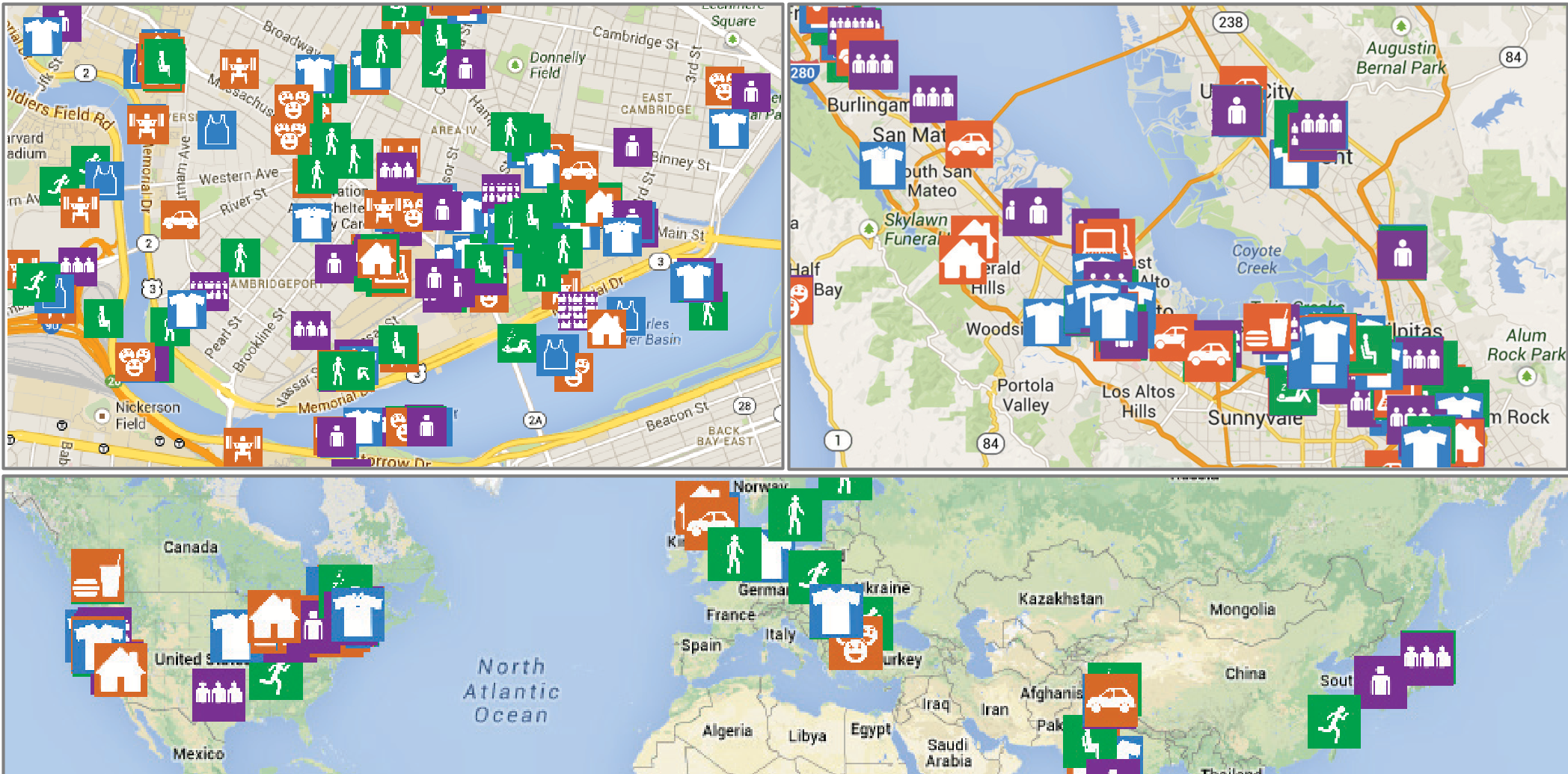
The deployment wasn't just theoretical. The 82 participants generated a rich dataset that mapped the pulse of cities. By aggregating these 1-second bursts, the researchers created a "human-centered street view," showing when cafes shift from work zones to social hubs and tracking city energy levels throughout the day.
Critical Analysis & Conclusion
Takeaway
Twitch Crowdsourcing proves that we can lower the barrier to participation to nearly zero. It suggests a future where "subject experts"—who are usually too busy to sit down for a 30-minute task—could lend their expertise 2 seconds at a time while waiting for their commute.
Limitations
- Task Variety: The authors noted that "Census" tasks became repetitive if the user stayed in the same location.
- Complexity: Some tasks, like "Structuring the Web," pushed the limits of the time-frame (approaching 3 seconds), suggesting that complex data needs to be broken down into even smaller, serial fragments.
Future Outlook
This work lays the foundation for "Ubiquitous Crowdsourcing." Imagine a world where scientific discovery, language learning, or urban planning are powered by the collective "twitch" of billions of smartphone users as they go about their day.