
Twitcident: Bridging the Gap Between Social Noise and Crisis Intelligence
14104_Semantics + filtering + search = twitcident. exploring information in social web streams.
Twitcident is a semantic framework and Web-based system designed for real-time filtering, searching, and analyzing information from Social Web streams (primarily Twitter) during crisis incidents. It leverages semantic enrichment (NER, classification, and linkage) to outperform traditional keyword-based methods in emergency contexts.
TL;DR
Social media is the "world’s nervous system" during crises, but its noise level is deafening. Twitcident is a semantic framework that filters Twitter streams by enriching short messages with external knowledge (DBpedia) and metadata. It replaces basic keyword searches with advanced faceted search, doubling filtering precision and significantly helping emergency services find critical updates during fires, floods, and earthquakes.
Problem & Motivation: The 140-Character Dilemma
During a disaster, information propagates on Twitter faster than official news. However, emergency responders face two massive hurdles:
- Sparsity: A tweet like "#txfire is approaching Austin" lacks the deep context needed for automated systems to categorize it accurately.
- Noise: Keyword-based filters (e.g., searching for "Fire") return thousands of irrelevant "chatter" posts, obscuring life-saving data.
The authors hypothesized that by enriching these short bursts of text with semantic "facets" (who, what, where), they could transform a chaotic stream into a searchable database.
Methodology: The Power of Semantic Enrichment
The heart of Twitcident lies in its multi-stage pipeline that turns a raw tweet into a structured Incident Profile.
1. Incident Detection & Profiling
The system monitors emergency broadcasting services (like P2000 in the Netherlands). When an incident is flagged, Twitcident initializes a weighted set of facet-value pairs (e.g., location: Moerdijk, type: Fire).
2. Semantic Enrichment
Instead of just reading words, the system performs:
- Named Entity Recognition (NER): Mapping entities to DBpedia URIs.
- Linkage Analysis: Following URLs within tweets to scrape the content of news articles or reports, adding that context back to the original tweet profile.
- Classification: Moving beyond keywords to identify "reports of damage," "casualties," or personal experiences (seeing, hearing, smelling).
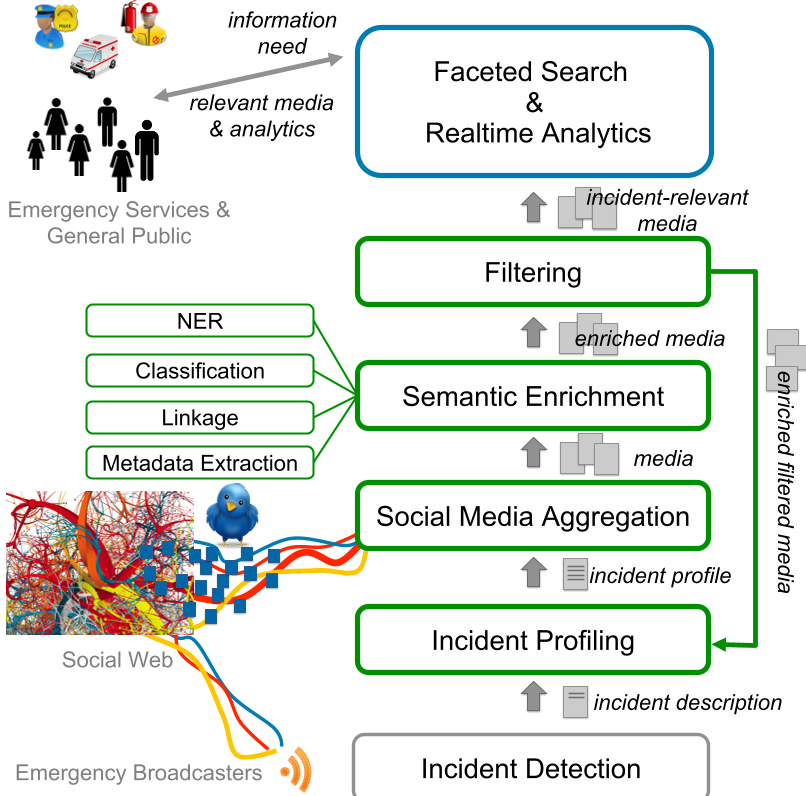
3. Adaptive Faceted Search
Twitcident doesn't just list tweets; it provides a "faceted" interface similar to an e-commerce site. Users can filter by location, time, or person. The system intelligently ranks these facets using:
- Temporal Sensitivity: Promoting "trending" facets during the peak of an incident.
- Personalization: Adapting the interface based on the user’s historical interests and activities.
Experiments & Results: Precision in the Dark
The framework was tested against the TREC microblog benchmarking task (16 million tweets).
Key Findings:
- Filtering Performance: Semantic filtering outperformed keyword-based language models across all metrics. Specifically, it was more robust—keyword search precision drops as queries become more complex, whereas the semantic approach remains stable.
- Search Effectiveness: Personalized search strategies achieved a significant boost, proving that different responders (e.g., a medic vs. a logistics officer) need different information views.
- Link-based Enrichement: Scraping external links mentioned in tweets increased the density of information, especially for target tweets that were otherwise too short to analyze.
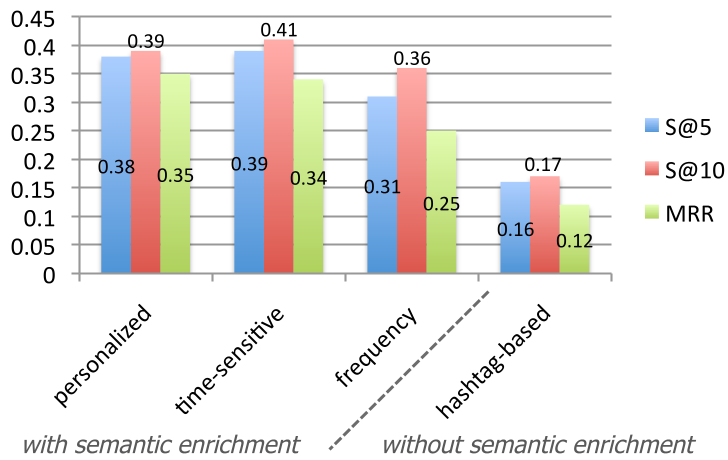
Critical Analysis & Conclusion
Twitcident represents a milestone in Event-Driven Information Retrieval. By moving from textual matching to semantic understanding, it provides a blueprint for modern crisis management tools.
Limitations
- Latency: Processing external URLs and performing multi-service NER takes time (up to hundreds of milliseconds), which is challenging for high-velocity streams.
- Language Dependence: The system relies on translation services for non-English tweets, which may introduce noise or loss of nuance during critical events.
Takeaway
The success of Twitcident proves that Context is King. In social streams, a message's value isn't just in its text, but in its connection to the real-world entities it describes. Future systems will likely integrate Large Language Models (LLMs) to automate this semantic extraction even further, but the "faceted" logic remains the gold standard for high-stakes information retrieval.