
Twitter as a Political Thermostat: How Social Media Adoption Aligns Congress with the People
The Impact of Twitter Adoption on Decision Making in Politics
This paper investigates the impact of Twitter adoption on the voting behavior of 442 U.S. House Representatives during the 111th Congress. Utilizing a fixed-effect model and WNOMINATE scaling, it demonstrates that social media engagement acts as an information-rich channel that aligns politicians' legislative decisions more closely with their constituents' political orientations.
TL;DR
Does tweeting actually change how a politician votes? This study analyzes 442 U.S. House members to find that adopting Twitter acts as a "political thermostat." By providing a low-cost, high-frequency channel for constituent feedback, Twitter adoption nudges Congressmen to align their legislative voting more closely with the ideological leanings of their home districts, effectively reducing the "representation gap."
The Representation Gap: Why Politicians Drift
In a perfect democracy, a representative's votes would be a mirror of their district's will. However, in reality, politicians often drift toward ideological extremes, driven by party pressure or donor interests. Historically, the public only had a voice during election cycles. The researchers behind this paper asked: Could the 24/7 "information-rich" environment of social media force a continuous realignment between the representative and the represented?
Methodology: Scaling Ideology and Adoption
To measure this, the authors combined three distinct datasets:
- WNOMINATE Scores: A mathematical scaling of every roll-call vote to place Congressmen on a spectrum from -1 (Liberal) to +1 (Conservative).
- Cook’s PVI: A measure of the district's baseline political orientation.
- Twitter Metadata: The exact month each member joined the platform.
By using a Fixed Effect Model, the researchers could control for stable traits like a politician's gender or tenure, focusing purely on the change in voting behavior after the "treatment" (joining Twitter).
Note: The research model posits that the "Political Difference" at the start of the term moderates how Twitter adoption affects future voting.
Core Insight: The "Alignment" Effect
The most striking finding isn't just that politicians change, but how they change. The study found a significant negative interaction between Twitter Adoption and Political Difference.
- If a Congressman was "Too Conservative" for their district: After joining Twitter, they began voting less conservatively.
- If a Congressman was "Too Liberal" for their district: After joining Twitter, they moved toward the conservative edge.
Essentially, Twitter acts as a corrective force. The public’s voice on the platform functions as a signal that pulls the representative back toward the district's "median voter."
SOTA Comparison: Beyond Simple Correlation
Unlike previous studies that merely noted "politicians use Twitter for position-taking," this work proves a causal link to actual legislative outcomes. To ensure the results weren't just a fluke of timing, the authors used an Instrumental Variable (IV)—the number of peers from the same state joining Twitter—to prove that the change in voting was driven by social media engagement, not just general political trends.
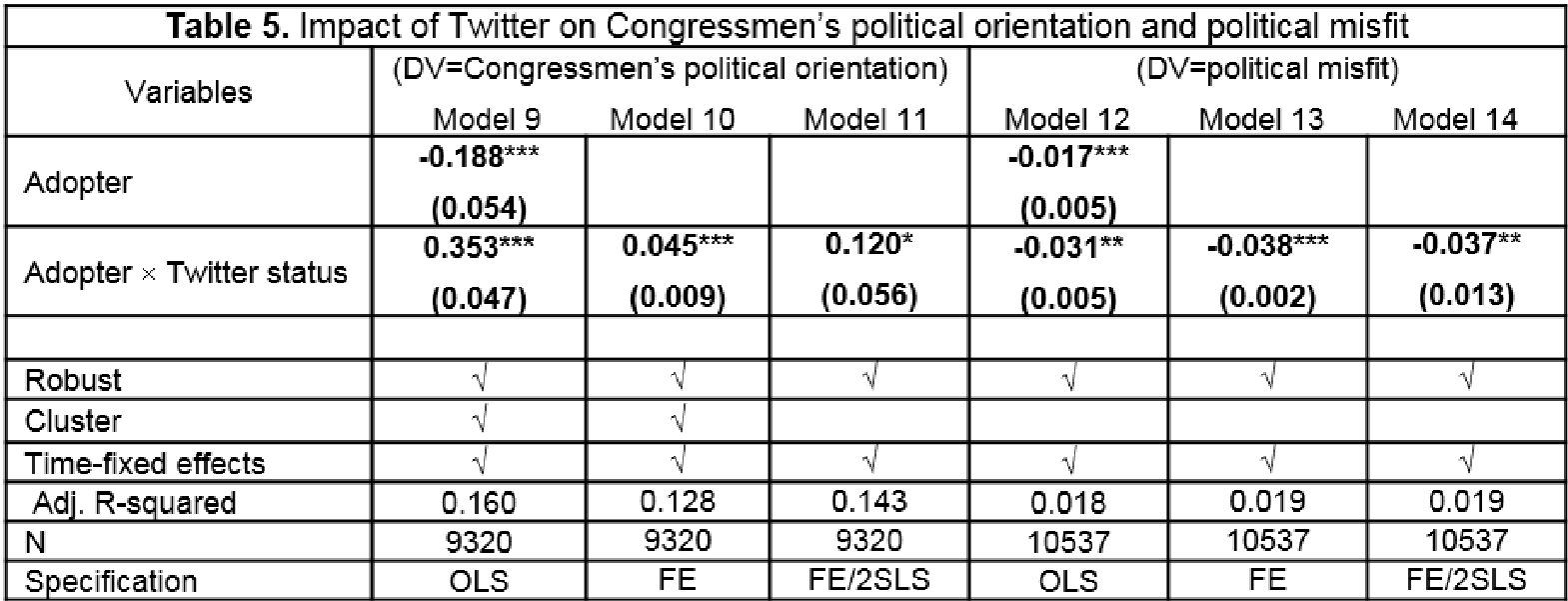 The interaction terms in Models 4 and 14 show a consistent, significant reduction in "Political Misfit" following Twitter adoption.
Critical Analysis: Is it all Positive?
While the paper presents Twitter as a tool for better representation, it also leaves us with questions about the "Elite Politician" bias. The authors acknowledge that Congressmen are elite decision-makers; would the same hold true for local leaders?
Furthermore, the study was conducted during the 111th Congress (2009-2010), a time when Twitter was arguably more of a "town square" and less of an "echo chamber." In today's highly polarized, bot-driven era, one might wonder if social media still acts as a thermostat or if it has become a furnace, pushing politicians further into their respective corners.
Conclusion: Reflections for the Digital Age
This research provides a rare, quantitative glass-box view into how digital tools influence institutional decisions. It suggests that:
- Social Media is an Information Canal: Content-rich networks reduce the cost for decision-makers to "sample" public sentiment.
- Transparency Breeds Accountability: The public nature of Twitter interactions makes it harder for representatives to ignore the ideological delta between them and their voters.
For future researchers, the next frontier lies in Natural Language Processing (NLP)—analyzing the content of those tweets to see which specific interactions (replies vs. mentions) drive the most significant legislative shifts.
Takeaway: Accountability doesn't just happen at the ballot box; it happens 140 characters at a time.