
Twitter: The New Gold Standard for Election Forecasting in Developing Nations?
Twitter-based Election Prediction in the Developing World
This research investigates the efficacy of Twitter-based election forecasting in the developing world, specifically focusing on the 2014 Indonesian Presidential Election. By comparing a pipeline of data collection, filtering, de-biasing, and sentiment analysis against 20 traditional polls, the authors demonstrate that even basic Twitter predictors can achieve SOTA-level accuracy (MAE of 1.3%) and outperform most traditional offline polling institutes.
TL;DR
In the 2014 Indonesian Presidential Election, Twitter proved to be more than just a social hub; it became a superior forecasting tool. Researchers from Delft University of Technology demonstrated that a refined Twitter-based pipeline achieved a Mean Absolute Error (MAE) as low as 0.62%, outperforming every major traditional polling institute in the country. This work shifts the focus of social media analytics from developed nations to the developing world, where the impact of such "cheap" data is most transformative.
Context: Why Developing Worlds are Different
In countries like the US or Germany, traditional polls are highly refined. In the developing world, however, polls are expensive, frequently biased by the "house effect," and often based on limited face-to-face sampling. This research asks: Can the digital signals from the 17% of Indonesians online provide a more accurate pulse than a professional pollster?
Methodology: Beyond Simple Keyword Counts
The researchers didn't just count mentions. They built a sophisticated pipeline to address the inherent chaos of social media data:
- Dynamic Keywords: Instead of static names, they monitored "Trending Topics" to capture shifting campaign hashtags (e.g., #IndonesiaHebat).
- User vs. Tweet: They proved that counting users (one vote per person) is vastly superior to counting tweets, which prevents "super-users" from skewing the results.
- The Anti-Noise Filter: They manually and automatically identified "slacktivists" and bots—accounts that only exist to hype a candidate but don't represent actual voters.
- Sentiment Physics: Using Naive Bayes, they interpreted not just the mention of a candidate, but the intent.
 The study utilized a massive dataset of 7 million tweets from nearly 500,000 users during the election cycle.
Key Results: Outclassing the Professionals
The findings were startling. On a national level, the best Twitter-based model (UserCount + Sentiment) achieved an MAE of 0.62%.
To put this in perspective:
- Traditional Polls Average MAE: 4.2%
- Twitter Baseline (Tweet Count): 3.3%
- Twitter Optimized (User Count + Sentiment): 0.62%
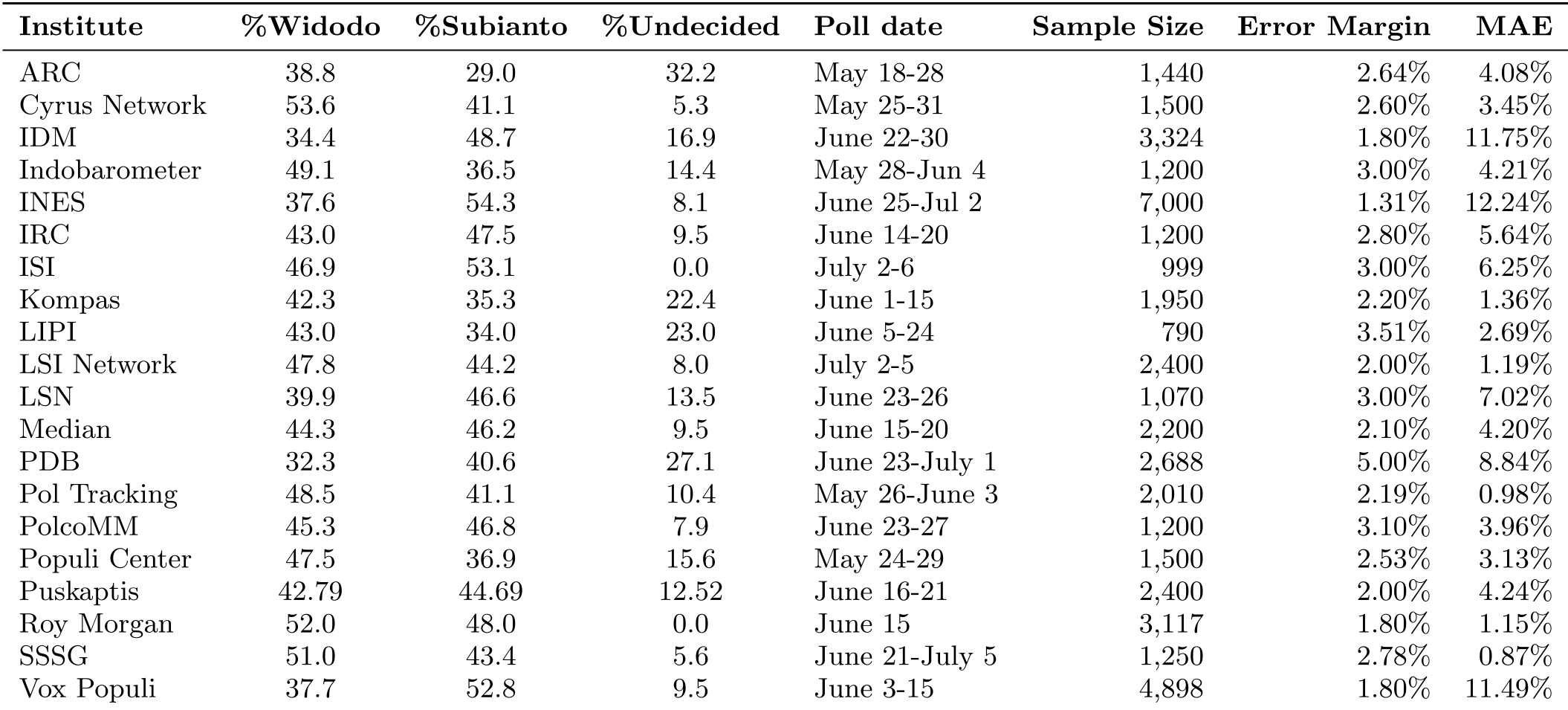 Table: Comparison of 20 traditional polling institutes. Many showed double-digit errors, while Twitter remained consistently accurate.
The "Urban Bias" Catch
While the national results were SOTA, the researchers noted a major limitation: Geographic Skew. Twitter activity is heavily concentrated in urban centers like Jakarta. In rural provinces like Central Kalimantan, the data was sparse, leading to higher errors. Furthermore, the sentiment analysis struggled with the linguistic diversity of Indonesia—most analysis was done in the national language (Indonesian), potentially missing nuances in regional dialects.
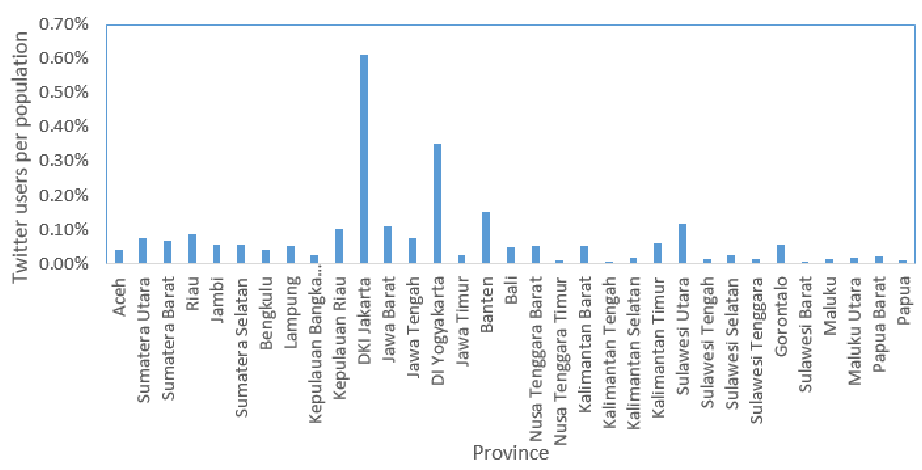 Figure: The correlation between Twitter penetration and population. The "digital divide" remains the primary hurdle for localized predictions.
Critical Insight: The Value of "Cheap" Data
This paper provides a powerful Inductive Bias: in environments where traditional data is expensive and unreliable, even skewed digital data—if processed correctly—can serve as a better "ground truth." The takeaway for future researchers is clear: focus on de-biasing and user-centric modeling rather than just "Big Data" volume.
Conclusion
The study concludes that Twitter-based election prediction is not just a "fun experiment" but a viable, competitive alternative to traditional sociology in the developing world. As internet penetration grows, the "Twitter Poll" may eventually move from a post-hoc analysis tool to a real-time democratic indicator.