
Precise Social Targeting: Finding Twitter Communities via Celebrity Following Patterns
Finding twitter communities with common interests using following links of celebrities
The paper proposes an efficient community detection method on Twitter that identifies clusters of users with shared interests by leveraging their following links to category-specific celebrities. Using the Clique Percolation Method (CPM) and Infomap, the authors demonstrate that this "interest-first" approach uncovers larger and more cohesive communities compared to standard global network partitioning.
TL;DR
Instead of analyzing the entire Twitter graph to find "who is interested in what," this paper suggests we start with the "what" (celebrities) to find the "who" (fans). By analyzing the overlapping followers of category-specific celebrities, the authors efficiently identify highly cohesive, like-minded communities that are far more useful for viral marketing than traditional, broad-network partitions.
Academic Context: This work moves beyond general topology-based community detection (like Girvan-Newman) to an "Attribute-Inferred" topological approach, proving that shared interests drive stronger structural connectivity on micro-blogging platforms.
Problem & Motivation: The Scale Paradox
The standard approach to community detection is a "Top-Down" nightmare:
- Map the entire multi-billion link network.
- Run intensive clustering algorithms (CPM, Louvain, etc.).
- Analyze the resulting clusters to guess what they care about.
The authors argue this is backward. Many detected communities are just structural artifacts with no common bond. For targeted advertising, we need the opposite: communities defined by intent. The insight here is simple but powerful: If you follow five different country music stars, you aren't just a music fan; you are part of a specific, tightly-knit social sub-culture.
Methodology: The Interest-First Pipeline
The researchers developed a three-stage pipeline to isolate these "High-Interest" pockets:
- Celebrity Selection & Classification: Using Wikipedia and Google to categorize "Seed Celebrities" (those with >10,000 followers) into niches like Blogging, News, Music, or Film & TV.
- Affinity Filtering: They define an interest metric, , representing how many celebrities in a specific category a user follows.
- Graph Synthesis: They construct a friendship graph only among users who meet a certain threshold. This drastically reduces the graph size while increasing the density of relevant links.
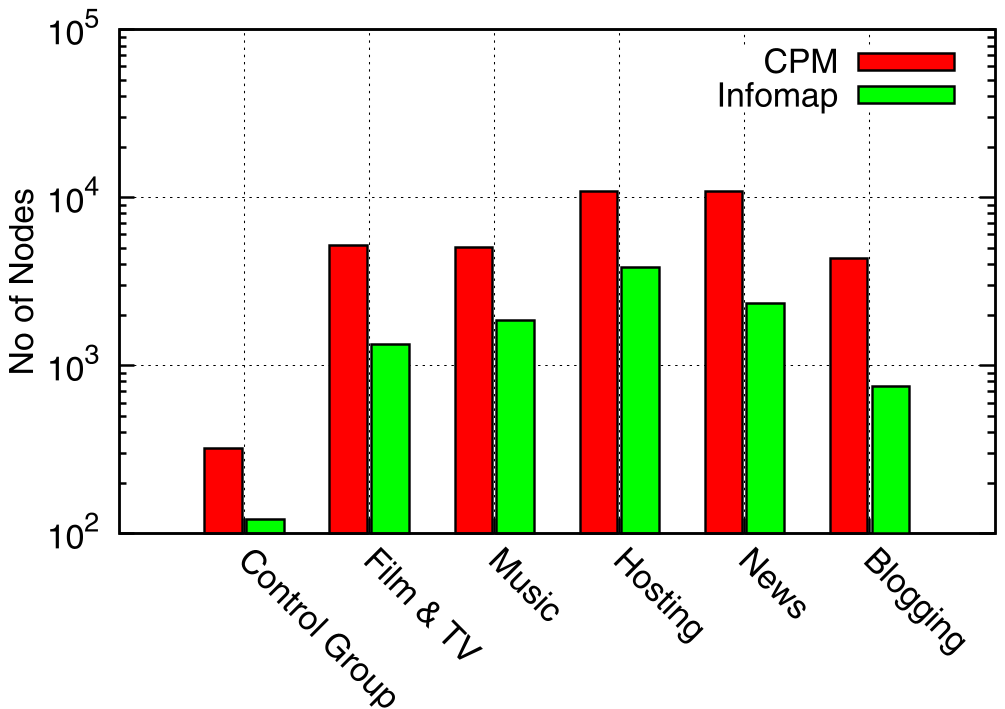
The authors then applied two distinct algorithms—Clique Percolation Method (CPM) for overlapping structures and Infomap for flow-based clustering—to ensure their findings weren't algorithm-dependent.
The "Interest Specialization" Effect
One of the paper's most compelling sections distinguishes between General Interest (Music) and Specialized Interest (Country Music).
The data reveals a clear "Deepening" effect:
- Cohesion: As interest becomes more specialized, members are more likely to know each other. The Clustering Coefficient for Country Music fans (0.76) significantly outperformed the general Music control group.
- Connectivity: Specialized communities have shorter "Path Lengths" (approx. 2.1 hops), meaning information spreads through a specialized niche much faster than through a broad interest group.
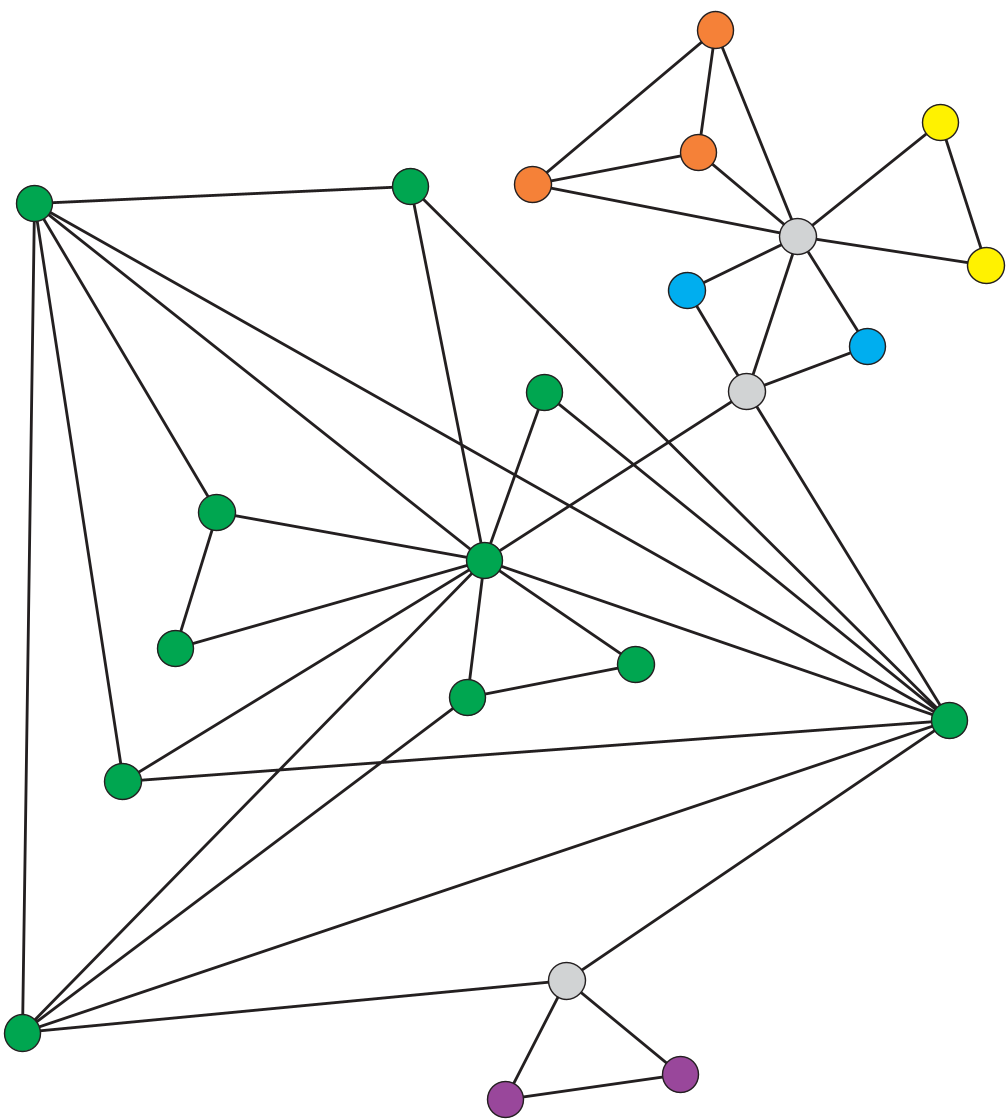 Figure: The community structure of fans following seven specific country singers shows a dense, interconnected core.
Experiments & Results: Efficient Identification
The authors compared their interest-based communities against a random control group of ~200,000 users.
- Scale-Free Characteristics: Despite being sub-sampled, these communities maintained power-law degree distributions, indicating the presence of "mini-influencers" within the niche who act as information hubs.
- Quantifiable Gains: Using produced the largest and most robust clusters, consistently outperforming the control group across all graph metrics (Clustering Coeff, Average Degree, and Path Length).
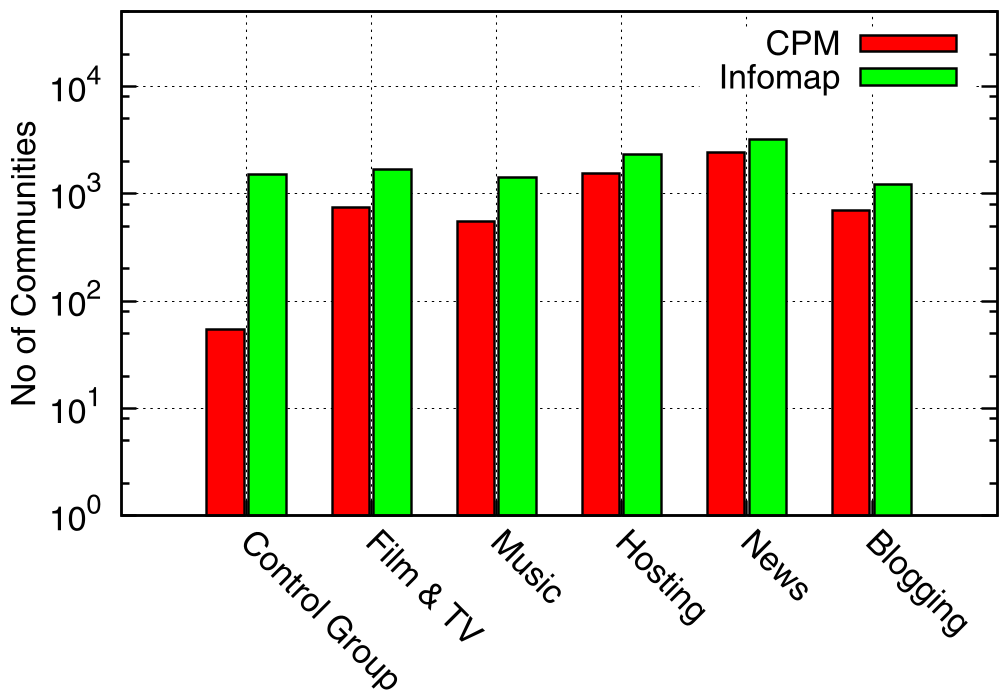 Figure: Interest-based groups (News, Music, etc.) consistently form larger average communities than the non-interest control group.
Critical Analysis & Conclusion
Takeaway
This method provides a "scalpels-not-sledgehammers" approach to social media analytics. By using celebrity following links as a proxy for interest, researchers can bypass the noise of the global Twitter graph and focus on the high-signal clusters that matter for specific applications.
Limitations
- Manual Seed Labeling: The reliance on manual Wikipedia classification for celebrities is a bottleneck (though the authors suggest automated NLP fixes for future work).
- Temporal Decay: Interests change; the study uses a static snapshot from 2009, which may not account for the high churn rate of "trending" interests.
Future Outlook
As social platforms move toward "Interests Graphs" (like TikTok) rather than "Social Graphs" (like early Facebook), the logic in this paper becomes even more relevant. Future iterations could use BERT or GPT-based embeddings to automatically identify "latent celebrities" and map communities across cross-platform data.