
The Semantic Mirage: Why Your Twitter Samples Are Thinner Than You Think
On data collection, graph construction, and sampling in Twitter
This paper investigates the complexities of data collection and graph construction on Twitter using its free API. It introduces a methodology for building "semantic graphs" (multi-edge type networks) and evaluates how disparate API rate limits and sampling strategies (Breadth-First Search) bias the resulting network topology and joint metrics.
TL;DR
Social network analysis often treats Twitter as a simple graph, but it is actually a complex semantic graph with multiple edge types (Follows, Retweets, Replies). This paper by Wendt et al. reveals that collecting this data via the free Twitter API is not just slow—it's structurally biased. Due to the "Curse of Dimensionality" and disparate API limits, even a massive data collect results in a "thin" sample where nodes are surprisingly close to the unexplored boundary.
Context & Positioning
In the landscape of network science, most sampling literature (like Leskovec’s Forest-Fire or Snowball sampling) assumes a homogeneous graph. This work is a crucial methodological critique, positioning itself at the intersection of data engineering and graph theory. It highlights that the process of collection is as influential as the algorithm of sampling.
The Problem: The API Rate-Limit Trap
The central challenge is the heterogeneity of access. On Twitter's free API:
- Follower/Friend requests: Limited to 15 per 15 minutes (very slow).
- Timeline requests: Limited to 300 per 15 minutes (20x faster).
This creates a dilemma. If you sample at the rate of the fastest collector, your follower network will be a skeleton. If you throttle to the slowest, you'll never get a large enough dataset. This "lopsidedness" isn't just a quantity issue; it distorts the joint statistics (e.g., the correlation between who you follow and who you retweet).
Methodology: Constructing the Semantic Graph
The authors suggest a multi-queue system where different collectors (Friend, Follower, Timeline) feed a shared "to-visit" queue.
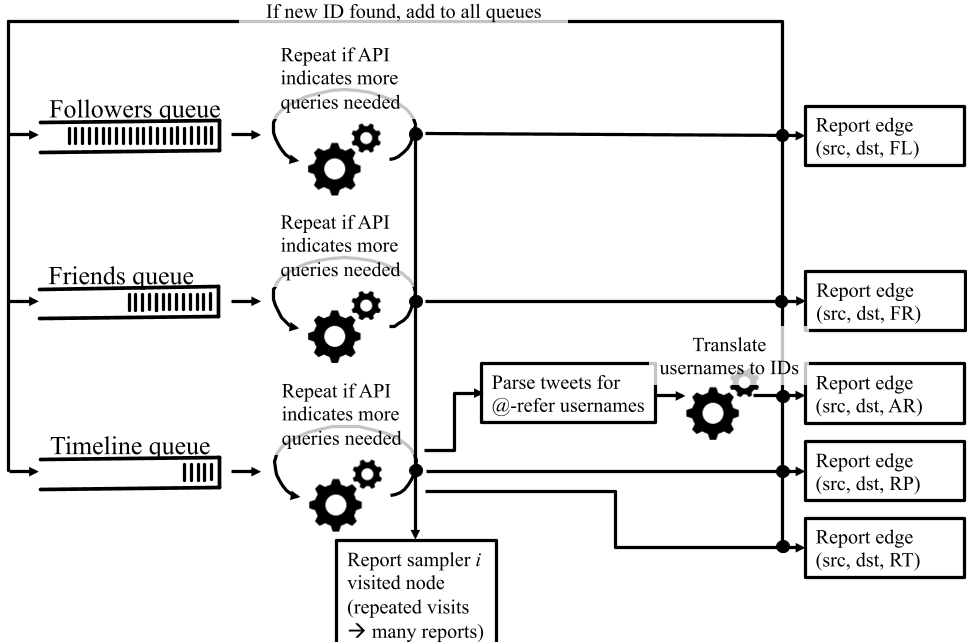
They contrast two construction philosophies:
- Collecting Separately: An edge exists only if both endpoints were visited by the specific collector for that edge type.
- Collecting Jointly: An edge exists if the source was visited by the relevant collector and the destination was visited by any collector in the system.
Experimental Insights: The Boundary Problem
The most striking finding is the sampling failure rate. When the authors tried to re-sample their own collected data (simulating an API crawl), they hit "unvisited" nodes almost immediately.
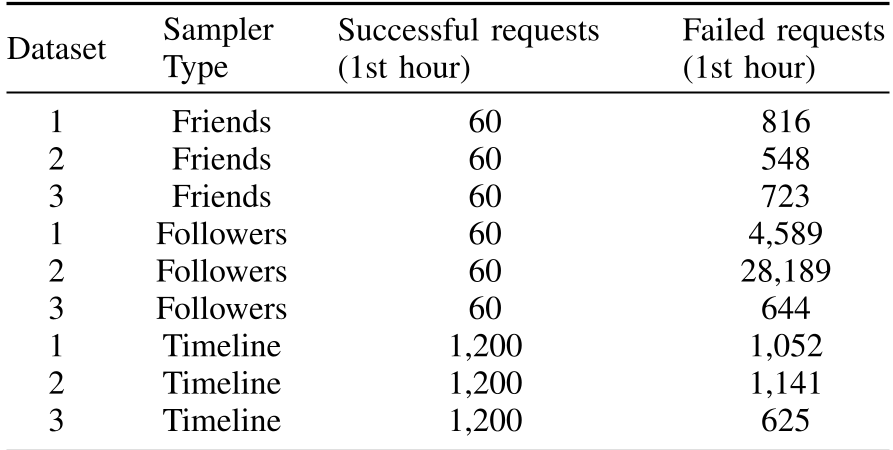
As shown in Table IV, the "Failed requests" (unvisited nodes) in the first hour of a BFS sampler often dwarf the successful ones. For example, in Dataset 2, the follower sampler had 60 successful requests vs. 28,189 failures.
Why does this happen? The Curse of Dimensionality
The authors hypothesize that each edge type adds a "dimension" to the search space. In high-dimensional spaces, the "volume" is mostly near the "surface." Because the collectors expand at different speeds, the sampled space is not a dense sphere but a thin ellipse. Any sampling order that differs even slightly from the original collection quickly "pokes through" the thin skin of the data into the void of unvisited nodes.
Critical Analysis & Takeaways
The paper is a cautionary tale for any researcher working with "crawled" datasets.
- Internal Consistency: "Collecting Jointly" helps increase graph size but significantly lowers the Clustering Coefficient (by ~36%) and weakens cross-edge correlations.
- Information Flow Risk: If paths in your sample are always close to the "edge" of the data, any conclusion about how information spreads (Information Flow) is likely missing critical shortcuts that exist in the real world but were missed by the API limits.
Future Work: This research suggests that APIs should allow "arbitrary page access" (page of ) rather than just reverse-chronological iterators, which would allow for truer random sampling of edges and mitigate the chronological bias inherent in current social media research.
Conclusion
This work shifts the focus from how to sample to how the medium (the API) constrains the message. For the social network community, it serves as a wake-up call that complex semantic richness comes with a significant cost to structural representativeness.