
Deciphering the Viral Code: Why Follower Counts Matter Less Than You Think
Features Found in Twitter Data and Examination of Retweeting Behavior
This paper investigates information dissemination on Twitter by analyzing large-scale datasets across generic and event-specific keywords. It proposes a mathematical framework based on "Preferential Attachment" to explain the emergence of power-law distributions in retweet (RT) counts, demonstrating how user behavior shifts during significant real-world events.
TL;DR
In the digital age, we often assume that having a massive following is the golden ticket to virality. However, research by Shioda and Minamikawa reveals a different reality: Information dissemination on Twitter is driven by social proof, not just social status. By analyzing millions of tweets, the authors show that once a tweet starts gaining traction, the "number of retweets" itself becomes the primary driver for further sharing, following a strict power-law distribution that makes follower counts almost irrelevant.
The Motivation: Moving Beyond the "Influencer" Myth
Why do certain tweets about a local earthquake or a police officer giving out candy explode into global trends while "influencer" posts often fizzle out? Existing literature has often struggled to quantify the transition of Twitter from a personal "daily thoughts" tool to a high-speed "information dissemination" engine during real-world events.
The authors set out to solve a specific puzzle: What governs the "rich-get-richer" phenomenon of retweets? They observed that the correlation between a user's follower count and the resulting number of retweets is surprisingly low (typically below 0.2). This suggests that the mechanism of the platform itself—how users interact with already popular content—is more powerful than the identity of the sender.
Methodology: The Math of Popularity
The core of this research lies in applying the Preferential Attachment mechanism (also known as the Matthew Effect) to social media behavior.
1. The Basic Model
The authors propose that the probability of a tweet being retweeted is proportional to , where:
- : The "attractiveness" or intrinsic quality of the content.
- : The number of RTs the tweet has already received.
Through their derivation, they prove that this behavior inevitably leads to a power-law distribution with an exponent . This perfectly matches "generic" keywords like "beautiful" or "wonderful."
2. The Extended Model (For Major Events)
For high-impact events (e.g., the Reiwa era announcement or major earthquakes), the power-law exponent often drops below 2.0. To explain this, the authors introduced Time-Dependence. By making the rate of new original tweets and retweets vary over time, the model can account for the intense "burstiness" of major news.
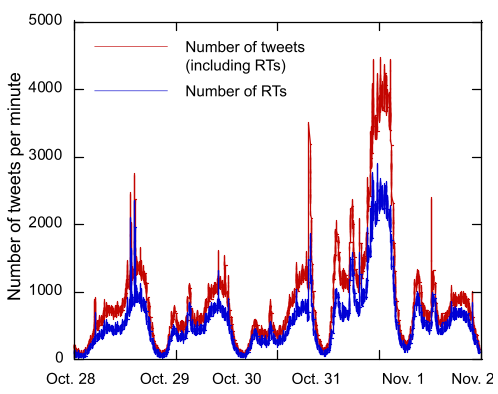 Table 1: The shift in Twitter's role—generic keywords have lower RT ratios, while event-driven keywords (Earthquake) see RT ratios exceeding 85%.
Key Insights from Experimental Results
The Power-Law Signature
Regardless of the keyword—be it "Halloween" or the "Flu"—the distribution of retweets consistently showed a linear trend on a double-logarithmic scale. This is the hallmark of a power-law distribution, indicating that a tiny fraction of "super-tweets" accounts for the vast majority of platform traffic.
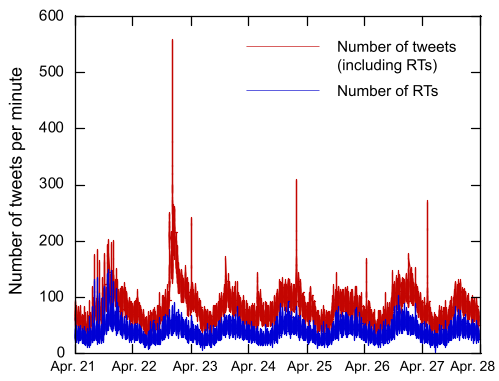 Figure 11: The clear linear slope in this log-log plot demonstrates the power-law nature of retweeting behavior during an earthquake.
Follower Count vs. Virality
One of the most striking findings is summarized in Table IV of the paper. For almost every keyword analyzed, the correlation between retweets and follower counts is negligible. In contrast, the correlation between retweets and "favorites" (likes) is extremely high (~0.9).
What does this mean? It implies that while your initial audience (followers) might provide the spark, the inferno of virality is fueled by the platform's broader audience reacting to the content's perceived popularity and quality, independent of who you are.
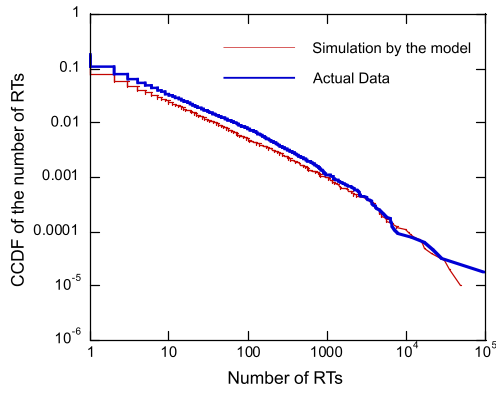 Figure 22: The Extended Model (solid line) shows a near-perfect fit with real-world data from the Miss Universe event, validating the time-dependent preferential attachment theory.
Deep Insight & Conclusion
The research concludes that Twitter acts as a massive "copying machine" during crises or major events. When the "attractiveness" factor () is small relative to the current RT count (), people are effectively "voting" for what is already popular.
Takeaways for the Future:
- For Researchers: The simple preferential attachment model needs temporal components to accurately simulate high-intensity news cycles.
- For Content Creators: You don't need a million followers to go viral, but you do need to capture early momentum. Once the "RT count" starts to climb, the platform's internal mechanics take over.
- Limitations: The study acknowledges it doesn't yet account for "network topology" (who follows whom specifically). Future work integrating the actual social graph will likely yield even more precise exponents for these power laws.
By shifting our focus from who posts to how the crowd reacts, this paper provides a robust mathematical foundation for understanding the chaotic but predictable nature of social media virality.