
Turning Tweets into Urban Action: High-Precision Event Detection for Smart Cities
Twitter Event Detection in a City
The paper presents a comprehensive framework for city-level event detection using Twitter data specifically focused on waste management in Montevideo. By integrating multi-modal analysis (text and images) with georeferencing, the authors achieved a 94% recall rate in identifying citizen complaints and real-world issues.
TL;DR
Researchers from the University of the Republic, Uruguay, have developed a specialized framework to transform the "noise" of Twitter into actionable data for city management. Focusing on waste management in Montevideo, the system uses a combination of SVMs, Random Forests, and Computer Vision to detect citizen complaints with 94% accuracy, turning social media into a real-time sensor for municipal services.
Problem & Motivation: The Gap in Citizen Participation
Large cities are complex ecosystems where traditional formal communication channels (like official apps or hotlines) often fail due to friction. Citizens increasingly turn to Twitter to air grievances about overflowing containers or uncollected litter because of its immediacy.
The technical challenge is twofold:
- Filtering: How do you find a specific complaint about a trash can in Montevideo among millions of global tweets?
- Validation: How do you ensure a tweet is a legitimate "event" (a real-world occurrence at a specific time and place) and not just a general comment or a joke?
Methodology: The Four-Stage Enrichment Pipeline
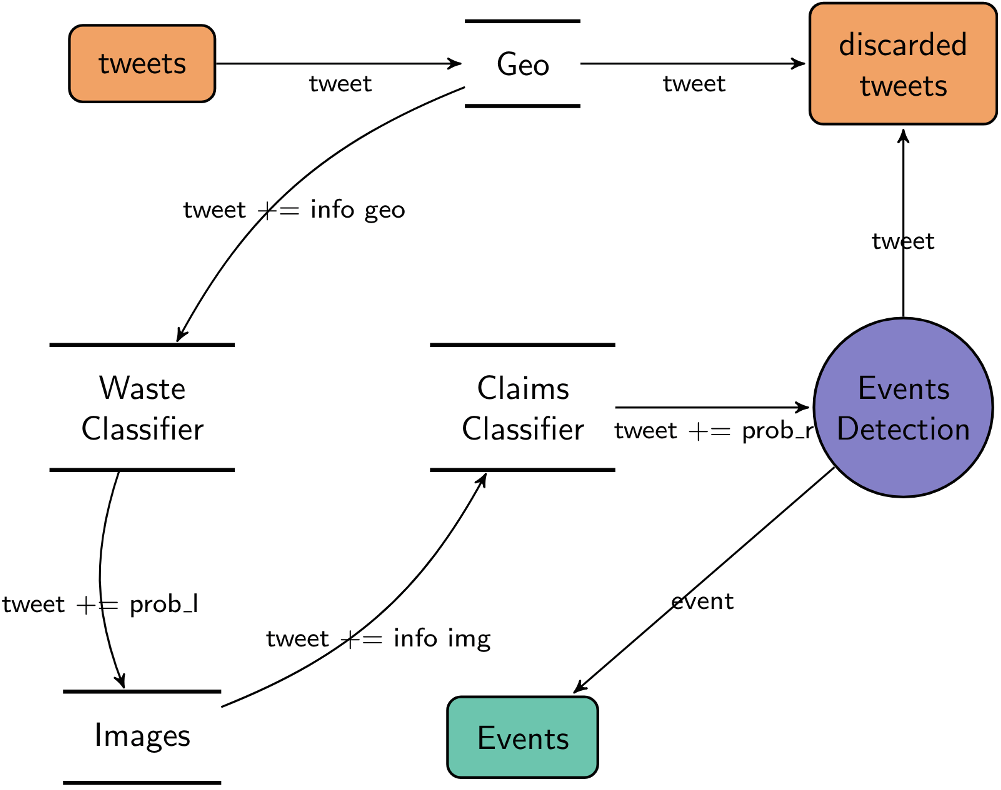
The authors propose a modular architecture that progressively refines raw data into "Events."
1. Information Retrieval
Tracking specific keywords (e.g., "contenedor", "basura", "@montevideoim") to filter the global Twitter stream into a manageable local dataset.
2. Multi-Modal Enrichment
This is the core "intelligence" of the system. The framework uses four parallel modules:
- Georeferencing: Infers location from text if GPS is disabled.
- Image Processing: Uses Google Cloud Vision to detect "waste" or "litter" in attached photos.
- Claim Classifier: An SVM-based model trained on 120,000 official municipal records to recognize the linguistic structure of a "complaint."
- Waste Classifier: Specifically identifies if the topic is garbage-related.
3. Event Detection (The Final Decision)
Using a Random Forest model, the system aggregates the outputs of all modules. Interestingly, the authors discovered that Georeferencing (74% importance) and Claim Classification (17.5% importance) were the most critical factors in determining if a tweet was a "Useful Event."
Experiments & Results: Precision where it counts
The system was tested over 105 days, capturing over 15,000 tweets. When compared against manual annotations (the ground truth), the results were impressive:
- Recall: 94%. The system caught almost every real event reported.
- False Positive Rate: 4%. Very few non-events were flagged, preventing "alert fatigue" for city workers.

Why not just use text?
The "Image Processing" module, while having lower feature importance, provided a crucial "sanity check." As shown in the study, images often illustrate a reality expressed in text, and in scenarios where keywords might be ambiguous, the visual evidence of "litter" or "bins" significantly boosts confidence in the classification.
Critical Analysis & Future Outlook
The primary strength of this work is its pragmatism. By training the classifiers on actual municipal data (the SUR system), the models learned exactly what a "valid complaint" looks like in the local context.
Limitations:
- The system relies heavily on keyword matching in the retrieval phase. This might miss "slang" or sarcasm.
- The 4% false positive rate, while low, still represents hundreds of tweets when scaled to a larger city.
Conclusion: This framework proves that cities don't always need new apps; they need better "ears." By treating Twitter as a distributed sensor network, Montevideo can respond to urban issues faster than ever, marking a significant step toward the "Smart City" ideal where technology serves as a seamless interface between citizens and their environment.