
Beyond the Ticker: Leveraging Twitter Mood Dimensions for Smarter Financial Forecasting
Exploiting Twitter Moods to Boost Financial Trend Prediction Based on Deep Network Models
This paper introduces a framework that integrates high-dimensional Twitter mood data with historical financial indices to predict next-day market trends using Deep Neural Networks (DNN) and Convolutional Neural Networks (CNN). By expanding the POMS lexicon with WordNet, the authors quantify six dimensions of public sentiment, achieving superior prediction accuracy on S&P 500 and NYSE indices compared to traditional HMM and SVM baselines.
TL;DR
Predicting the stock market is notoriously difficult due to its non-linear nature. This research moves beyond simple price charts by injecting "Society Moods" extracted from millions of tweets into Deep Learning models. By using CNNs and DNNs, the authors demonstrate that the collective emotional state of Twitter users—ranging from "clearheaded" to "confused"—can significantly sharpen the accuracy of next-day trend predictions for major indices like the S&P 500.
Background & Positioning
In the world of finance, three theories battle for dominance:
- Technical Analysis (TA): The future is in the past price patterns.
- Efficient Market Hypothesis (EMH): All information is already baked into the price.
- Behavioral Economics (BE): Human emotion and social psychology drive the market.
This paper firmly plants its flag in the Behavioral Economics camp. While previous works used simple sentiment (Positive vs. Negative), this study utilizes the Profile of Mood States (POMS) to capture a nuanced six-dimensional emotional spectrum, positioning itself as a pioneer in merging multi-dimensional sentiment with deep learning architectures.
The Core Challenge: Why is Sentiment Hard to Use?
Sentiment data is noisy, high-dimensional, and often exhibits complex lag effects. Traditional models like Support Vector Machines (SVM) or Hidden Markov Models (HMM) often fail to grasp the subtle temporal correlations between a "tired" society on Monday and a market dip on Tuesday. The authors argue that we need models that can "filter" this noise and "learn" which emotions actually matter.
Methodology: DNN vs. CNN
The authors propose a two-pronged deep learning approach:
1. The DNN Approach (The Universal Fitter)
The Deep Neural Network (DNN) treats the last 7 days of financial data and Twitter moods as a large feature vector (77 dimensions).
- The Insight: Use DNN's capacity for non-linear mapping to find hidden connections between mood and price.
- The Guardrail: They implement Dropout to prevent the model from simply "memorizing" the noise in the Twitter data.
2. The CNN Approach (The Pattern Finder)
CNNs are typically associated with images, but here they are applied to Time-Series.
- Convolution: Sliding windows move across the time dimension to detect specific "shapes" in mood swings or price changes.
- Pooling: Max-pooling extracts the most significant "signal" while discarding minor fluctuations.
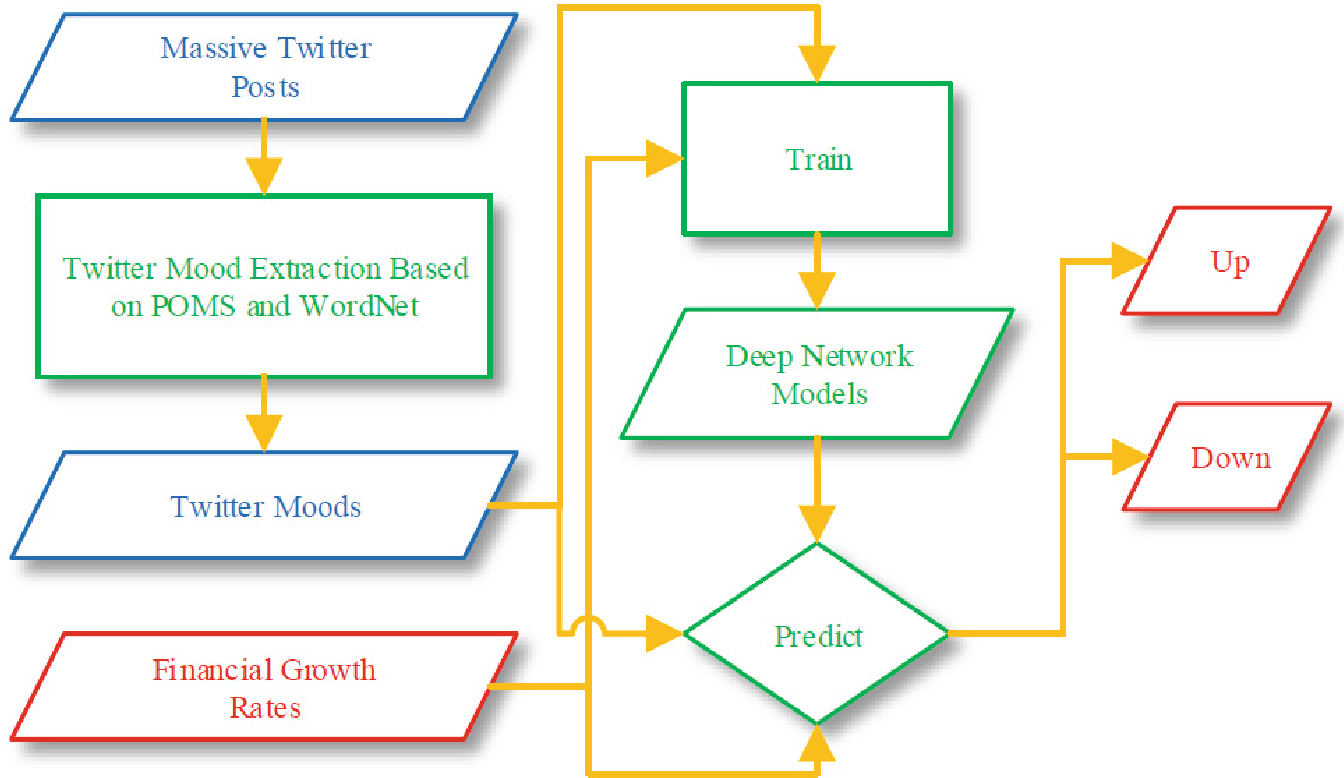 Figure 1: The overarching workflow from Twitter raw data to financial prediction.
Experimental Insights & SOTA Comparison
The researchers tested their models on two massive datasets (Twitter2009 and Twitter2011). The results were clear: Deep Learning + Mood > Financial Data alone.
- Mood Boosting: Adding Twitter moods consistently lowered error rates across DNN and CNN models.
- CNN Supremacy: On the Twitter2011 dataset for the NYSE, the CNN-all model achieved the lowest error rate of 39.733%, outperforming the SVM-based baseline.
- Depth Matters: For the DNN, increasing hidden layers from 1 to 3 improved accuracy, confirming that the relationship between public mood and finance is multi-layered.
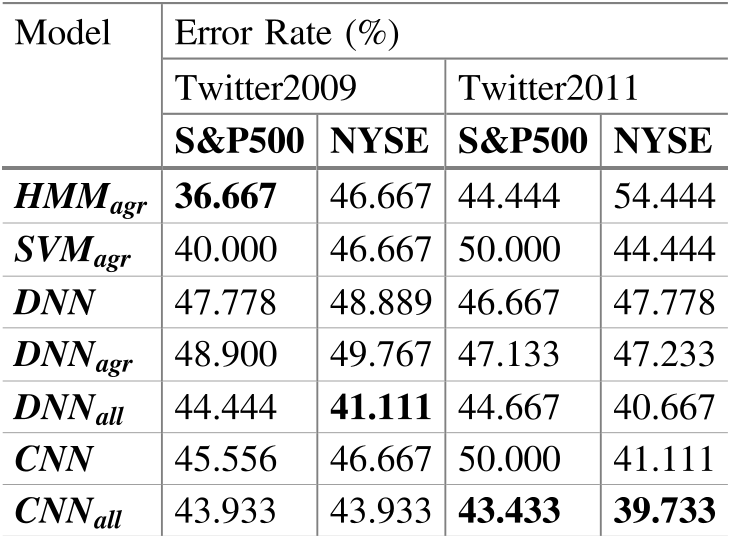 Table 6: Error rate comparison between HMM, SVM, DNN, and CNN configurations.
Critical Analysis & Future Outlook
While the results are promising, the study reveals an interesting "Data Hunger" problem. On smaller datasets (Twitter2009), traditional models like HMM occasionally outperformed the deep networks. This suggests that for deep learning to truly dominate financial forecasting, we need massive, high-quality social datasets.
Takeaway: The future of FinTech isn't just in the numbers—it's in the narrative. Effectively "reading" the room (the global society) via CNNs offers a competitive edge that technical indicators alone cannot provide. In future iterations, expanding this to include Financial News and Recursive Neural Networks (RNNs) could provide an even more robust temporal understanding.
Summary Table
| Feature | DNN Method | CNN Method |
|---|---|---|
| Input Handling | Flattened feature vector | Time-series spatial mapping |
| Primary Strength | Complex non-linear fitting | Temporal pattern extraction |
| Best For | Relationship discovery | Robust trend detection |
| Recommended Layers | 3 layers (based on results) | 1-2 layers (to avoid overfit) |