
Automatic Health Credibility: Using Machine Learning to Combat Misinformation on Social Media
News on Twitter: Engagement, Exposure and Estimating Credibility using Machine Learning
The paper introduces a machine learning framework to automatically estimate the credibility of health-related information on social media. Leveraging the "FakeHealth" repository and H2O AutoML, the authors developed classifiers (notably XGBoost) to evaluate web pages based on a 10-point professional checklist, achieving a peak accuracy of 95% for specific criteria.
TL;DR
Researchers have developed a machine learning-based approach to automatically audit health news shared on Twitter using professional 10-point criteria. While some metrics like "Cost Discussion" can be identified with 95% accuracy using XGBoost, the study reveals a sobering reality: social media users are significantly more likely to share and be exposed to low-credibility health information than high-quality scientific content.
The Misinformation Gap
In an era where health decisions are increasingly influenced by viral tweets, the lack of real-time fact-checking is a public health risk. Existing tools like DISCERN or the Quality Index for health-related Media Reports (QIMR) are robust but suffer from a fatal flaw: they require manual, expert labor. This creates an "information lag" where misinformation travels halfway around the world while the truth is still being audited.
The authors' insight was to treat the expert manual checklist not just as a static tool, but as a training signal for a scalable Machine Learning (ML) architecture.
Methodology: Automating the Expert Eye
The study utilized the FakeHealth repository, which includes professional ratings for health stories. These ratings aren't just "True" or "False"; they are broken down into 10 nuanced criteria, such as:
- Quantifying benefits and harms.
- Identifying funding sources and conflicts of interest.
- Detecting "disease-mongering" or sensationalist language.
The Pipeline
- Preprocessing: Removing noise (emojis, URLs, stop words) using NLTK.
- Representation: Converting text into Word Vector Representations to capture context.
- Model Selection: Using H2O AutoML to test a suite of classifiers, including Gradient Boosting (GBM), Deep Learning, and Stacked Ensembles.
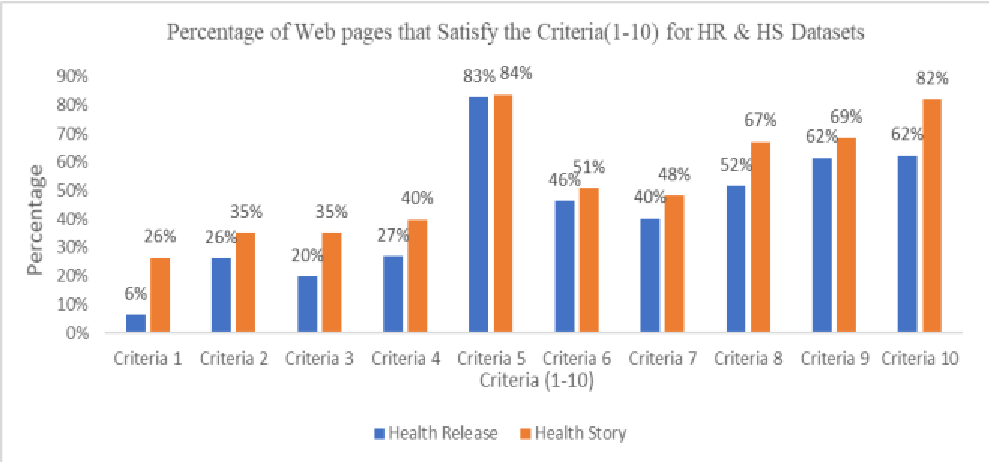 Above: The frequency of different credibility criteria met across the Health Release (HR) and Health Story (HS) datasets.
Results: The Power of XGBoost
The study found that XGBoost was the dominant performer, often outperforming Deep Learning models. This is likely due to the structured nature of the checklist task and the relatively small sample size, which favors gradient-boosted trees over data-hungry neural networks.
- Best Performance: Criterion 1 (Costs) - 95% Accuracy.
- Worst Performance: Criterion 8 & 9 (Availability and Novelty) - Accuracy dipped near 55%.
| Criteria Type | Top Model | Accuracy | AUC |
|---|---|---|---|
| Discusses Costs | XGBoost | 95% | 87% |
| Identifies Funding | GBM | 76% | 77% |
| Quantifies Benefits | GBM | 74% | 75% |
High Stakes: Exposure to Low Credibility
The most alarming part of the research lies in the engagement metrics. The authors analyzed the potential exposure—the cumulative number of followers of users sharing specific news.
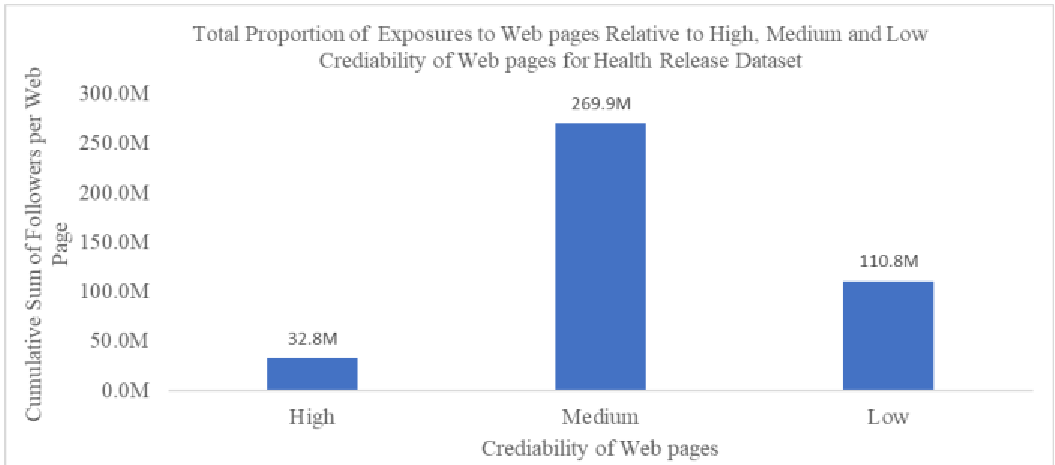 Exposure analysis: Low-credibility web pages reach a massive portion of the Twitter audience, often exceeding high-credibility news.
In the Health Release dataset, low-credibility pages accounted for 27% of total exposure (over 110 million views), while high-credibility pages were shared the least. This confirms that sensationalist or inaccurate health news often possesses higher "virality" than dry, evidence-based reporting.
Critical Insight & Future Outlook
While the study proves that ML can automate parts of the health audit process, it highlights two major challenges:
- Complexity of Nuance: Machines still struggle to determine "novelty" or "sensationalism"—concepts that require a deeper semantic understanding of scientific progress.
- Human Behavior: Accuracy in detection is only half the battle. If social media algorithms and human psychology continue to favor low-credibility content, automated flags must be paired with effective user-interface interventions.
The path forward involves multi-modal algorithms—systems that don't just "read" the text but also analyze the images and videos that drive today's health trends.
Takeaway
This research is a call to action for platform designers. We have the ML tools to categorize health credibility with high accuracy (up to 95%). The next step is integrating these tools into social feeds to ensure that 110 million people aren't being led astray by a single low-credibility link.