
Tweeting the Future: How Social Media Predicts Your Next Move and Potential Crime
Using Twitter for Next-Place Prediction, with an Application to Crime Prediction
The paper introduces a text-enriched approach for next-place prediction using Twitter data, specifically integrating TF-IDF textual features into classification and regression models. It achieves a significant breakthrough by correlating these predicted mobility patterns with real-world crime occurrences in Chicago, demonstrating state-of-the-art accuracy in venue-type prediction.
TL;DR
Researchers from the University of Virginia have developed a model that listens to the "implicit hints" in your tweets—like saying "I'm hungry"—to predict where you are going next with over 71% accuracy. More importantly, they've proven that these predicted waves of human movement are statistically linked to where crimes like burglary and theft are likely to strike next.
Background Positioning
While current SOTA models for human mobility focus on "where you've been" (using GPS logs or Foursquare check-ins), this work pivots to "what you're saying." It bridges the gap between Natural Language Processing (NLP) and Spatial-Temporal Criminology, moving from retrospective "hot-spot" mapping to proactive intent-based prediction.
Problem & Motivation: The Silence of the Coordinates
Standard next-place prediction models are "silent"—they treat coordinates as numbers but ignore the human intent. If a user tweets "@joshua: I'm hungry," they aren't at a restaurant yet, but they likely will be soon.
The authors identified two major gaps:
- Textual Neglect: Existing models ignore the rich semantic clues in tweets that signal future transitions.
- Static Policing: Crime prediction often relies on historical "hot spots," which fail to account for the dynamic flow of potential victims and offenders across the city.
Methodology: The Text-Enriched Engine
The core innovation lies in anchoring ephemeral text to physical venue types (e.g., Food, Nightlife, Residence).
1. Classification & Regression
The authors developed a two-step SVM process:
- Step 1: Predict if the user will stay or move.
- Step 2: If moving, use TF-IDF features from the tweet to predict the target Foursquare venue type.
2. The Interaction Effect
Beyond just classifying types, they used Regression to predict the distance to every venue type. They found that an "Interaction Model" (which accounts for the fact that shops and restaurants often cluster together) performed best.
(Note: The paper utilizes a combination of POS tagging via TweetNLP and SVM classification to bridge text with Foursquare venue categories.)
Experiments & Results: Outperforming the Baselines
The results were striking. The Text-Enriched model outperformed standard Markov Chain models by a wide margin.
| Model | Prediction Accuracy |
|---|---|
| Most Frequent Check-in | 59.0% |
| Order-2 Markov Model | 54.7% |
| Text-Enriched Model (Ours) | 71.4% |
The Crime Correlation
The researchers then mapped Chicago in a 2000-meter grid and found that predicted movements to "Shop & Services" destinations positively correlated with Burglary. Interestingly, "Narcotics" crimes showed a negative correlation with movement toward Universities, likely due to increased security presence in those zones.
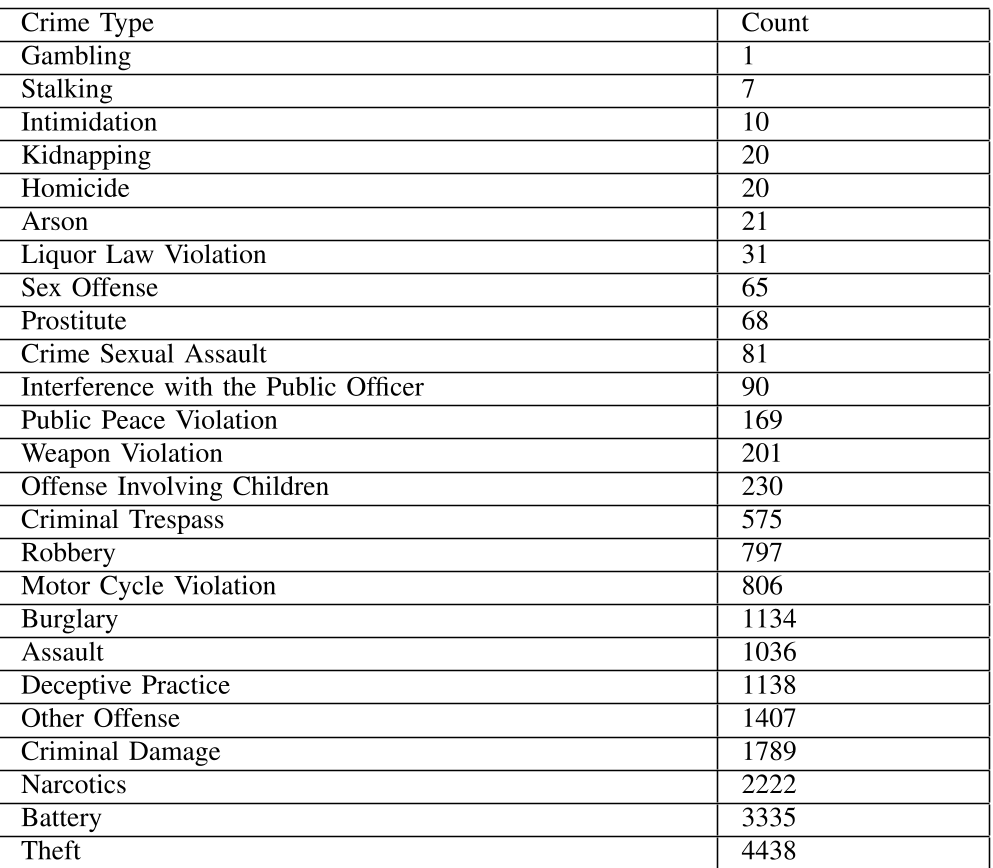 Table showing the significant counts of different crime types used for the correlation analysis.
Critical Analysis & Conclusion
Takeaway
This research proves that "Next-Place Prediction" isn't just for targeted advertising—it's a critical component of "Routine Activity Theory" in the 21st century. By knowing where people intend to go, we can predict the shifting "confluence of victims and offenders."
Limitations
- Data Sparsity: The model requires users to post at least 20 tweets per month, potentially biasing results toward "power users."
- Simple NLP: Using TF-IDF is effective but misses the nuanced context that modern Large Language Models (LLMs) could provide.
Future Work
The authors suggest that future systems should integrate user relationship networks (who you talk to) and more complex spatial constraints to turn these correlations into a high-precision, automated crime forecasting system.