
Beyond the Hype of Mention Counting: Solving Twitter Sample Bias in Election Predictions
Twitter population sample bias and its impact on predictive outcomes: A case study on elections
The paper proposes a four-stage methodology for drawing representative Twitter population samples to improve predictive outcomes, specifically applied to municipal elections in six Brazilian cities. By using machine learning to infer user demographics—gender, age, and social class—the authors move beyond simple mention counting to create a stratified sample that mirrors the actual electorate.
TL;DR
For years, "predicting elections with Twitter" has been a volatile field—some studies claim success while others fail spectacularly. This paper argues that the problem isn't the data, but the sample bias. By filtering bots and using Machine Learning to infer the age, gender, and social class of users, the authors created a stratified sample that accurately predicted Brazilian municipal elections, outperforming raw volume counts and rivaling professional pollsters.
Context: The Trouble with "Internet Popularity"
In the early 2010s, researchers thought that more tweets meant more votes. However, the "Google Flu Trends" failure and numerous election misses proved that the "virtual world" is not a perfect 1:1 reflection of reality. Twitter users are not an accurate cross-section of the voting public; they are skewed toward specific demographics (often younger and wealthier). If we don't correct for this Inductive Bias, our predictions are merely measuring "Echo Chambers" rather than "Electorates."
The Methodology: A 4-Step Pipeline for Reliable Polls
The authors propose a rigorous methodology to bridge the gap between Twitter data and real-world proportions.
1. Filtering Noise
Before analyzing opinions, they use a Random Forest classifier to strip away spammers and news media profiles. These entities generate high volume but have zero voting power, acting as "noise" in the system.
2. User Characterization (The Core)
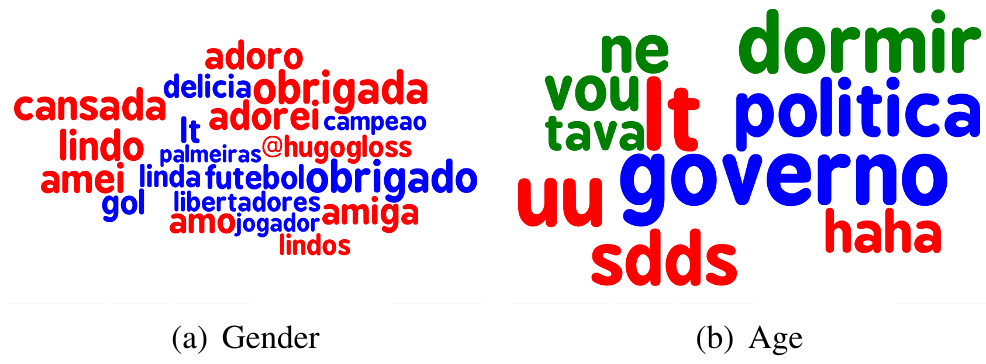
The paper uses Multinomial Naive Bayes (MNB) to predict:
- Gender: Using a name dictionary and text patterns.
- Age: Segmented into three groups (<25, 25-45, >45).
- Social Class: A unique approach mapping Foursquare check-ins to local per-capita income data to classify users as Lower, Middle, or Upper class.
3. Stratified Sampling
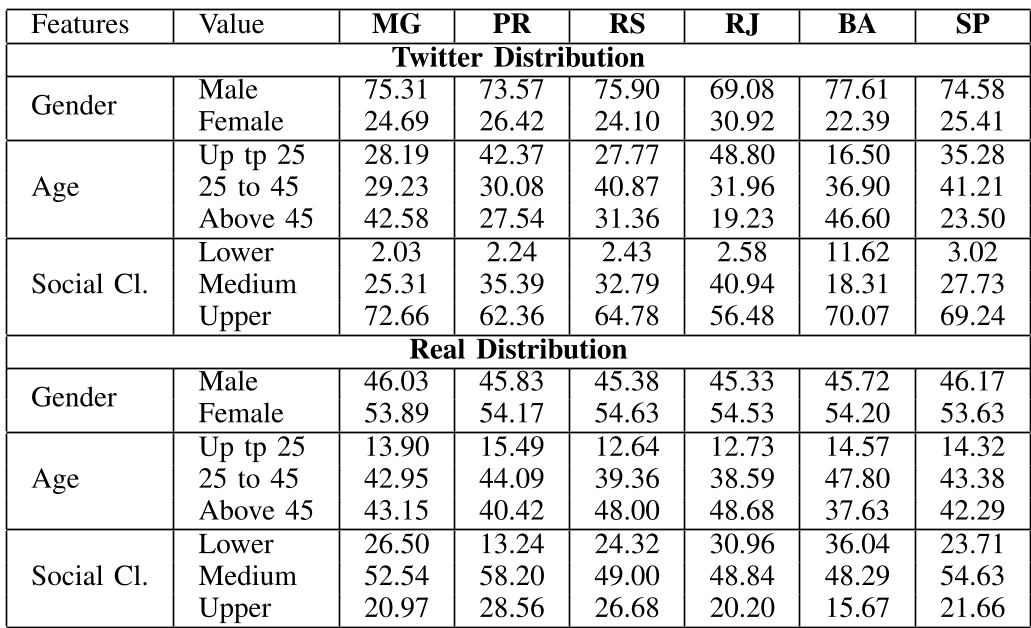
Instead of using all 129,290 filtered users, the authors draw a stratified sample. If the real-world census says 55% of voters are female but the Twitter data is 75% male, the methodology downsamples the male group to match the real-world distribution.
Experimental Battleground: The Brazilian Municipal Elections
The framework was tested against six major Brazilian cities. The results were compared against official polls (IBOPE/DataFolha) and the "baseline" method of simple mention counting.
Case Study: Rio de Janeiro
In Rio, raw mentions suggested a victory for a candidate (Freixo) who had massive support from celebrities and upper-class youth. However, the real electorate was much more diverse. By classifying social classes and sampling accordingly, the authors correctly predicted the lead of the eventual winner (Paes), who dominated the lower-class demographics that were underrepresented on Twitter.
Insights on Sentiment and Volume over Time
The paper introduces a vote counting formula (Eq. 2) that treats a positive mention as a vote and a negative mention as a "not-vote," distributing that preference among other candidates.
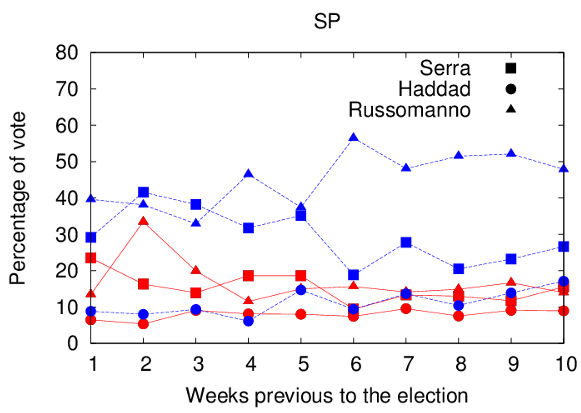 Figure 5 illustrates that while raw mentions (dashed lines) can be misleading, the "Unique Users + Sentiment + Social Class" approach (full lines) tracks much closer to the eventual election outcome.
Critical Analysis & Conclusion
Takeaways
- Demographics Matter: A million tweets from one demographic group are less valuable than a thousand tweets from a representative cross-section.
- Social Class is the "Missing Link": In developing nations like Brazil, social class is a stronger predictor of voting behavior than age or gender.
Limitations & Future Work
The primary bottleneck of this method is Data Scarcity. Because the stratified sampling requires specific proportions of "hard-to-find" groups (like lower-income elderly users on Twitter), the system needs a massive initial input (likely the Twitter Firehose) to yield a statistically significant sample. Future work will likely look at oversampling techniques and more sophisticated NLP to extract intent from ironic or sarcastic political commentary.