
Mining the Noise: Can Twitter Explain Why Your Internet is Down?
Exploiting Twitter for the Semantic Enrichment of Telecommunication Alarms
The paper explores the use of Twitter data to provide semantic enrichment and context for telecommunication network alarms at Portugal Telecom. By pairing 873k network alarms with nearly 500k Portuguese tweets, the authors investigate whether social media can reveal external causes of technical failures or gauge customer dissatisfaction levels.
Executive Summary
TL;DR: This research investigates whether the "digital chatter" on Twitter can help telecom operators understand the root causes of network alarms. While the study confirms that Twitter effectively "feels" the rain and storm events that trigger outages, identifying specific technical complaints or rare accidents remains a significant challenge due to the overwhelming volume of irrelevant social media noise.
Positioning: This work is an exploratory feasibility study situated at the intersection of Information Extraction (IE) and Network Operations (NetOps). It moves beyond general event detection by attempting to ground social media data in the specific, localized technical logs of a major ISP (Portugal Telecom).
Problem & Motivation: The Context Gap
When a telecommunications tower fails, the Network Operations Center (NOC) sees a red light on a dashboard. They know where it happened and what equipment is failing, but they often don't know the why. Was it a lightning strike? A car crashing into a utility pole? Or just a localized power outage?
The authors' insight was that people are "social sensors." When a storm hits or the internet goes out, people tweet. If these tweets could be automatically linked to network alarms, operators could gain immediate semantic enrichment—turning a dry technical log into a context-rich incident report.
Methodology: Pairing Alarms with Tweets
The core challenge is the "Needle in a Haystack" problem. To find relevant data, the authors developed a two-step alignment process:
- Spatio-Temporal Mapping: They synchronized a dataset of 873k alarms with 498k tweets. Tweets were matched if they occurred within a window starting 15 minutes before the alarm and ending 60 minutes after it was archived.
- Semantic Classification: Using the Mallet toolkit, the researchers deployed 12 Maximum Entropy classifiers to categorize tweets into types such as Accident, Nature, Politics, and Sports.
 Example of paired data: Tweets occurring during specific alarm windows at localized network station areas.
Experiments & Results: Rain and Swearing
The researchers used a Z-test to determine if certain keywords appeared more frequently during alarms than during normal operations.
- The Weather Connection: Words like chuva (rain) and trovoada (thunder) showed a significant increase during alarm events. This suggests that "Nature" events are the most easily identifiable external causes on social media.
- The Sentiment Side: There was a statistically significant increase in "swearing" (e.g., merda, foda) during alarms. This acts as a proxy for customer frustration, even when the users don't explicitly name the ISP.
- The Difficulty of Precision: Despite these correlations, only 43% of "net-related" tweets during an alarm were actually complaints. The rest were irrelevant chatter, highlighting the difficulty of building a fully automated system.
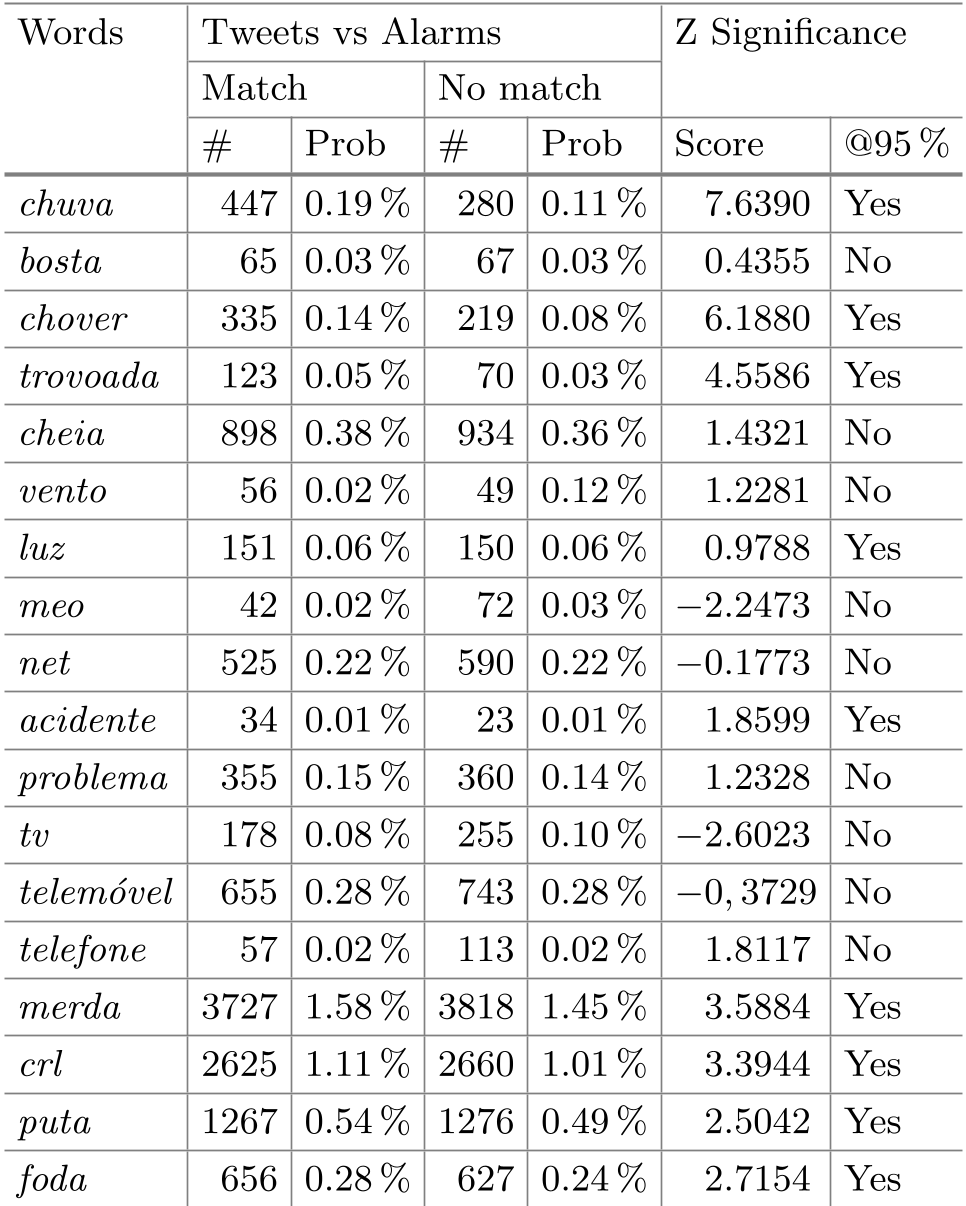 Statistical significance results: Identifying which keywords (like rain and swearing) are truly correlated with network failures.
Critical Analysis & Conclusion
The Takeaway
The study proves that Twitter is a viable—though noisy—source for identifying environmental causes of network failures. It provides a blueprint for ISPs to monitor "social sentiment" as a secondary validation layer for their technical alarms.
Limitations
- Sample Size: Using Twitter's free "Streaming API" only provides a 1% sample of total tweets, which is arguably too thin for hyper-local event detection in smaller countries like Portugal.
- Language Specificity: Portuguese NLP tools for social media are less mature than English ones, leading to potential inaccuracies in entity recognition (e.g., confusing the location "Luz" with the word for "electricity").
Future Outlook
The authors suggest moving toward a Multi-Source Enrichment model. Instead of relying solely on Twitter, future systems should integrate structured weather feeds and professional news RSS streams, which offer higher signal density. Additionally, training specific "Complaint Classifiers" could help companies quantify the "Quality of Experience" (QoE) impact of every technical glitch.
Final Thought: While social media isn't a replacement for technical telemetry, it offers the "human side" of the network—reminding operators that behind every alarm is a frustrated user tweeting into the void.