
Bridging Microblogging and Academia: Semantic Resource Recovery in Moodle
Use of Twitter and Semantic Resource Recovery in the Educational Context
The paper introduces a context-sensitive Moodle plugin designed to integrate Twitter and external digital repositories into the educational environment. Using ontologies as a semantic backbone, the system performs "Semantic Resource Recovery" to provide students with tweets and documents filtered by relevance to their specific course.
TL;DR
This research tackles the gap between formal Virtual Learning Environments (VLEs) and the informal, real-time nature of social media. By developing a specialized Moodle plugin, the authors leverage ontologies to turn Twitter and external digital repositories into a semantically filtered stream of knowledge, ensuring that students receive only the most relevant materials for their specific course.
Academic Positioning: This work sits at the intersection of Semantic Web in Education and Social Learning Frameworks, moving beyond simple API integration toward context-aware information retrieval.
Problem & Motivation: The Noise in Information Overload
In the modern educational landscape, information is abundant but relevance is scarce. When a student searches for "Arrays" within a computer science course, they don't want a dictionary definition of a general arrangement; they want Java-specific or Python-specific tutorials.
The authors identify two key limitations in previous works:
- Lack of Context: Standard search engines in VLEs treat queries in isolation.
- Isolated Silos: Valuable discussions happening on Twitter and high-quality documents in digital libraries (like DSpace) remain disconnected from the student's primary learning environment (Moodle).
The research intuition is elegant: Use the existing organizational structure of Moodle (Courses -> Categories) as a natural "context selector" to activate specific domain ontologies.
Methodology: The Semantic Engine
The system architecture is a multi-layered pipeline designed to normalize and rank unstructured and semi-structured data.
1. Data Integration (The Harvester)
The system uses the OAI-PMH (Open Archives Initiative – Protocol for Metadata Harvesting) to pull metadata from various digital providers. This allows the plugin to surface articles and books without hosting the massive files locally.
2. The Ontology-Driven Query Expansion
When a user enters a query, the system doesn't just search for those keywords. It consults a Domain Ontology to:
- Expand: Add synonyms and related terms (e.g., "matrix" for "array").
- Filter: Prioritize terms that carry higher weights within that specific discipline's XML-defined relations.
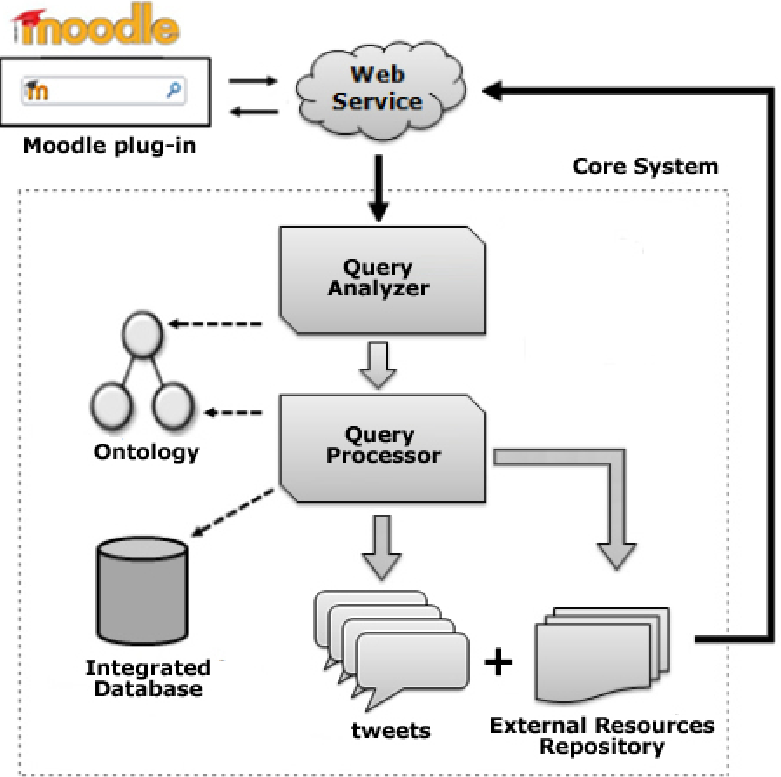 Figure: The procedural flow from user query to contextualized document recovery.
3. Preprocessing (The Linguist)
Since the project focuses on the Portuguese language, it implements PTStemmer and Jazzy (Java Spell Check API). The preprocessing involves removing stopwords, stemming, and correcting spelling to ensure that the short, often informal text of a "tweet" can be accurately mapped to formal academic concepts.
Experiments & Results
The implementation demonstrates a seamless integration between PHP (Moodle) and Java (Semantic Core) via Web Services.
Key Findings:
- Similarity Metrics: The authors found that standard metrics like TF-IDF or Jaccard coefficients struggled with the brevity of tweets (140 characters).
- Weight-Based Ranking: By assigning weights to conceptual relations within the ontology, the system achieved a higher degree of relevance in the ordered list of retrieved resources.
- Unified Interface: The plugin allows students to post tweets with auto-generated course hashtags, ensuring the "Tweets Database" remains self-organizing.
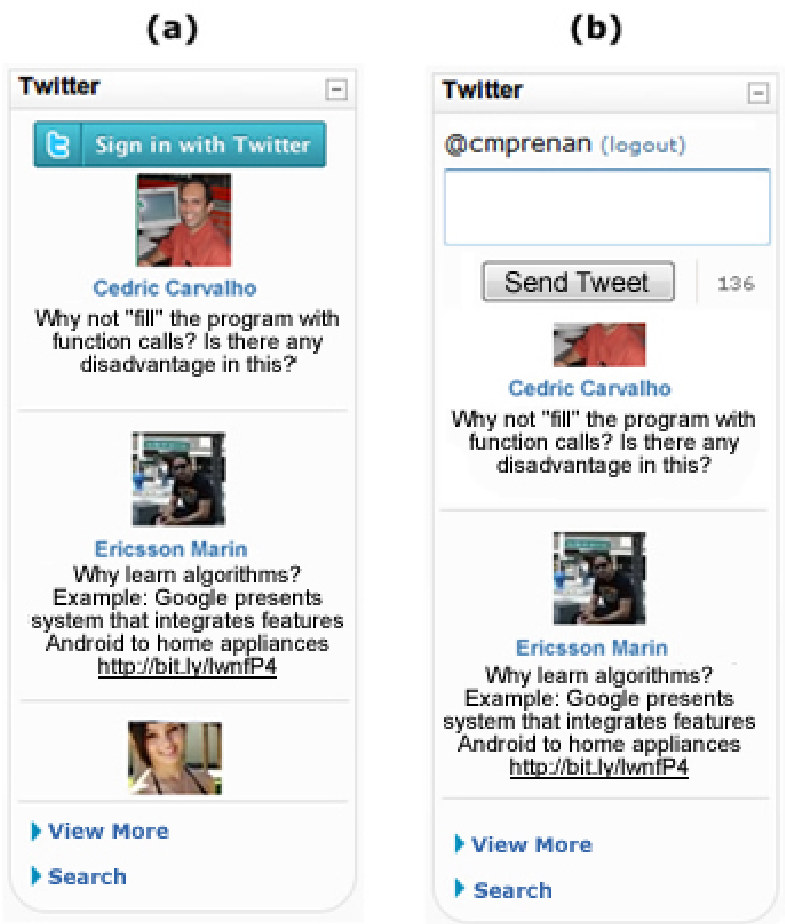 Figure: The Moodle interface showcasing Twitter authentication and the semantic search entry point.
Critical Analysis & Conclusion
Takeaway
The value of this work lies in its Inductive Bias: it assumes that the context of a student's current Moodle module is the best predictor of their search intent. This significantly reduces "noise" in the learning process.
Limitations
- Manual Ontology Effort: The system relies on experts to build and weight the ontologies. This is a scalability bottleneck in rapidly evolving fields.
- Language Specificity: While adaptable to other Western languages, the current NLP pipeline is heavily optimized for Portuguese.
Future Outlook
With the rise of Large Language Models (LLMs), the "manual ontology" step could potentially be replaced by Retrieval-Augmented Generation (RAG), where the context is defined by a vector embedding of the course syllabus rather than a hard-coded XML relationship file. However, this paper provides the essential logic for how social networking and formal education can coexist.