
BPEF: Taming the Twitter Sentiment Beast with Bootstrap Ensembles
Twitter Sentiment Analysis: A Bootstrap Ensemble Framework
The paper proposes the Bootstrap Parametric Ensemble Framework (BPEF) for Twitter sentiment analysis, focusing on a multi-layer stack approach. By combining expansion (generating diverse models) and contraction (iterative selection), BPEF achieves SOTA performance, significantly outperforming existing tools like Sentiment140 and SentiStrength.
TL;DR
Twitter sentiment analysis is notoriously difficult due to extreme class imbalance and "feature sparsity" (tweets are just too short!). This paper introduces the Bootstrap Parametric Ensemble Framework (BPEF), a two-stage system that expands a massive pool of 896 diverse models and then surgically prunes them down to a highly efficient ensemble. The results? An 80% improvement in performance balance, finally allowing sentiment time series to accurately detect viral events.
Problem & Motivation: The "Neutral" Trap
Most Twitter sentiment tools suffer from a "Neutral Bias." Because the vast majority of tweets are neither positive nor negative, models naturally gravitate toward predicting "Neutral" to keep their accuracy high. However, for a brand manager or a social scientist, the subjective tweets (Positive/Negative) are the most valuable.
The authors identify two structural "pain points":
- Representational Richness: Only 20% of words in tweets appear more than twice, compared to nearly 45% in product reviews. This makes it impossible for standard models to learn robust patterns.
- Class Imbalance: The skewed distribution leads to high "Overall Accuracy" but abysmal "Macro Recall," meaning the tool misses the specific sentiment shifts during a crisis.
Methodology: Expansion and Contraction
The BPEF architecture operates like a professional scout: first, identify everything possible (Expansion), then pick only the most unique players (Contraction).
Stage 1: The Expansion (Building the Pool)
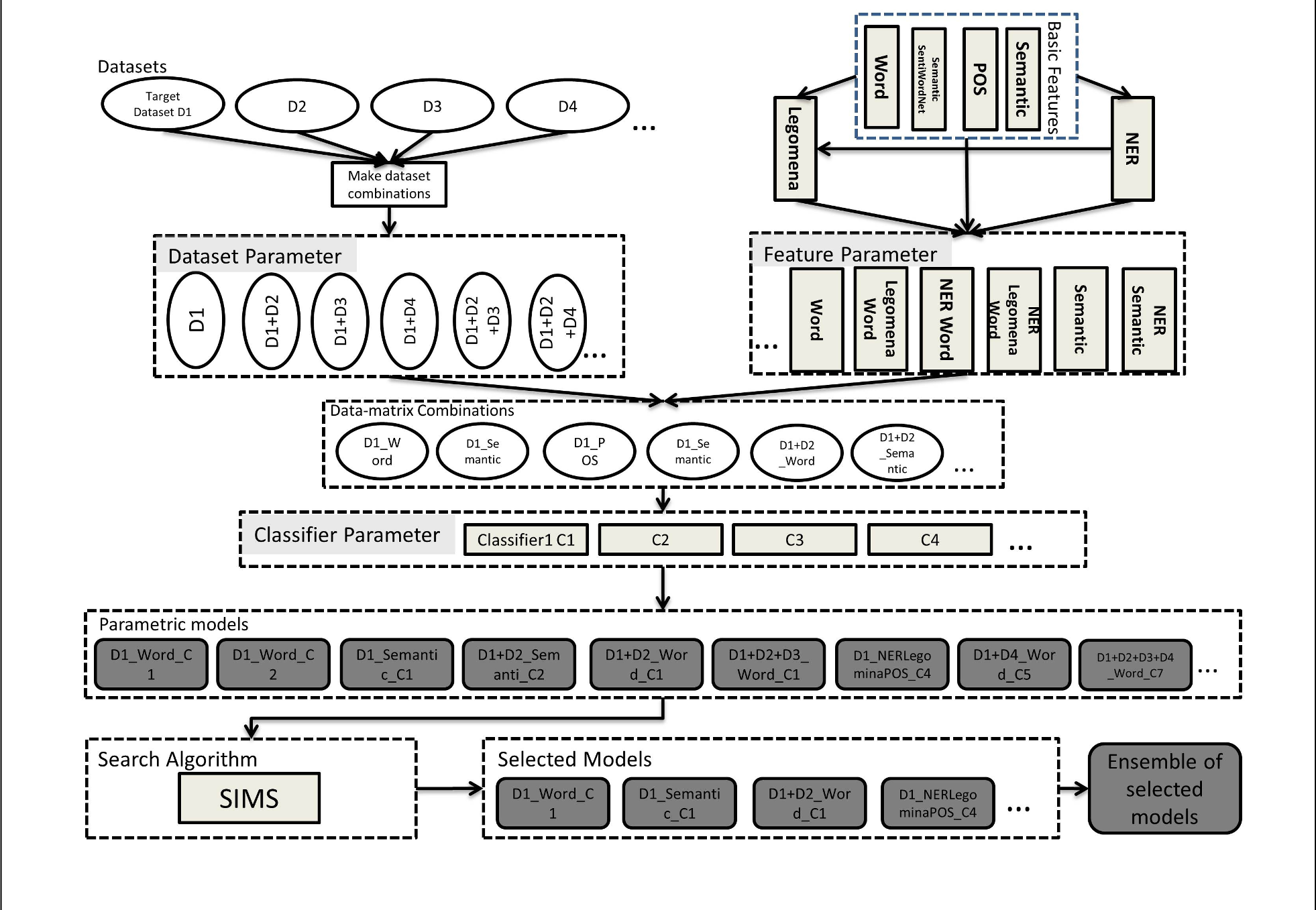
The framework creates 896 parametric models by permuting:
- Datasets: Mixing target data with secondary domains (e.g., Tech and Fast Food) to learn domain-independent patterns.
- Features: Using SentiWordNet (SWNt) labels, POS-word combinations, and "Legomena" (replacing rare words with specific tags) to fight sparsity.
- Classifiers: Deploying 7 different algorithms ranging from SVMs to RBF Neural Networks.
Stage 2: The Contraction (SIMS)
Rather than using all 896 models (which would be redundant and slow), the authors use Step-wise Iterative Model Selection (SIMS). This is a greedy search that selects models not just based on individual performance, but based on how much unique value they add to the existing ensemble.
Experiments & Results: Balanced Intelligence
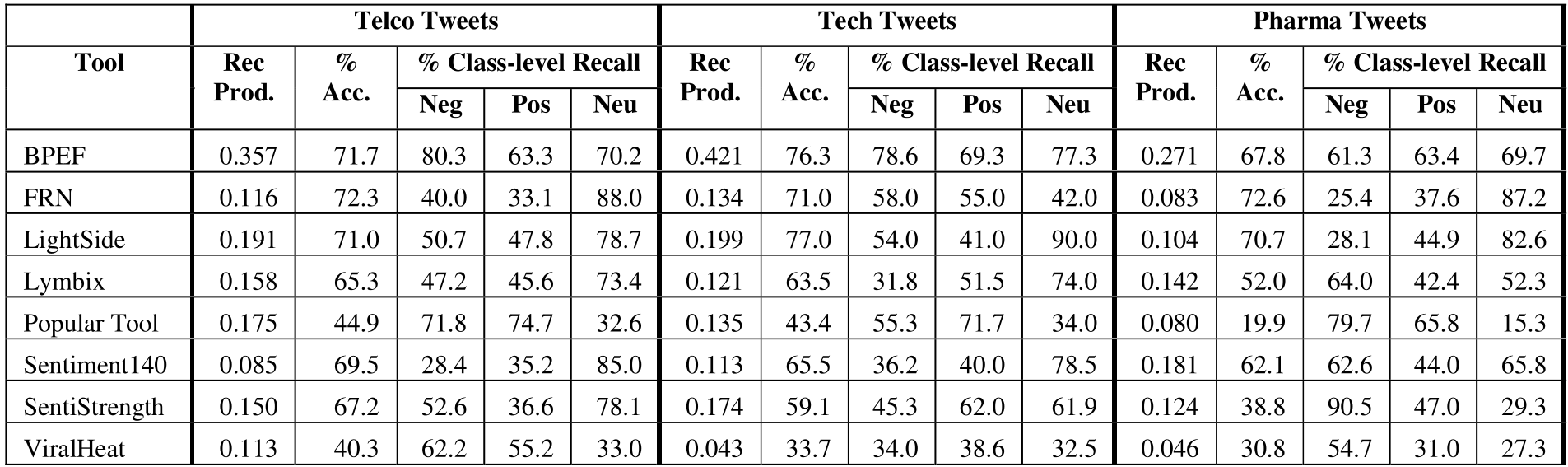
The BPEF was tested against seven established tools (including Sentiment140 and ViralHeat). While other tools often had very high neutral recall but failed to hit 50% on positive/negative classes, BPEF maintained a stable, high recall across all three.
- Macro Recall: Significant outperformance across Telco, Tech, and Pharma datasets.
- Efficiency: SIMS identified that an ensemble of only 30 models performed better than a cumbersome ensemble of 400+ models selected by a Genetic Algorithm.
Deep Insight: Why SIMS Beats Genetic Algorithms
The most fascinating finding is visualized in the model correlation networks below. SIMS specifically picks models with low correlation (spatially separated in the network).
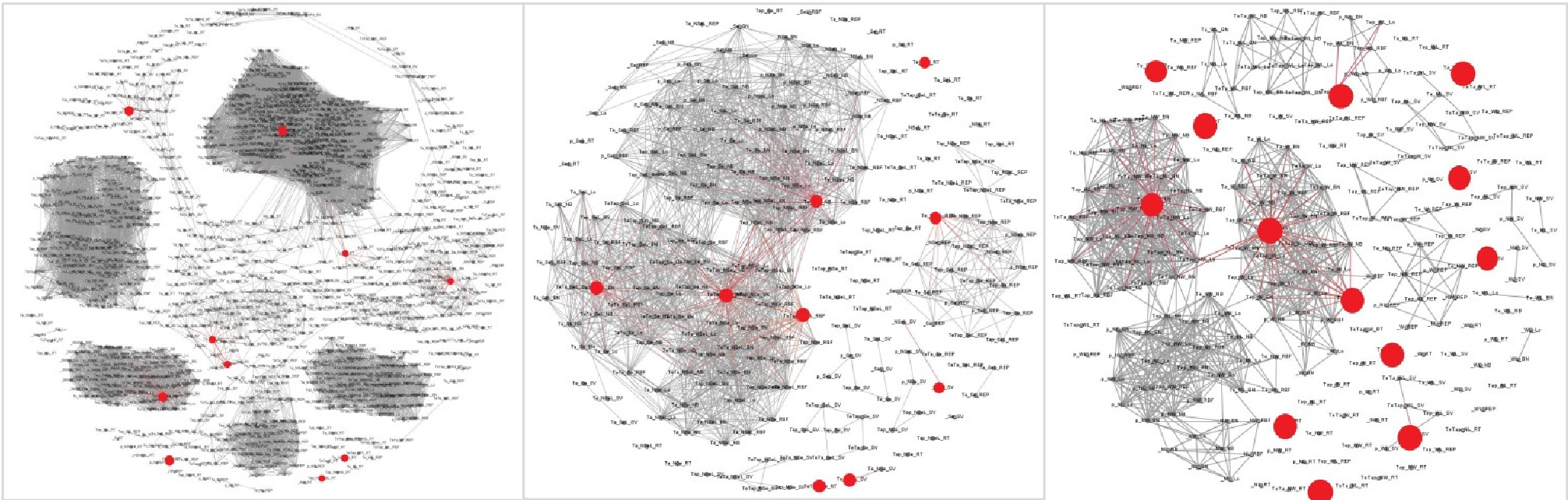
While a Genetic Algorithm might pick the "top 100" best-performing models, SIMS realizes that if all 100 models make the same mistake, the ensemble fails. By picking a diverse team, the BPEF ensemble "covers for" the weaknesses of its individual members.
Real-World Impact: Detecting the "Viral" Moment
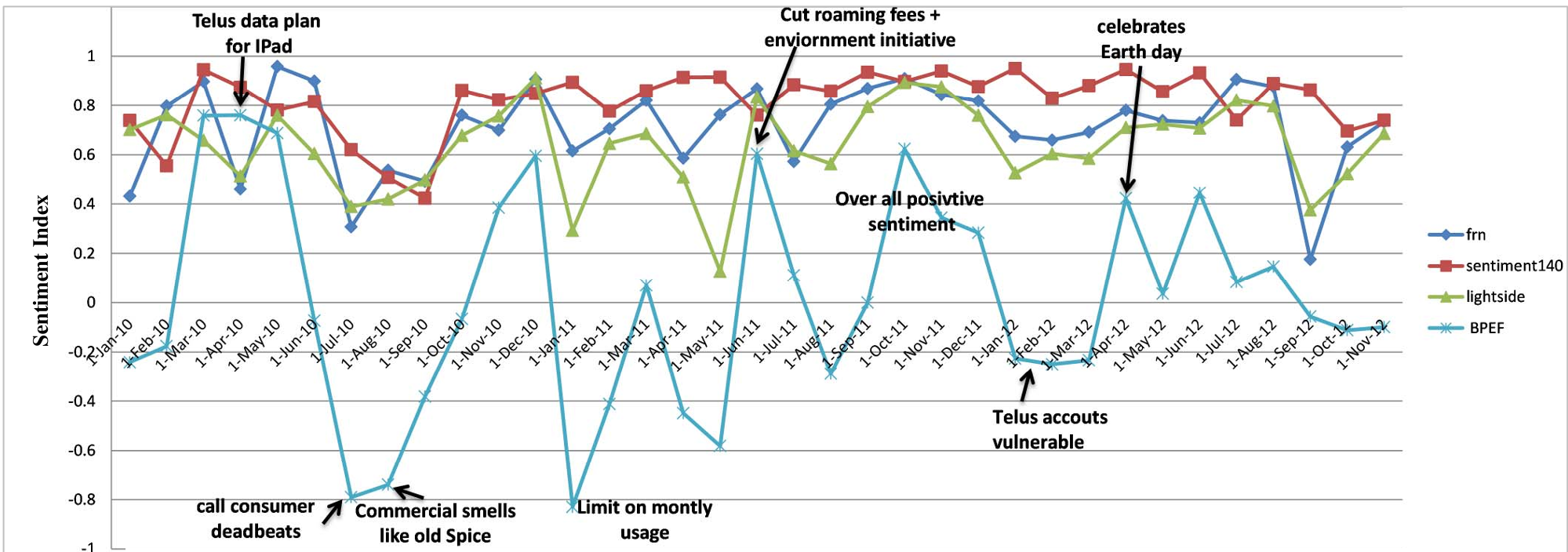
To prove the framework's value, the authors mapped sentiment for the telco company Telus. When Telus accidentally called its customers "deadbeats," BPEF showed a sharp, accurate dive into negative territory, whereas other tools remained stubbornly positive or neutral.
Conclusion & Future Work
BPEF proves that for noisy, sparse environments like Twitter, Ensemble Diversity > Model Complexity. While the study utilizes classical machine learning, the SIMS approach could easily be extended to prune modern Transformer-based ensembles, potentially reducing inference costs while maintaining high-fidelity sentiment signals.