
Elevating Airline Feedback: Deep Learning and Ensemble Methods for Twitter Sentiment Analysis
Sentiment Classification System of Twitter Data for US Airline Service Analysis
This paper presents a multi-class sentiment classification system for the US airline industry using Twitter data. By leveraging Doc2vec (Distributed Memory model) for phrase-level vector representation and evaluating seven distinct machine learning classifiers, the study achieves a peak accuracy of 86.5% with the Random Forest algorithm.
TL;DR
This research tackles the inefficiency of traditional airline feedback systems by applying advanced NLP techniques to Twitter data. By utilizing Doc2vec for context-aware embeddings and comparing seven machine learning models, the study identifies Random Forest as the premier choice for sentiment classification, reaching an F-measure of 86.5%.
Background Positioning
In the spectrum of NLP research, this work moves beyond simple Bag-of-Words (BoW) frequency counts into the realm of Deep Learning-based embeddings. It sits at the intersection of practical Industry 4.0 applications and classical supervised learning, providing a blueprint for real-time customer satisfaction monitoring.
Problem & Motivation: The Noise in the Clouds
Traditional questionnaires suffer from "feedback fatigue"—customers often provide half-hearted or inaccurate responses. Twitter, however, offers "gold-mine data" where genuine emotions are expressed.
The technical challenge lies in the informality of tweets. They are riddled with slang, odd punctuation, and critical word-order dependencies. A phrase like "Not a great flight" vs. "Great flight, not" carries the same words but opposite meanings. Standard classifiers often miss this distinction. The authors' insight was to use a model that "remembers" context.
Methodology: The Power of Document Vectors
The core of this system is the Doc2vec Distributed Memory (PV-DM) Model.
Architecture Analysis
Unlike Word2vec, which only looks at local word windows, Doc2vec introduces a Paragraph ID. This ID acts as an additional feature vector that represents the "intent" or "theme" of the entire tweet. As the model trains, the Paragraph ID essentially "remembers" what is missing from the current context, allowing for a much richer semantic representation.
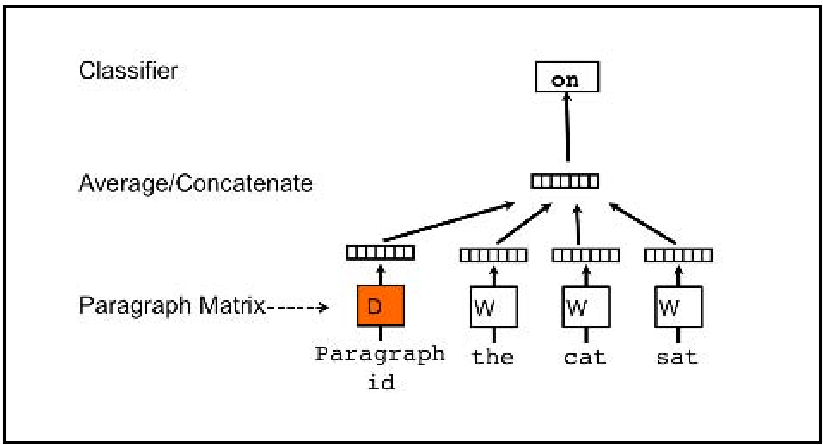 Fig 1: The PV-DM framework where the paragraph token acts as memory to predict the next word in the sequence.
The Classification Suite
The study rigorously tests seven algorithms:
- Linear/Probabilistic: Logistic Regression, Gaussian Naïve Bayes.
- Distance-Based: KNN, SVM (using pairwise multiclass strategy).
- Ensemble Methods: Random Forest, AdaBoost.
Captured Insights: Heavy Turbulence in Sentiment
The experimental results on 14,640 tweets revealed a stark reality: the majority of airline mentions are negative. This "negativity bias" on social media makes the classification of the rare "positive" and "neutral" tweets even more challenging (class imbalance).
Experimental Results
The Performance Table below demonstrates a clear victory for ensemble-based approaches. Random Forest and AdaBoost significantly outperformed the "lazy learners" like KNN.
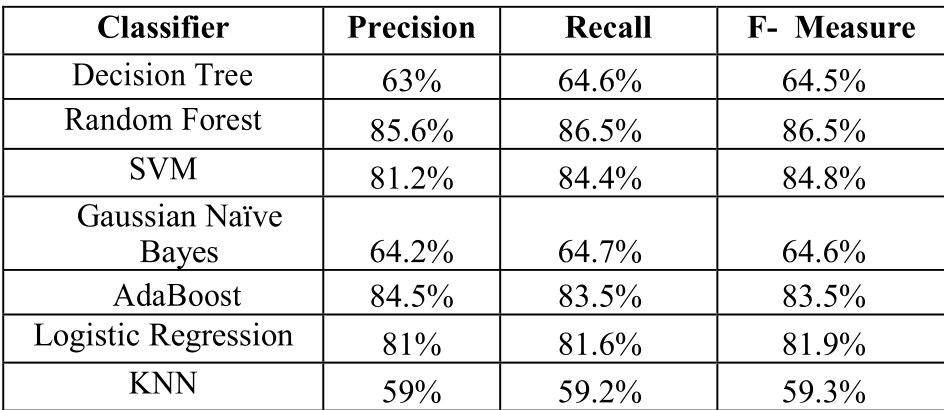 Table 1: Comparative Accuracies across the seven classifiers.
Why did Random Forest win? Random Forest utilizes a multitude of decision trees and a "majority vote" system. This inherent Inductive Bias makes it highly resilient to the noise and outliers typically found in pre-processed Twitter data compared to sensitive models like Gaussian Naïve Bayes.
Critical Analysis & Conclusion
Takeaway
The combination of Doc2vec + Random Forest provides a high-accuracy, scalable solution for sentiment monitoring. It effectively bridges the gap between raw human emotion on social media and actionable business intelligence.
Limitations
- Data Volume: At 14,640 tweets, the dataset is relatively small for deep learning standards.
- Sarcasm: The paper does not explicitly address sarcasm, which is a notorious "classifier-killer" in Twitter sentiment analysis.
Future Outlook
The next logical step for this research is the transition to Transformer architectures (BERT/GPT). While Doc2vec captures word order, Transformers use Self-Attention to weigh the importance of different words dynamically, which could likely push the 86.5% accuracy ceiling even higher.
Senior Editor's Note: This study serves as a robust baseline for any enterprise looking to automate their DevOps/Customer Success feedback loops using traditional yet powerful ML pipelines.