
The Contagion Monitor: Decoding the Structural DNA of Social Movements
A Twitter Social Contagion Monitor
This paper introduces a "Contagion Monitor" system designed to identify and categorize social movements, rumors, and viral phenomena on Twitter. Utilizing a structural network approach, it distinguishes between "simple contagions" (low-threshold/news) and "complex contagions" (high-threshold/political movements) by measuring adoption thresholds and critical mass breakout points.
TL;DR
Researchers have developed a "Contagion Monitor" that identifies emerging social movements on Twitter by analyzing how they spread, rather than just what they say. By quantifying the "social threshold" required for a user to join a conversation, the system successfully distinguishes between low-stakes viral news and high-stakes political transformations like protests or systemic social shifts.
Background: Beyond the Keyword Trend
In the era of rapid digital information, distinguishing between a passing meme (low-threshold) and a brewing revolution (high-threshold) is a critical challenge for sociologists and analysts alike. Most existing tools rely on volume or sentiment analysis, which often fails to capture the underlying social pressure required to adopt "costly" behaviors.
The authors pivot from linguistics to Network Topology. Their core insight is based on the theory of Complex Contagions: while a simple virus or a joke might "infect" you upon a single exposure (simple contagion), joining a controversial political movement usually requires confirmation from multiple independent social sources (complex contagion).
Methodology: High-Threshold Signatures
The system utilizes two primary metrics to identify these high-stakes movements:
- CDF (Cumulative Distribution Function): Specifically looking at the percentage of users who wait for two or more "friends" to adopt a hashtag before joining themselves.
- MTR (Mean Tie Ratio): Measuring the density of links among the first 100 adopters to see if the movement is emerging from a tightly-knit, reinforced core.
The System Architecture
The monitor operates in two modes: a high-breadth Streaming Contagion Monitor (SCM) for global trends and a high-depth Regional Contagion Monitor (RCM) focusing on specific communities (e.g., Nigerian Twitter).
 The Complex Contagion Score (CCS) categorizes hashtags based on their adoption threshold (CDF) and initial network density (MTR).
Key Results: Validating Social Theory
To prove the system works, the authors used Amazon Mechanical Turk to "human-label" thousands of hashtags. The results were striking:
- Controversial vs. Sports: Hashtags with high social reinforcement (high k-threshold) were significantly more likely to be labeled by humans as "political" or "controversial."
- The Critical Mass Point: The monitor identifies the exact moment a movement "breaks out" of its local cluster. This is marked by a positive shift in propagation rate and a sudden drop in the density of new adopters as the movement hits the mainstream.
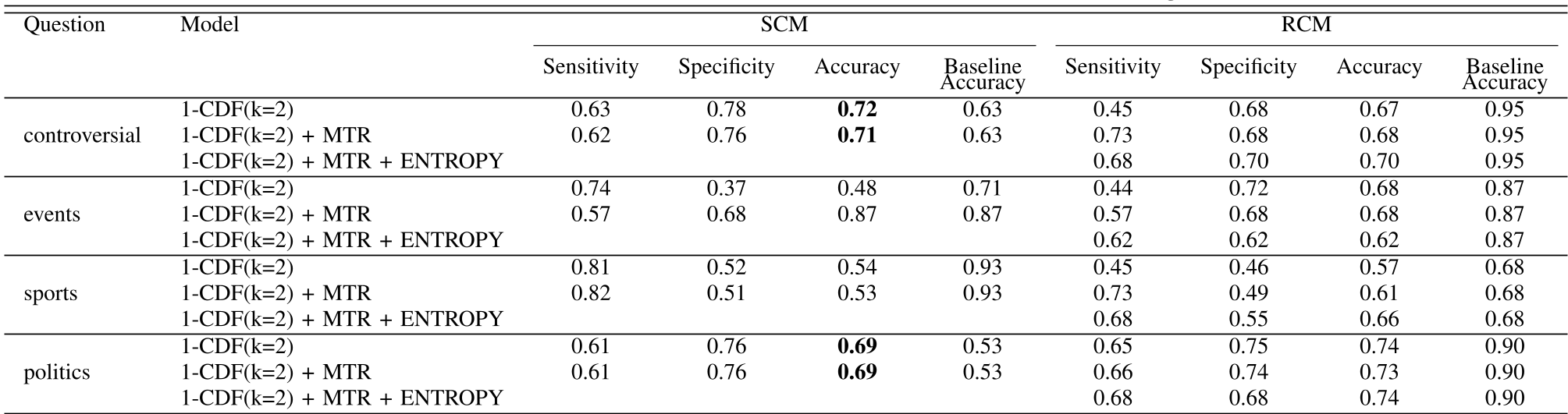 The table demonstrates that structural metrics (1-CDF) are highly effective predictors for "Controversial" and "Political" topics across both SCM and RCM datasets.
Deep Insight: The Spam Anomaly
One of the most fascinating findings was a negative relationship between MTR and controversy in certain datasets. While theory suggests high-threshold movements should start in dense clusters, the data showed that extremely high density often indicated bot networks or spam. This "over-density" acts as a structural signature for artificial manipulation, allowing the monitor to potentially filter out inorganic trends.
Critical Analysis & Conclusion
The Contagion Monitor represents a major step forward in Observational Social Science. By treating Twitter as a "natural experiment," the authors validated decades of social theory at scale.
Limitations:
- The reliance on "digital traces" can be noisy; as the authors noted, bot networks can mimic some complex contagion signatures.
- Ethical concerns regarding the monitoring of high-risk movements (e.g., pro-LGBT hashtags in jurisdictions where they are criminalized) remain a significant challenge for researchers in this field.
Future Outlook: The success of the "South By Southwest" (SXSW) case study—where the monitor correctly predicted the rise of then-fringe comedians Desus and Mero—suggests that this tool has immense value beyond politics, extending into commercial trend forecasting and A&R talent discovery.