
Twitter as a Real-Time Sensor: Solving the Spiking Query Classification Problem
Exploiting Twitter for Spiking Query Classification
The paper introduces a graph-based semi-supervised method for classifying "spiking queries"—search terms that experience sudden surges in popularity. By integrating heterogeneous Twitter metadata including tweets, users, and hashtags, the system achieves state-of-the-art topical classification for extremely fresh queries where traditional search logs are unavailable.
TL;DR
When a celebrity makes a surprise announcement or a sudden sporting event occurs, search engines face a "cold start" problem: people are searching for terms the engine hasn't indexed yet. This paper proposes a graph-based framework that uses Twitter's "super-fresh" content—specifically hashtags and user profiles—to classify these spiking queries into categories like "Sports" or "Celebrities" with over 50% F-score accuracy, outperforming traditional news-based methods.
The Problem: The Latency of Search Resources
Traditional query classification often relies on Web Search Results and Query Logs. However, these resources are reactive. When a query spikes (a sudden burst in frequency), there is a critical window where:
- Web crawlers haven't indexed enough relevant pages to provide a rich context.
- News agencies (the traditional baseline for "fresh" info) often lag behind by hours or even days.
The authors demonstrate this by showing that for a trending mobile app ("Karelog"), Twitter activity exploded on the day of the spike, while news coverage didn't peak until two weeks later.
Methodology: The Query-Twitter Graph
The core innovation lies in the construction of a heterogeneous graph . Instead of just looking at the words in a tweet, the authors model three specific relationships:
- Context Similarity: Traditional NLP similarity between queries based on the "Bag-of-Words" in the tweets containing them.
- User Correlation: A bipartite-style relationship. If a user primarily tweets about sports, then a new spiking query they use is likely sports-related.
- Hashtag Correlation: Hashtags act as community-driven anchors. Queries appearing alongside
#WorldCupare highly likely to belong to the "Sports" category.
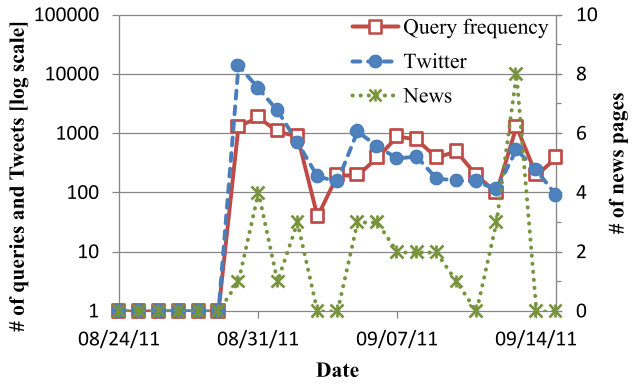 Figure: The graph captures how users and hashtags serve as bridges between known and unknown categories.
Label Propagation via Modified Adsorption
Because manually labeling thousands of queries is expensive, the authors use Semi-supervised Learning. They take a small set of labeled queries and use a "Modified Adsorption" algorithm to "flow" these labels across the graph. The weights are balanced by a parameter , which adjusts the influence of content vs. social metadata.
Experiments & Results
The researchers replicated a real-world scenario by sliding a 4-week window across 2011 data, using the first 27 days to train and the 28th day as the "test" day for newly spiking queries.
| Method | Precision | Recall | F-score |
|---|---|---|---|
| NewsGraph (Baseline) | 45.5% | 30.3% | 36.4% |
| QueryGraph (Text only) | 46.1% | 42.1% | 44.0% |
| QueryTwitterGraph (Proposed) | 50.9% | 50.1% | 50.5% |
Key Insight: The Power of Metadata
A critical discovery was that UserGraph (which ignores tweet text and only looks at user/hashtag connections) actually outperformed the text-only QueryGraph. This suggests that in the noisy world of social media, who is talking is often more informative than what they are saying.
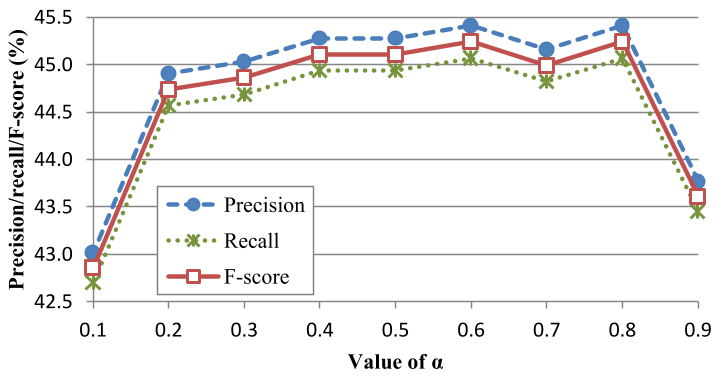 Figure: Tuning the threshold and balance shows that emphasizing social metadata () yields the highest accuracy.
Critical Analysis & Conclusion
Takeaway
Twitter is a superior "real-time sensor" for search engines compared to news feeds. By leveraging the social graph (users and hashtags) alongside the textual content, we can overcome the resource scarcity usually associated with "super-fresh" topics.
Limitations & Future Work
One limitation is that the current model assumes a query belongs to a single dominant category. In reality, a spiking query could be multi-faceted (e.g., a "Sports" figure involved in a "Politics" scandal). The authors suggest that moving to Multi-label Classification and incorporating stronger social signals like Follower-Followee relationships and Retweets will be the next frontier for this research.
Ultimately, this work proves that when the world moves fast, our classification systems must look beyond the dictionary and into the social structure of the internet.