
The Physics of the Trend: Quantifying the Invisible Interest of Twitter Users
Suggestion of Operation Method of the Interest Shift Model of the Twitter User
The paper proposes the Interest Shift Model (ISM), a mathematical framework to quantify Twitter users' interest transitions during "booms." By extending linear differential equations and the SEIR (Kermack-McKendrick) model, the authors successfully visualize potential interest—representing users who consume content without tweeting—achieving high alignment with real-world tweet volume data (R² 0.7–0.9).
TL;DR
Why do some social media "booms" vanish overnight while others lead to sustained cultural movements? This paper introduces the Interest Shift Model (ISM), a mathematical framework that treats Twitter trends like a biological outbreak but with a twist: it accounts for the "invisible" audience. By distinguishing between users who tweet and those who simply watch, the authors achieved an R² accuracy of up to 0.9 in predicting trend lifecycles.
Context: Beyond the "Retweet"
In the world of social media analytics, we usually count what we can see: Tweets, Likes, and Shares. However, research suggests that over 33% of users are "consumers" who read but never post. Prior models, like the standard Kermack-McKendrick (SIR) model used for diseases, assume that if you are "infected" with an interest, it must be visible. This paper argues that ignoring the "potential interest" of silent observers is why current marketing tools fail to predict which booms will last.
Methodology: Mapping the Human Mind as a Differential Equation
The authors propose a state-transition model where a user moves through four distinct phases:
- Indifference: No awareness of the topic.
- Interest(1): Surfaced interest (User contributes a tweet).
- Interest(2): Potential interest (User reads/follows but remains silent).
- Quiet: The interest has settled down or "cooled."
The core breakthrough is the Linear Interest Shift Model, which uses differential equations to calculate the rate at which users move between these states. Specifically, it looks at the balance between (rate of getting interested) and (rate of settling down before tweeting).
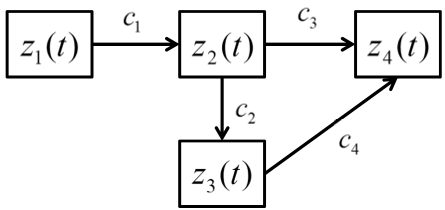
The authors also developed a Non-linear SEIR-based model that doesn't require a pre-defined "start time" for a boom, allowing it to naturally handle complex, multi-peak phenomena like election cycles.
Experimental Results: A Massive Leap in Accuracy
The authors tested their model against real-world data from the "Nuclear Power Plant" discussions in Japan and several 2012 trends (e.g., "Sky Tree," "Solar Eclipse").
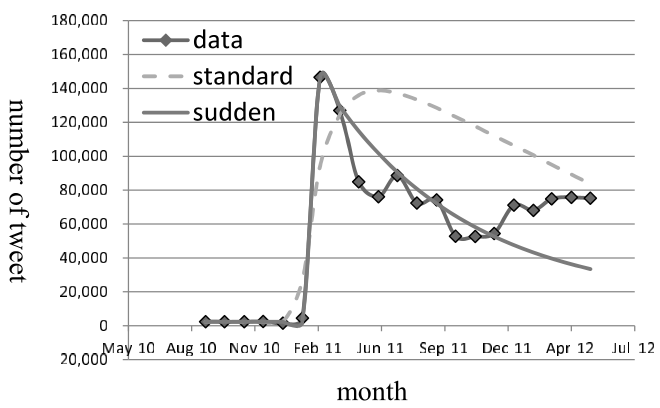
- The Failure of Old Models: The standard "Boom" model achieved a dismal R² of 0.007, failing to capture the nuance of social media.
- The Success of ISM: The Interest Shift Model achieved an R² of 0.896, effectively "catching up" to real-time data fluctuations.
Taxonomy of a Boom
Based on their mathematical analysis, the authors categorized all social media trends into three archetypes:
- Continuation: High (interest generation). Themes that branch into various sub-topics (e.g., Nuclear energy concerns) keep users in the "Interest" states longer.
- The Second Boom: Exponential growth that returns after a cooling period (e.g., Tokyo Sky Tree).
- One-Shot: Rapid spike and immediate death. The rate of cooling () far exceeds the rate of new interest (). Examples include seasonal events like an eclipse.
Deep Insights & Marketing Strategy
The study's most profound takeaway is that marketing success depends on .
- For Sustained Impact: You must provide diverse sub-topics to prevent users from "settling down" ().
- The Value of the Lurker: By quantifying "Interest(2)," businesses can gauge the true size of their audience. Even if tweet volume is low, a high "Potential Interest" score suggests a prime moment for targeted advertising or service launches.
Conclusion
This research moves social media analysis from "counting" to "physics." By modeling the hidden transitions of the human mind, the Interest Shift Model provides a roadmap for predicting the unpredictable. While the model currently relies on historical data to set parameters, future iterations could integrate real-time API streaming to predict booms before they even peak.