
Decoding the Digital Silhouette: How Positivity and Negativity Reshape Twitter Networks
An analysis of positivity and negativity attributes of users in twitter
This paper presents a comprehensive analysis of over 130,000 Twitter users to quantify and distinguish behavioral patterns between positive and negative emotional states. By utilizing the Linguistic Inquiry and Word Count (LIWC) tool for sentiment analysis and graph-based network metrics, the study establishes a taxonomy of seven user groups ranging from "Most Positive" to "Most Negative."
TL;DR
Can your follower count or your tendency to retweet versus reply reveal your underlying emotional state? This study analyzes 130,000 Twitter users to prove that emotional "positivity" and "negativity" aren't just sentiments—they are structural architects of our digital lives. The research finds that negative users essentially "shrink" their social presence, preferring the safety of retweets over the vulnerability of direct interaction.
The Hidden Signal in Social Noise
Psychological states have long been tied to physical cues—stuttering, social withdrawal, or physiological shifts. However, as our lives move online, these cues become "digital biomarkers." The challenge lies in the fact that negative or depressed users often go silent. This paper addresses a critical gap: How can we identify negative emotional states when the users themselves aren't explicitly asking for help?
The authors argue that the answer lies not just in what we say, but in how we reside within the network graph.
Methodology: From Sentiment to Systemic Classification
The researchers utilized the Linguistic Inquiry and Word Count (LIWC) tool to process over 45 million tweets. Unlike simple "thumbs up/down" sentiment analysis, LIWC categorizes words into psychologically meaningful buckets.
The Seven-Tier Taxonomy
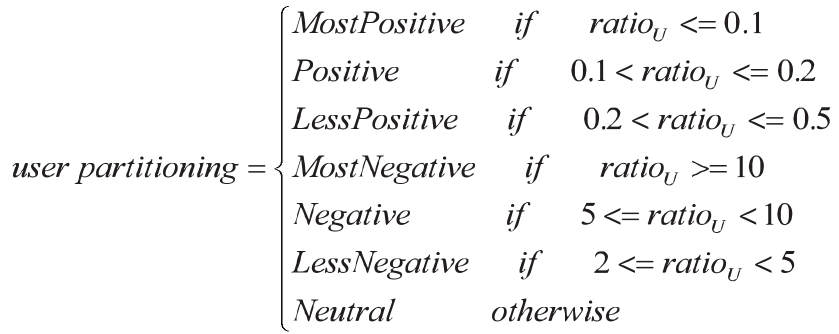
The core of the paper is a mathematical partitioning of users into seven distinct groups. By calculating a ratio () of weighted negative affect over positive affect, the authors created a spectrum:
- Most Positive ()
- Neutral
- Most Negative ()
This weighting is crucial because it accounts for the fact that pure volume of tweets varies wildly between users; a single negative tweet from an active user is less telling than a single negative tweet from a silent one.
Core Insights: How Emotion Changes Behavior
1. The Interaction Paradox
One of the most striking findings is the difference in interaction modes.
- Positive Users: Use Twitter for "Information Sharing." They have a higher number of followees and engage heavily in @-replies.
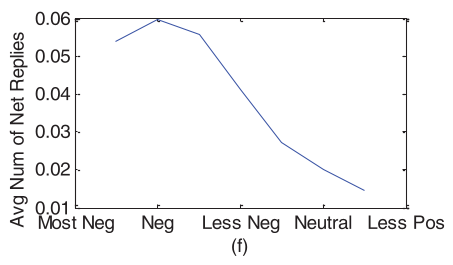
- Negative Users: Use Twitter for "Social Awareness and Empathy." They significantly favor retweeting over replying.
Why? The authors suggest that negative individuals find direct interaction exhausting or potentially harmful to their mood, whereas retweeting allows them to express agreement and seek emotional validation without the friction of a conversation.
2. Network Topology and Isolation
By analyzing "Biased Networks" (networks centered around a highly negative or positive seed node), the researchers found that:
- Positive users are the "glue" of the network, followed by all groups.
- Negative users exist in smaller, more isolated clusters.
- Interestingly, positive users often follow negative ones (perhaps out of curiosity or a desire to help), but negative users rarely follow each other, seeking instead the "emotional lift" of neutral or positive content.
The "Retweet" as a Cry for Support
The study highlights that positive tweets are shared 7.5x more than negative ones. However, in the "Negative Network," the volume of retweets is disproportionately high. This suggests that for a negative user, the Retweet button is a tool for seeking social connectedness while maintaining a defensive distance.
Critical Analysis & Future Outlook
While the paper provides a robust framework for identifying negativity, it acknowledges a statistical bias: the "Most Negative" group is significantly smaller (0.15% of the dataset) than the positive groups. This "data sparsity" in negative users is a common hurdle in mental health informatics.
The Takeaway: Future AI-driven intervention tools shouldn't just look for "sad keywords." They should monitor the structural decay of a user's social graph—fewer @-replies and an over-reliance on retweets may be the first digital warning signs of a declining mental state.
Limitations
- Dataset Recency: The data is from 2011; modern Twitter (X) dynamics, including algorithmic feeds and bot activity, may skew these patterns today.
- Causality: It remains unclear if negative emotions cause reduced interaction, or if reduced digital interaction exacerbates negative feelings.
This synthesis is based on "An Analysis of Positivity and Negativity Attributes of Users in Twitter" by Roshanaei and Mishra.