
Beyond Independent Issues: How Conflicting Beliefs Shape Social Consensus
Two-dimensional opinion dynamics in social networks with conflicting beliefs
The paper introduces two novel models for two-dimensional opinion dynamics in social networks where two distinct beliefs (A and B) are perceived as conflicting. Built upon the Hegselmann-Krause (HK) bounded confidence framework, these models simulate how "conflict" and "tolerance" parameters influence the emergence of consensus or fragmentation in agent beliefs.
TL;DR
In the world of social dynamics, most models assume your opinion on "Apple vs. Android" has nothing to do with your view on "Climate Change." This paper challenges that by introducing conflict-aware opinion dynamics. By proposing two models—one where agents reject the weaker belief (Model I) and one where they balance both (Model II)—the authors demonstrate that the inner attitude toward conflict is just as important as the social network structure itself in achieving consensus.
Problem & Motivation: The Independence Fallacy
Classical models like the Hegselmann-Krause (HK) model are great at showing how "open-mindedness" (tolerance) helps a group reach a consensus on a single topic. However, humans don't live in a vacuum. We often hold beliefs that are in direct competition.
Current multidimensional models treat opinions as independent vectors. The authors argue this is unrealistic for cases like competing scientific theories. If you start believing more in Theory A, your belief in Theory B should logically decrease. The paper's core insight is that we need an Internal Update step where agents reconcile their own conflicting views after talking to their neighbors.
Methodology: Network Update meets Internal Logic
The authors propose a two-stage process for every time step:
- Network Update (Social): Agents look at their "epistemic neighbors"—those within a tolerance bound ()—and average their opinions.
- Internal Update (Psychological): The agent then processes these two new values ( and ) based on a conflict parameter ().
The Two Attitudes Toward Conflict
The paper defines two distinct personas for handling conflict:
- Model I (The Decisive Agent): "I can't believe both." If there is conflict, the agent keeps the stronger belief and suppresses the weaker one.
- Model II (The Balancing Agent): "I need a consistent explanation." The agent normalizes their beliefs so they sum up toward 1 (Unity).
 Note: The HK update serves as the engine, but the conflict-resolution logic determines the final destination.
Experiments & Results: Conflict as a Catalyst
The researchers used Matlab simulations with 100-1000 agents. They compared "Independent" updates (everyone talks to anyone close in one belief) vs. "Joint" updates (you only talk to people who are close to you on both beliefs).
Key Findings:
- Model I results in Polarization: When conflict is high, the network splits into two camps. One group totally believes A and rejects B, while the other does the opposite.
- Model II results in Consensus: Surprisingly, even if agents start with diverse views, the normalization process (Model II) forces the beliefs to converge. If one belief has a higher tolerance (more "open-mindedness"), it eventually pulls the entire network to a unified consensus for both beliefs.
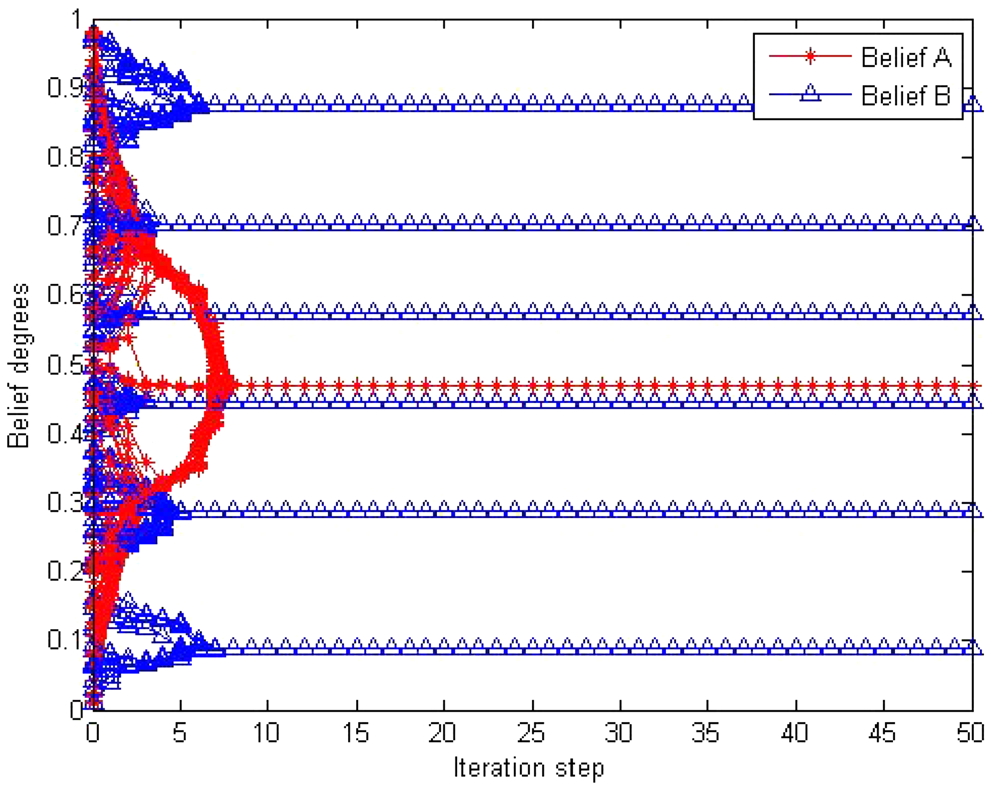 Fig: Comparison of belief trajectories. Notice how tolerance levels dictate whether the group stays fragmented or joins together.
Critical Analysis & Conclusion
Takeaway
The most profound insight here is that conflict doesn't always lead to division. In Model II, the internal pressure to have a "consistent" view of the world actually helps the social network align itself faster than if the topics were independent.
Limitations & Future Work
- Network Topology: This study used a "Complete Graph" (everyone can talk to everyone). Real-world social networks are "Small World" or "Scale-Free," which might change how quickly conflict spreads.
- External Media: The model doesn't yet account for mass media or "bots" that might intentionally inject conflict to prevent consensus.
Ultimately, this work provides a sophisticated mathematical framework for understanding Integrated Information Processing in social groups, moving us closer to a realistic "Physics of Society."