
"Two Is a Crowd": Why the Second Friend is the Tipping Point for Social Trends
“Two Is a Crowd” - Optimal Trend Adoption in Social Networks
The paper investigates optimal trend adoption strategies in social networks using an Erdős-Rényi random graph model. It proposes a hybrid adoption framework and identifies that the optimal threshold for a "follower" to adopt a trend—ensuring adoption only when a global majority does—is having exactly two active neighbors ().
TL;DR
Why do we wait for a second friend to join a platform or adopt a behavior before we jump in? This paper provides a rigorous mathematical proof using Random Graph Theory to show that a threshold of two neighbors is the optimal strategy for an individual to ensure they only follow trends that will actually become popular, based solely on local information.
Background: The Limits of Traditional Models
For years, social scientists used two distinct paradigms:
- The Cascade Model: One person influences another like a falling row of dominoes.
- The Threshold Model: You join only if a certain percentage or number of your friends join.
However, empirical data from LiveJournal and DBLP (the CS bibliography) showed a weird "kink" in the curve. The probability of joining jumps significantly when the second friend joins, then slows down. Existing models couldn't explain why two was the magic number.
The Hybrid Insight: Informed vs. Followers
The researchers split the social network into two functional groups:
- Informed Adopters (Insiders): They have "insider knowledge" and decide based on the trend's actual value (modeled via Influence Cascade).
- Followers (Imitators): They lack information and only watch the insiders to decide if a trend is worth it (modeled via Threshold Strategy).
The "Follower's" goal is simple: Don't join if the trend is a flop, but join if the insiders are making it a hit.
Methodology: Proving the Subcritical Safety
The authors analyzed the Subcritical Phase—a state where the trend is failing to reach the majority. Using Generative Functions () and Percolation Theory, they calculated the probability that a follower would find active neighbors in a dying trend.
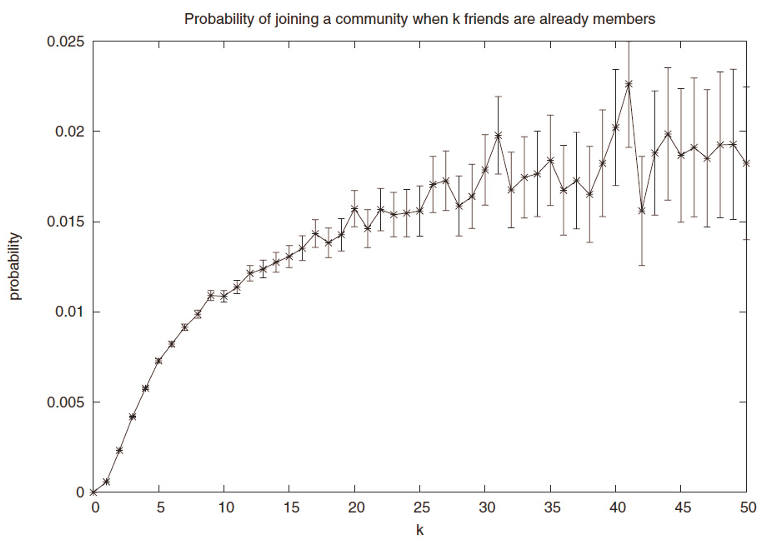 Fig 1: The hybrid graph G where G1 (Informed) influences G2 (Followers).
The math reveals a stark contrast:
- If you set your threshold at , you have a high risk of "accidental adoption"—following a trend that never actually goes viral.
- If you set it at , the probability of making a mistake drops to zero asymptotically as the network grows.
The "Second-Adoption" Phenomenon
The simulation results perfectly mirror real-world sociological observations. The "Double Jump" occurs at the point where the trend transitions from local clusters to a global phenomenon.
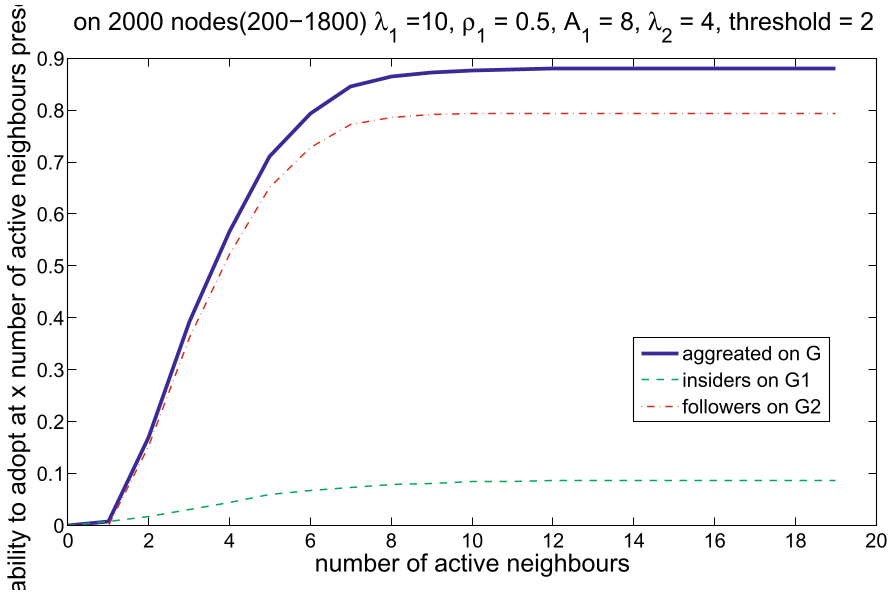 Fig 2: Notice the sudden rise in adoption probability when the second neighbor becomes active.
Why wins:
- Safety: It filters out "noise" from random early adopters who won't succeed.
- Sensitivity: It is the lowest possible "safe" threshold, allowing the follower to catch a successful trend as early as possible.
Critical Analysis & Future Outlook
While the model uses Erdős-Rényi graphs (which assume random connections), real social networks are often "Scale-Free" (Hubs and Authorities). However, the physics of the "two-person tipping point" remains a robust benchmark.
Takeaway for Tech: For developers building recommendation engines or social apps, "pushing" content to users once two of their friends have engaged is not just a heuristic—it's mathematically optimal for filtering relevance.
Conclusion
This study bridges the gap between abstract graph theory and human behavior. It proves that our tendency to wait for a second "vote of confidence" isn't just social pressure—it's an optimal statistical filter for navigating an information-heavy world.