
Beyond the Password: A Behavioral Biometrics Shield for Social Multimedia
A two-layer security model for accessing multimedia content in social networks
The paper introduces a "Two-Layer Security Model" designed specifically for securing multimedia content access in Online Social Networks (OSNs). It combines traditional Single Sign-On (SSO) with a semantic-based behavioral authentication layer that utilizes a user's unique activity patterns to verify identity.
TL;DR
This research addresses the growing threat of account hijacking in Online Social Networks (OSNs). While passwords (SSO) are a standard first line of defense, they are easily stolen. The authors propose a two-layer model that monitors how you behave after logging in—using your unique tagging, messaging, and interaction patterns as a digital fingerprint—to ensure that only the real owner can access private multimedia content.
Problem & Motivation: The Single Point of Failure
System administrators and web developers face a critical challenge: as multimedia content explodes on social platforms, so do the risks of unauthorized access.
The authors argue that current OSN security is dangerously "abstract." Once a malicious actor bypasses the initial Login (SSO), they have a "walled garden" pass to all private photos and videos. This occurs because existing frameworks do not verify identity during the session. The challenge is to add security without annoying the user with constant prompts—a concept the authors call "user convenience."
Methodology: The Behavioral "Reference Pattern"
The core innovation lies in the Second Layer: User Behavior Quantification.
1. Feature Engineering from Psychology
Instead of arbitrary metrics, the authors used two psychological questionnaires (NEO-FFI and FPB) to select features correlated with stable personality traits (Extraversion, Neuroticism, Openness). They narrowed it down to 6 "unfakeable" features:
- Block List usage (Neuroticism indicator).
- Friend Request targets.
- Wall posting frequency.
- Tagging habits on photos.
- Search engine permissions.
- Private messaging targets.
2. The Euclidean Distance Logic
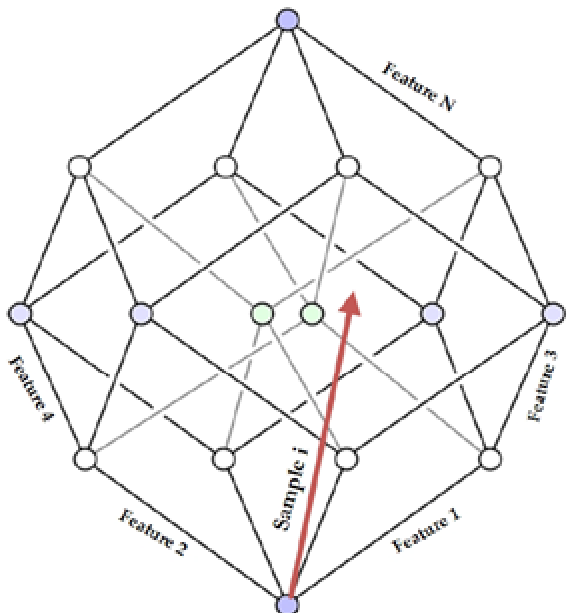
The system creates an N-dimensional space where each user has a Reference Pattern (their historical average behavior).

When a session starts, a Test Pattern is generated. The system calculates the distance using the formula:
If the distance exceeds a "Reference Threshold," the system suspects the user is an intruder and triggers a "Security Question." If the distance is small, the user is granted seamless access to multimedia, preserving convenience.
Experiments & Results: Stability and Accuracy
The authors validated their feature set with 67 participants over a 6-month period. Using IBM SPSS and Repeated Measures tests, they proved that these behaviors are consistent over time (with significance values typically , indicating no meaningful change in the user's inherent behavior pattern).
Performance Metrics
The paper defines success through two ratios:
- Right Detections (RD): Correctly identifying when an active user is actually an intruder.
- Model's Validity Range (MVR): A trade-off between strict security and user "persecution" (annoyance).
The statistical analysis confirmed that by grouping users via personality subscales, the model could effectively flag "Invalid Behavior" while minimizing "False Positives" for legitimate users compared to standard SSO-only models.
Critical Analysis & Conclusion
Takeaway
The shift from "what you know" (passwords) to "who you are" (behavior) is essential for modern privacy. This model effectively uses a semantic-behavioral bridge to secure multimedia content without forcing the user to jump through hoops unless suspicious activity is detected.
Limitations
- Cold Start Problem: The system requires a training period to build the "Reference Pattern" after a user signs up.
- Cultural Bias: The authors acknowledge that their questionnaire results might vary across different geographical or cultural areas.
- Feature Evolution: Static behavioral models may struggle if a user's life circumstances significantly alter their social media habits (e.g., changing jobs or moving countries).
Future Outlook
The next step for this technology is scaling. Moving from a controlled study of 67 people to a global OSN environment will require dynamic updates to the feature vectors and the integration of automated Model Validity Range (MVR) adjustments.