
2H-SC-HMM: Decoding the Temporal "Rhythm" of Human Emotion
Two-Level Hierarchical Alignment for Semi-Coupled HMM-Based Audiovisual Emotion Recognition With Temporal Course
The paper introduces a Two-Level Hierarchical Alignment-based Semi-Coupled Hidden Markov Model (2H-SC-HMM) for audiovisual emotion recognition. It focuses on modeling the complex temporal course of emotions (onset, apex, offset) and expression intensities using sub-emotion HMMs and a language model constraint.
TL;DR
The paper presents a sophisticated audiovisual emotion recognition framework called 2H-SC-HMM. Unlike traditional models that treat emotions as static or linearly simple, this work decomposes emotional expressions into three phases—Onset, Apex, and Offset—and two intensity levels. By using a unique two-level alignment (Model and State) and a sub-emotion language model, the system achieves SOTA performance on naturalistic datasets like SEMAINE, proving highly resilient to noise and data sparsity.
Background: Why Emotions are a Moving Target
In natural face-to-face conversation, emotions aren't just "on" or "off." They have a physical "course": a smile starts (onset), reaches its peak (apex), and fades away (offset). Most existing Hidden Markov Models (HMMs) assume this entire cycle happens in one sentence. However, in reality, a person might start being angry in sentence A and reach peak fury in sentence B.
The researchers identified that Model-level fusion (like Coupled HMMs) often fails here because they are too "rigid"—they try to force strict synchronization, which leads to over-fitting when training data is scarce or the environment is noisy.
Methodology: The Two-Level Alignment Strategy
The core innovation is the 2H-SC-HMM (Two-Level Hierarchical Alignment Semi-Coupled HMM). It operates on two distinct layers of synchronization:
- Model-Level Alignment: This explores the general tendency of how audio HMM sequences relate to visual HMM sequences. It asks: "Are the audio and visual onset phases overlapping?"
- State-Level Alignment: This dives deeper into the internal states of each sub-emotion HMM to model detailed temporal relations.
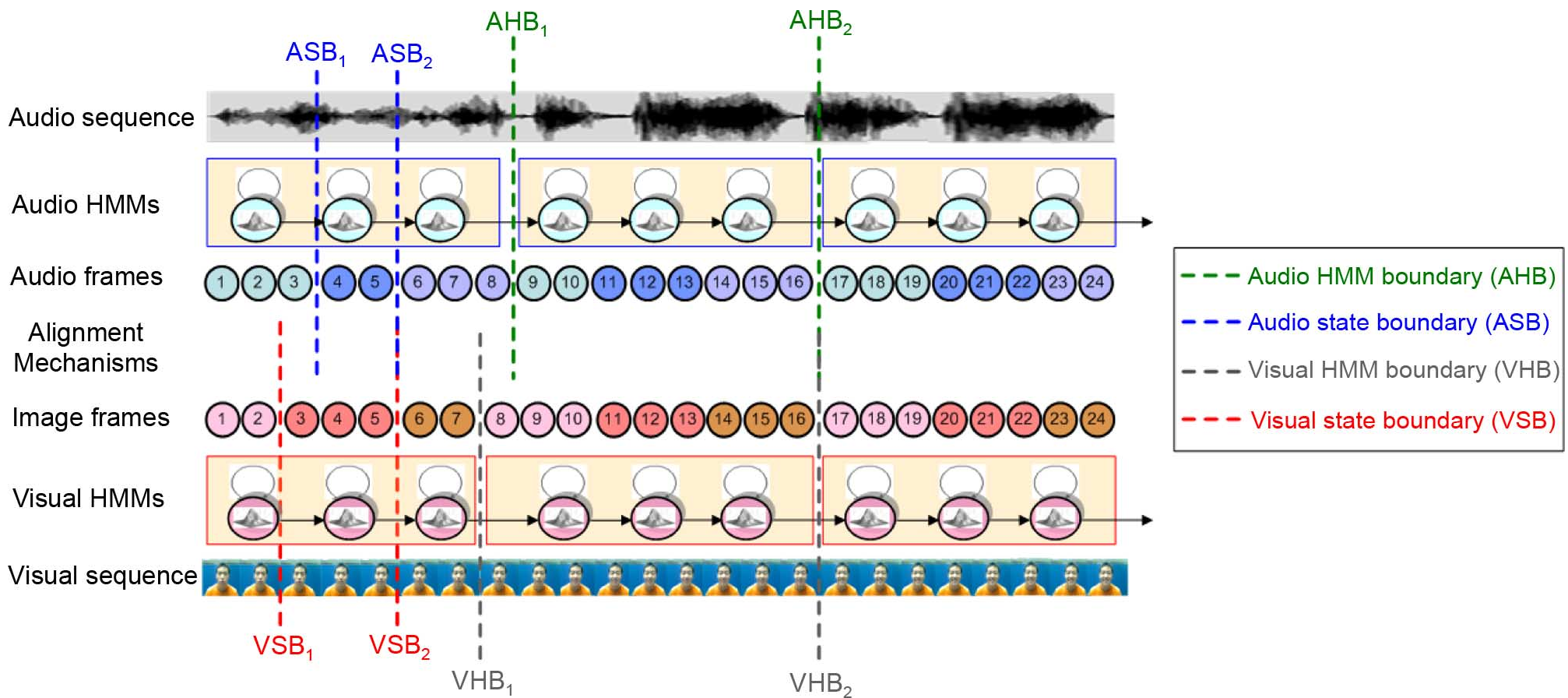 Fig 1: Illustration of the Model- and State-level alignment between audio and visual streams for a 'Happy' state.
Furthermore, the authors treat sequences of sub-emotions like words in a sentence, applying a Sub-emotion Language Model. This prevents the model from predicting impossible sequences (like jumping from "Neutral" directly to "Offset High Intensity").
Experimental Results: High Stakes in Naturalistic Data
The model was tested against two types of data: MHMC (Posed/Laboratory) and SEMAINE (Naturalistic).
Resilience to Noise and Sparsity
One of the most impressive "stress tests" involved partial facial occlusion (covering the mouth) and adding white Gaussian noise to the audio.
- Sparse Data: The 2H-SC-HMM maintained high accuracy even when training samples were cut to only 60 per state, whereas standard Coupled HMMs (C-HMM) plummeted due to over-fitting.
- Noisy Conditions: At 5dB SNR with partial facial occlusion, the proposed method significantly outperformed Error-Weighted fusion (EWC) because it doesn't rely on unreliable static weights.
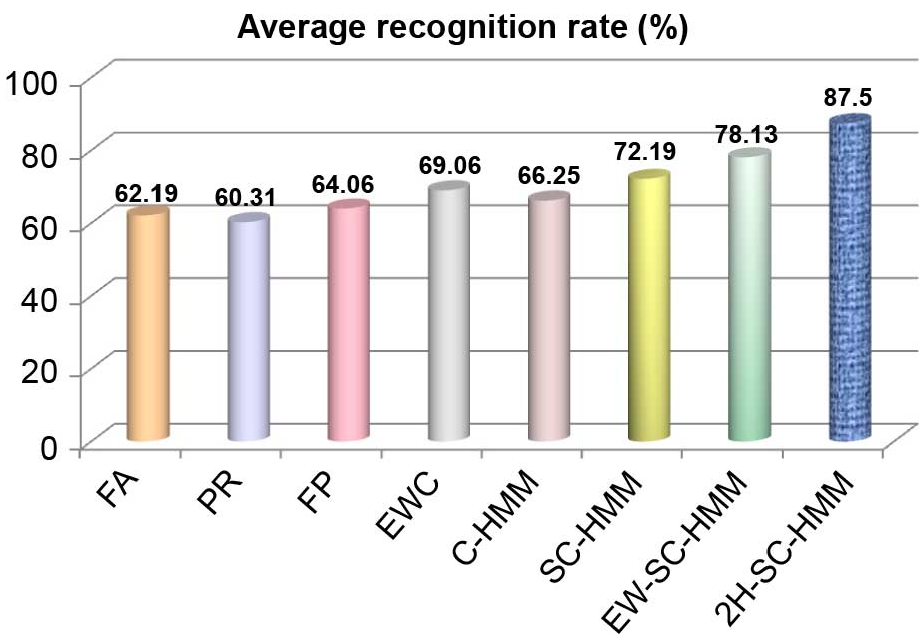 Fig 2: Average emotion recognition rates on the SEMAINE database, highlighting the superiority of 2H-SC-HMM in complex conversational environments.
Critical Insights & Future Outlook
The success of this work stems from its Inductive Bias: it assumes that human emotion is hierarchical and structured. By explicitly modeling Intensity (Low vs. High), the model distinguishes between introverted and extroverted expression styles—a common failure point for simpler classifiers.
Limitations:
- The model currently relies on manual selection of a "Neutral" frame for normalization.
- It assumes known Speaker IDs for feature calibration.
Future Work: The transition to unsupervised neutral segment detection and the integration of Textual Information (Linguistic content) will likely be the next frontier in making this model truly "in-the-wild" ready.
Conclusion
By moving away from "Tight Coupling" to a "Loosely Coupled Hierarchical Alignment," the 2H-SC-HMM provides a blueprint for how AI can better understand the nuances of human temporal dynamics. It proves that in the world of emotion, the way you get there is just as important as the destination.