
Deciphering the Critical Link: Trust Sensitivity Analysis via Binary Decision Diagrams
Two-Party Trust Sensitivity Analysis for Social Networks
This paper introduces a specialized Binary Decision Diagram (BDD) based algorithm designed for "Trust Sensitivity Analysis" in social networks. By adapting Birnbaum’s measure from reliability engineering, it successfully identifies which specific direct links contribute most to the overall trust score between two non-adjacent parties.
TL;DR
In modern digital social networks, trust is the currency of interaction. But which friend-of-a-friend connection is actually the "linchpin" of your trust in a stranger? This paper proposes a high-efficiency algorithm using Binary Decision Diagrams (BDD) and Birnbaum’s Measure to identify which direct links in a social network are the most critical to maintaining a trust relationship between two distant parties.
Background: Beyond Simple Trust Scores
While Social Network Services (SNS) like Facebook or LinkedIn allow us to quantify trust (e.g., "how much I trust B for movie advice"), trust is inherently asymmetric and transitive. Prior research has focused on calculating the final score (TidalTrust, EigenTrust), but has ignored the sensitivity of the network. If one person's opinion changes slightly, how drastically does the entire trust chain collapse? Identifying these critical links is essential for both information security and network reliability.
The Problem: The Complexity of Network Paths
In a typical social graph, information can flow through hundreds of overlapping paths. Calculating the importance of a single link across all these paths using brute force is computationally expensive.
- Prior Work Weakness: Most existing models treat all paths as independent or focus only on the shortest path, ignoring the complex dependencies of real-world networks.
- The Insight: The authors realized that trust propagation in a graph can be modeled as a logic function, much like a circuit or a power grid. By treating trust as a "system reliability" problem, they can use BDDs to simplify the logic.
Methodology: The BDD Engine
The core of the paper lies in transforming a social graph into a Binary Decision Diagram (BDD).
1. Shannon Decomposition
The BDD is built on the Shannon decomposition rule: This allows a complex trust function to be broken down into a rooted, directed acyclic graph where every node represents a link (trust/no-trust).
2. Identifying Importance (Birnbaum's Measure)
To find the most influential link, the paper adapts Birnbaum’s importance measure: Mathematically, this represents the partial derivative of the total trust score relative to a single link's trust probability.
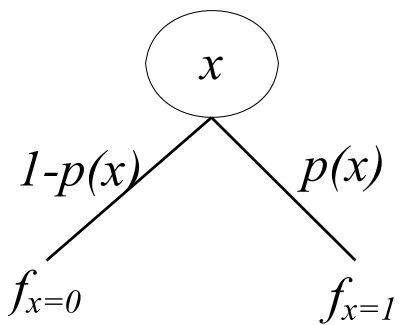 Figure 1: A BDD node structure representing a binary trust decision.
Experiments: Finding the Linchpin
The authors tested their algorithm on five different social network topologies. By assigning a baseline trust score of 0.7 to all links, they calculated the sensitivity of every individual connection.
Key Findings:
- In Graph 3: Link 1 was found to be the most "sensitive" (score 0.396), meaning any degradation in trust for Link 1 would have the most catastrophic impact on the overall network trust.
- Topology Matters: The results proved that the most "central" link in a physical graph is not always the most important in a trust BDD, highlighting the unique logic of trust flow.
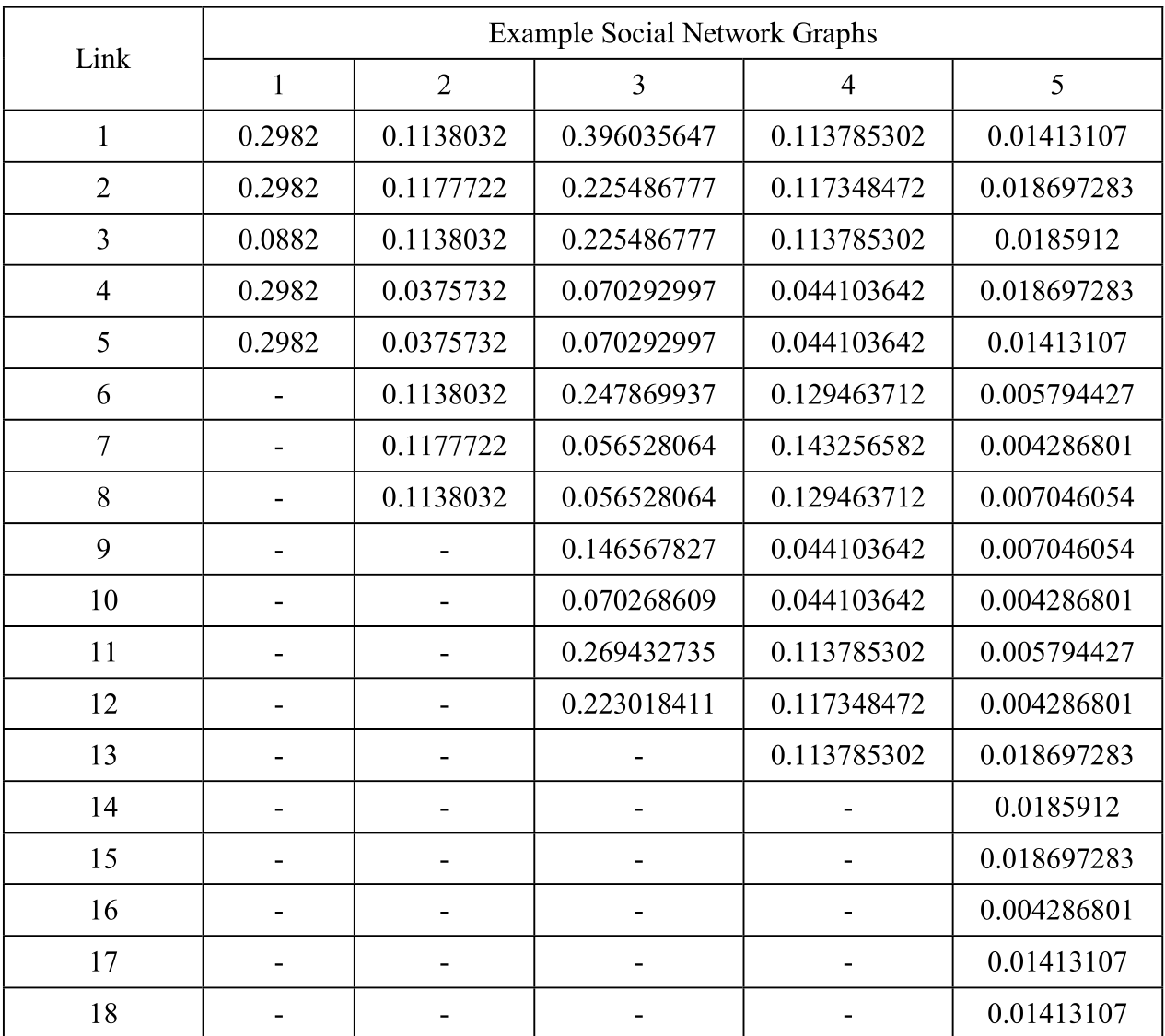 Table 1: Birnbaum’s measure results across five different social network graphs.
Critical Analysis & Conclusion
Takeaway
The BDD-based approach offers a significant computational advantage over traditional path-enumeration methods. It provides actionable intelligence for network administrators—helping them identify exactly which connections need to be protected to maintain a secure information flow.
Limitations & Future Work
- Binary Restriction: The current model assumes trust is a binary state (Trust vs. Non-trust). In reality, trust exists on a spectrum.
- Scalability: While BDDs are efficient, the variable ordering (the order in which links are added) is a known NP-hard problem.
- Perspective: Future iterations will likely incorporate multi-state system models to handle various levels of trust and apply the algorithm to massive datasets with millions of "parties."
By bridging the gap between reliability engineering and social science, this paper provides a robust mathematical foundation for the next generation of trustworthy social systems.