
Two-Phase Preference Disclosure: How Your "Likes" Betray Your Privacy
Two-Phase Preference Disclosure in Attributed Social Networks
This paper introduces a two-phase framework for inferring hidden user preferences in attributed social networks. By combining a greedy attribute clustering algorithm with multi-graph random walks (DeepWalk-inspired), it maps users and preferences into a joint latent space via Word2Vec embeddings to achieve state-of-the-art inference on sparse graphs.
TL;DR
Researchers have developed a potent new method to uncover your hidden social media preferences. By clustering massive amounts of attribute data and treating social interactions like "sentences" in a language model, they can predict your private interests—even when your friend list is hidden. Using a two-phase approach involving Greedy Clustering and Multi-Graph Random Walks, this method achieves a significant AUC of 0.68 in predicting secret user attributes.
Background & Motivation: Moving Beyond the Friends List
Most privacy research in social networks focuses on "Homophily"—the idea that you are like your friends. However, modern privacy settings often allow users to hide their friend lists, rendering these attacks useless.
The authors of this paper identify a different vulnerability: Cross-Attribute Correlation. Even if you hide your favorite travel destination, your interest in specific politicians, local businesses, or music genres might give it away. The challenge is the "Curse of Dimensionality"—there are millions of possible things to "like," making traditional statistical prediction computationally impossible.
Methodology: The Two-Phase Attack
Phase 1: Semantic Space Reduction (Clustering)
To handle hundreds of thousands of possible attribute values (e.g., every movie ever made), the system first groups them into balanced, homogeneous clusters. If many users like both Star Wars IV and Star Wars V, these are merged into a single "cluster label."
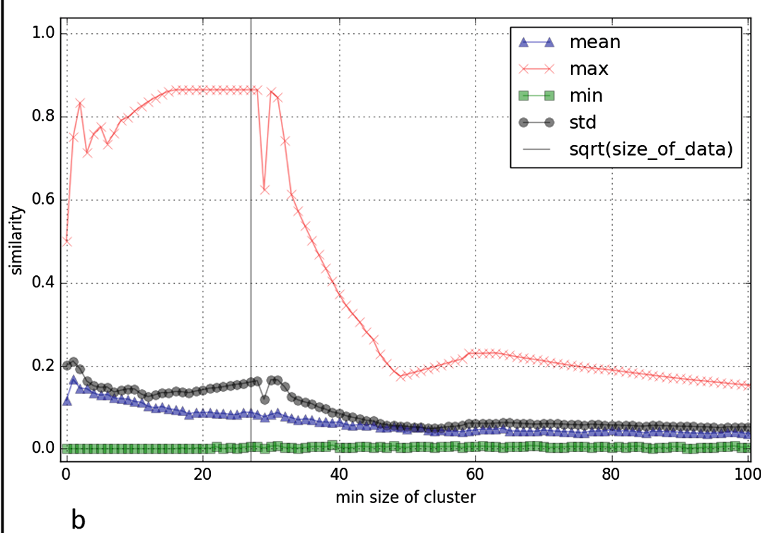
The authors use a greedy algorithm to maximize the Jaccard similarity within clusters while keeping cluster sizes balanced (). This turns a massive search problem into a manageable classification task.
Phase 2: Multi-Graph Random Walks & NLP
The core innovation lies in treating the social network as a document. The authors model the network as a collection of graphs:
- Link-ship Graph: Who follows whom.
- Attribute Bipartite Graphs: Who likes what.
By performing weighted random walks, a "walker" jumps between users and their attributes. For example, a walk might look like: [User A -> Movie Cluster B -> User C -> Politician D -> User A].
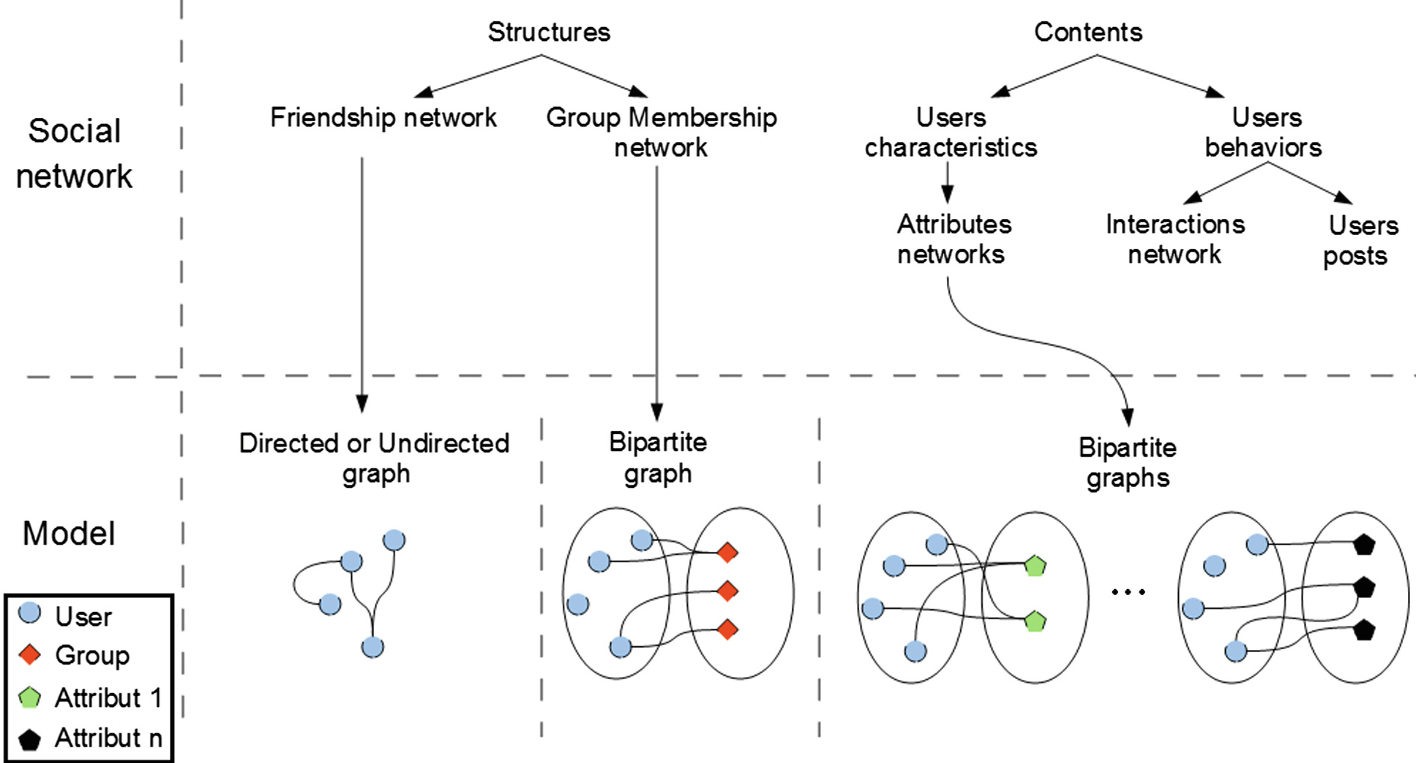
These walks are fed into a Word2Vec (Skip-gram) model. Just as Word2Vec learns that "King" and "Queen" are related, this model learns that certain users and certain secret attributes occupy the same "latent space."
Experiments: Real-World Facebook Data
The team tested their approach on a dataset of 15,012 Facebook profiles connected to over a million liked objects.
Key Findings:
- Accuracy: The model achieved an AUC of 0.68, significantly better than random guessing (0.5).
- Cross-Domain Leakage: The best results came from assigning weights to different attribute graphs (e.g., linking Travel Agencies with Politicians and Causes).
- Cosine Similarity > Euclidean Distance: The authors found that the direction of the vectors (context) was more important than their length (popularity) for determining hidden preferences.
Critical Insight: The "Why"
Why does this work so much better than traditional methods?
- Structural and Semantic Fusion: By combining friendship links and attribute links into a single embedding space, the model captures latent nuances that a single graph would miss.
- Handling Sparsity: Clustering "dense" interests allows the model to learn from aggregate patterns even when an individual user's profile is nearly empty.
Conclusion & Future Outlook
This work proves that "hiding" a specific attribute is not enough if your other public interactions are correlated with it. The authors suggest that the next step is building privacy-awareness tools that allow users to simulate these attacks on their own profiles before they become public.
Limitations: The model currently relies on high-quality clustering; if the initial clusters are "noisy," the subsequent NLP phase performance drops. Future research could explore end-to-end Graph Neural Networks (GNNs) to combine these two phases into a single differentiable step.