
Beyond Rules: Decoding Weibo Spammers via Two-Phase Behavioral and Topic Analysis
Two Phase Based Spammer Detection in Weibo
This paper presents a two-phase spammer detection framework for Weibo that combines traditional user behavioral analysis with advanced content mining. The approach utilizes an SVM classifier for feature-based detection and Latent Dirichlet Allocation (LDA) to identify semantic topic anomalies, effectively distinguishing sophisticated spammers from legitimate users.
TL;DR
The battle against social media spam has shifted from blocking simple bots to identifying human-like "Internet Water Army" accounts. This paper introduces a dual-layered approach for Sina Weibo: combining SVM-based behavioral classification with LDA-driven content mining. By analyzing not just how a user posts, but the latent topics they discuss, the system achieves an F-measure exceeding 99% in behavioral detection and successfully categorizes five distinct archetypes of modern spammers.
Problem & Motivation: The Rise of the "Human" Spammer
In the ecosystem of Sina Weibo, simple rule-based filters are no longer sufficient. Spammers have evolved into two difficult categories:
- Sophisticated Bots: Programs that mimic "personification" behaviors, such as reposting legitimate content to blend in.
- Internet Water Army: Paid human posters who manually manage accounts to spread rumors or hidden advertisements.
Existing research often focuses on either the Social Graph (who follows whom) or Surface Statistics (how many URLs are present). The authors argue that these are insufficient because a high-volume professional account (like a news outlet) might look like a spammer statistically, while a clever spammer might look like a normal user behaviorally. The "missing link" is the semantic intent of the content.
Methodology: The Two-Phase Defense
The authors propose a sequential verification pipeline to catch what single-layer filters miss.
Phase 1: SVM Behavioral Classification
The first layer uses a Support Vector Machine (SVM) with a Radial Basis Function (RBF) kernel. It examines 18 specific features, including:
- The Follower/Following Gap: Spammers often follow thousands but have few followers.
- Message Density: The average number of messages per day (spammers are often 3x more active).
- Interaction Ratios: The fraction of messages containing hashtags, mentions (@), or pictures.
Note: The feature vector captures the "Social Fingerprint" of the user.
Phase 2: LDA Content Mining & KL Divergence
The core innovation lies in the second phase. Even if a spammer mimics a human's posting frequency, their topics are usually narrow and promotional.
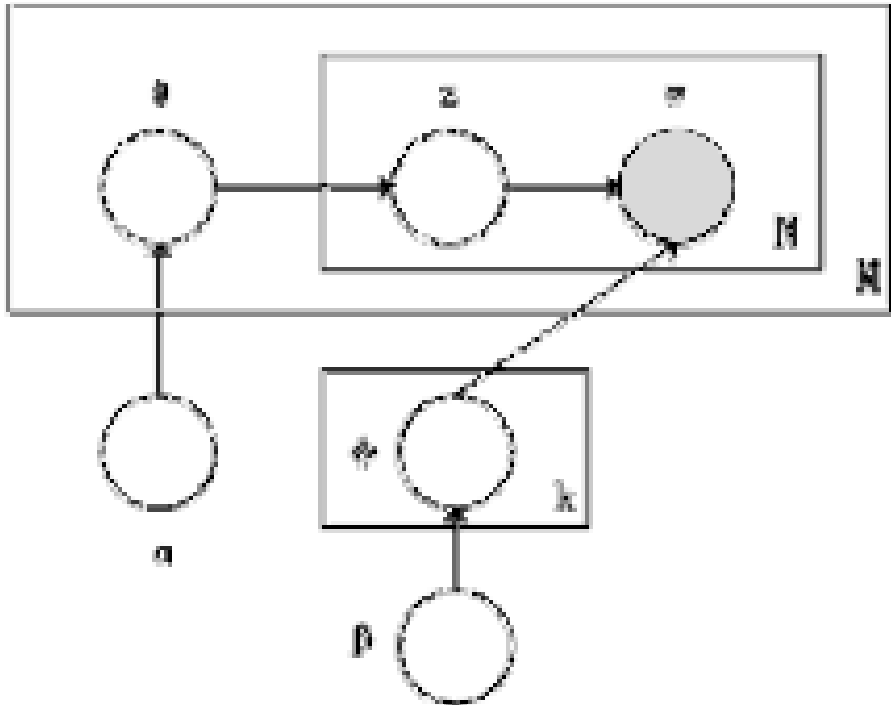
- LDA Modeling: The system treats a user's collective posts as a document and uses Latent Dirichlet Allocation to find the hidden "Topics" (e.g., advertising, weather, shopping).
- KL Divergence: The system calculates the "distance" between a user's topics and a known "Spam Feature Dictionary." If the topics align too closely with the spam dictionary (low KL divergence), the user is flagged.
The Taxonomy of Spammers
The research identifies Five Types of spammers that the system is designed to catch:
- Full Advertising: >90% ad content.
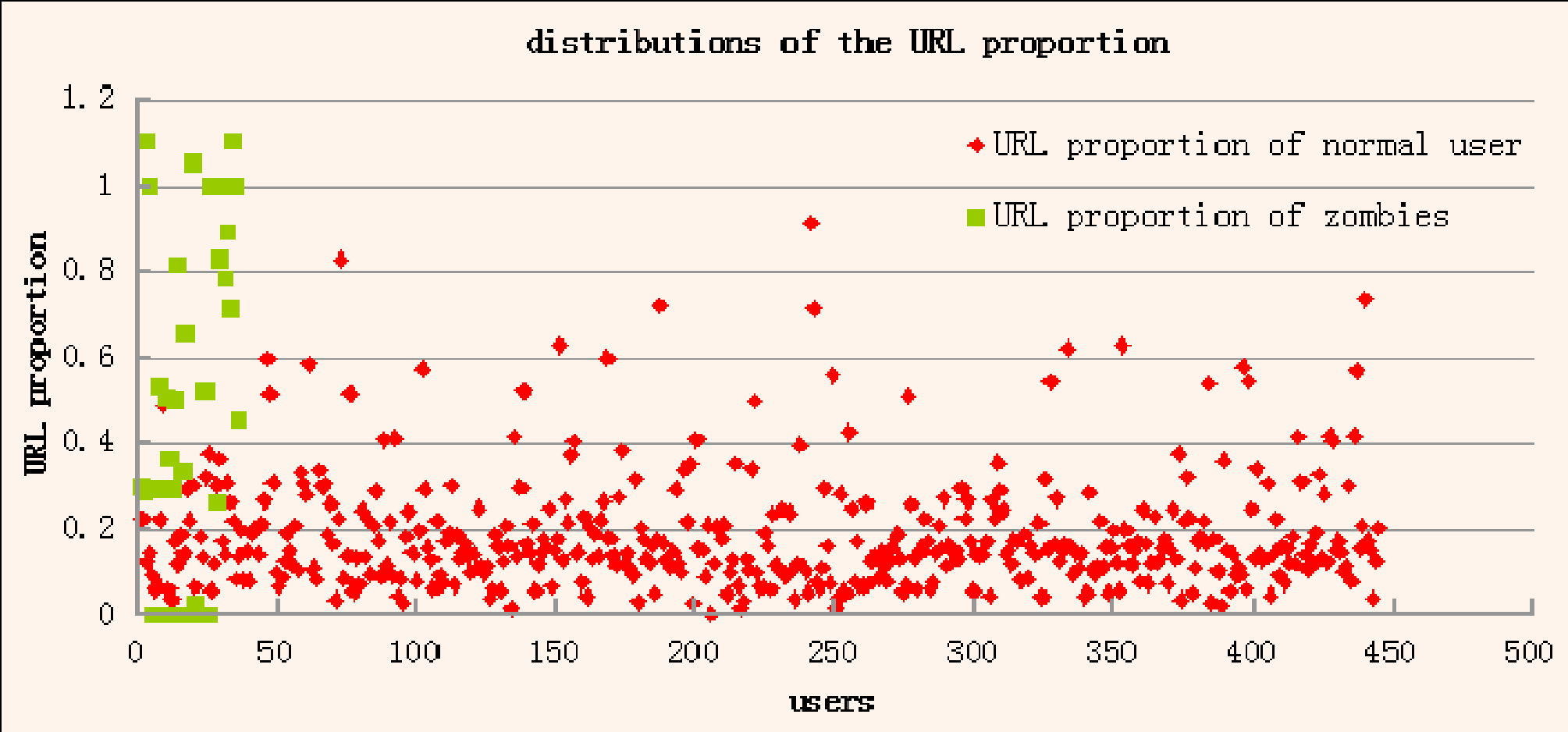
- URL Spammers: Obsessive link sharing (often multiple per post).
- Non-Personality: Accounts that only post about a single repetitive topic (e.g., just weather bots).
- Non-Original: Accounts that only repost, often leading to "Sorry, this post has been deleted" loops.
- Hybrid: A mix of the above, requiring relaxed thresholds to catch.
Experimental Results
The authors crawled a massive dataset from Weibo (364,586 posts from normal users vs. 16,553 from spammers).
SVM Performance
Compared to traditional classifiers like Naïve Bayes or Decision Trees, the SVM approach dominated with nearly perfect precision and recall.
| Classifier | Precision (Spammer/Normal) | F-measure |
|---|---|---|
| SVM | 0.995 / 0.991 | 0.992 |
| Decision Tree | 0.935 / 0.945 | 0.945 |
| Naïve Bayes | 0.933 / 0.942 | 0.942 |
Content Mining Insights
The LDA-based phase maintained an 87.18% Precision and 94.44% Recall. Interestingly, the authors performed a "failure analysis" on why some normal users were flagged as spammers.
- Case study: A famous actor (liuyuxinyoyo) was flagged because she deleted most of her posts due to negative news, leaving a small, "atypical" document for the LDA to analyze.
- Case study: A songwriter (linxi) used many URLs for a legitimate "Micro-interview," mimicking a URL spammer's profile.
Critical Analysis & Conclusion
This work successfully demonstrates that semantic topic analysis is a vital "Phase 2" for modern social network security. While behavioral features catch the "robots," LDA catches the "intent."
Takeaway: Spammer detection is no longer just about quantifying activity but qualifying it. However, the study shows that low post volumes (small sample size) still pose a significant challenge for topic models like LDA, leading to potential false positives for celebrities or irregular users. Future work likely needs to incorporate "contextual" metadata (like the actual destination of shortened URLs) to further reduce these errors.