
Locating the Viral Epicenter: A Two-Stage Strategy for Large-Scale Social Networks
A two-stage algorithm to estimate the source of information diffusion in social media networks
2014-04-01
Summary
Problem
Method
Results
Takeaways
Abstract
The paper introduces a Two-stage Maximum-Likelihood (ML) source localization algorithm designed for large-scale social networks. By leveraging the highly clustered topography of real-world networks, it identifies a candidate cluster first and then pinpoints the specific information source, outperforming traditional single-stage methods.
## TL;DR
Detecting the origin of a rumor or a viral marketing campaign in a network of millions is like finding a needle in a haystack. This paper presents a **Two-stage Maximum-Likelihood (ML) algorithm** that cuts down the required number of "sensor" nodes by approximately 3% compared to existing methods while maintaining high accuracy. The secret lies in treating the network not as a flat entity, but as a collection of dense communities.
## The Problem: The High Cost of "Watching"
In modern social media, identifying where a piece of information (or misinformation) started is critical for both security and marketing. However, existing source localization techniques face a scalability wall:
1. **Global Observation is Impossible**: You cannot monitor every user's private activity or status due to privacy and computational overhead.
2. **Sensor Overhead**: Previous state-of-the-art methods required about 20% of the network to act as "sensors" (nodes that report arrival times). For Twitter's 40M+ users, that would mean 8 million volunteers—an impossible task.
## The Insight: Modular Topography
The authors observe that social networks are **highly clustered**. People form tight-knit communities with strong ties, connected by sparse "gateway" nodes.
Instead of searching the whole network at once, the authors propose a "Zoom-in" strategy:
1. **Stage 1 (Coarse Search)**: Identify which cluster likely contains the source by monitoring "Gateway Nodes."
2. **Stage 2 (Fine Search)**: Once the cluster is identified, focus all sensor capacity within that cluster to find the exact node.
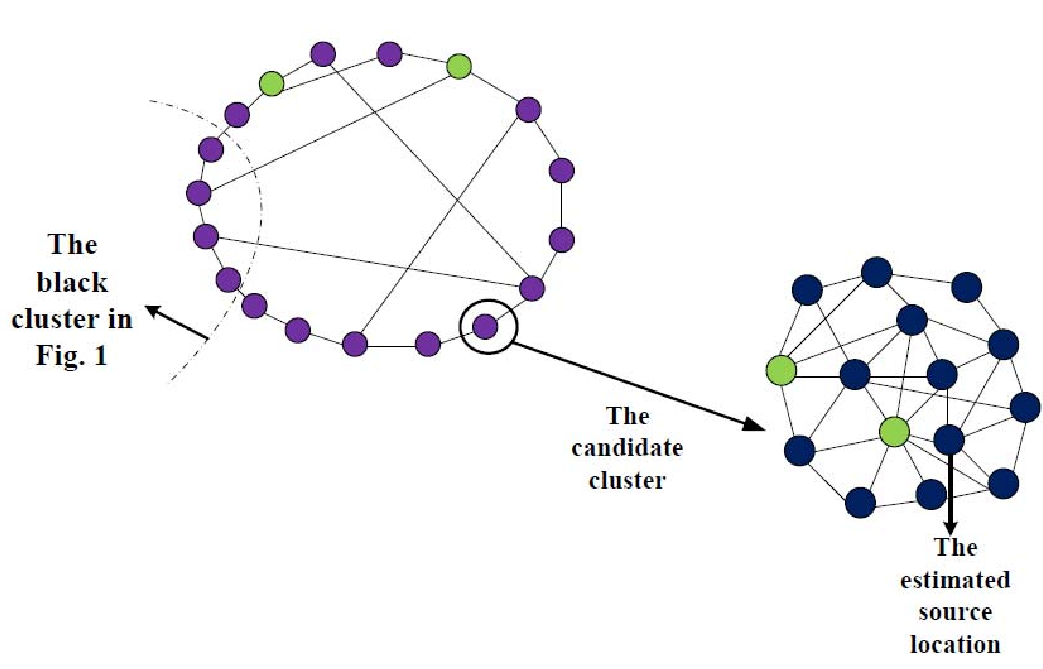
*Fig 1. The Two-stage process: The left shows gateway nodes identifying the cluster; the right shows localized search within the candidate cluster.*
## Methodology: Math Behind the Search
The algorithm assumes information spreads via the **Susceptible-Infected (SI)** model. The time delay for information to pass between nodes is modeled as a Gaussian distribution $N(\mu, \sigma^2)$.
The core is a **Maximum Likelihood Estimator (MLE)**. Since we don't know exactly *when* a rumor started ($t^*$), the algorithm uses the **Time Difference of Arrival (TDOA)** between pairs of sensors. This forms a multivariate Gaussian distribution:
$$ \hat{s} = \max_{s \in \mathcal{V}} f(\mathbf{D} | s) $$
Where $\mathbf{D}$ is the vector of arrival time differences. By maximizing this likelihood, the system finds the most probable source $s$.
## Experiments & SOTA Comparison
The researchers tested their algorithm on both synthetic modular networks and real-world Twitter snapshots.
**Key Findings:**
* **Efficiency**: To achieve an 80%+ detection rate, the new algorithm required only **2% of the nodes** to be sensors, compared to 5% for the best single-stage algorithms (a 60% relative reduction in sensor nodes).
* **Heterogeneity is a Plus**: Interestingly, the algorithm performs *better* when the network is heterogeneous (i.e., when different edges have different transmission speeds). This is because the unique "time signatures" of paths become more distinguishable.
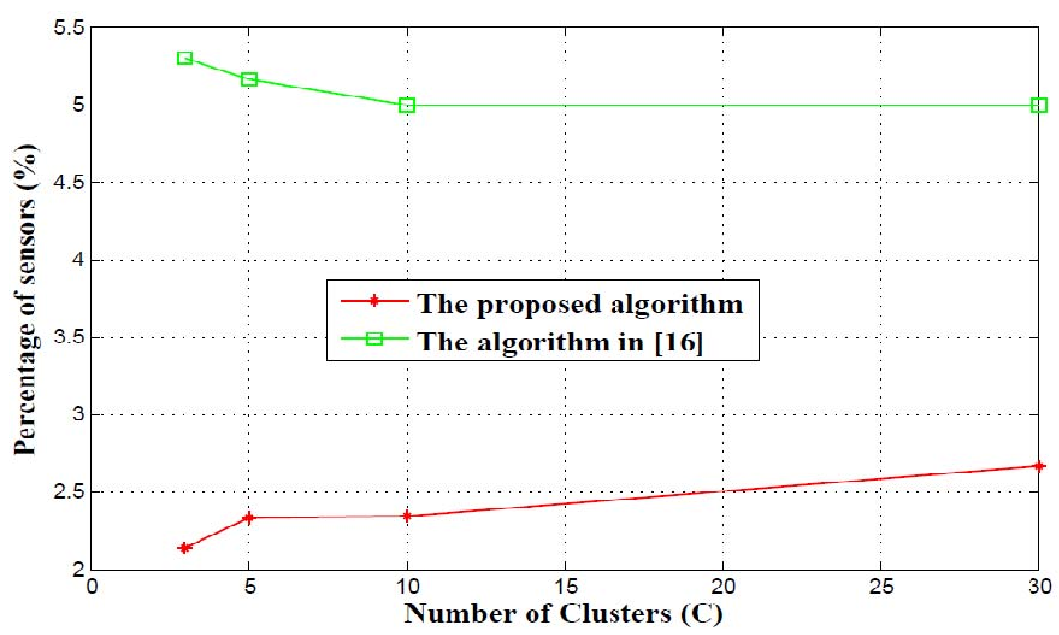
*Fig 2. The proposed two-stage algorithm (blue) achieves target accuracy with significantly fewer sensors than the single-stage alternative (red).*
## Critical Analysis & Future Outlook
The beauty of this work is its **Inductive Bias** toward community structures. By aligning the algorithm's architecture with the physical reality of social clusters, the authors achieved a major gain in efficiency.
**Limitations**:
* **Shortest Path Assumption**: The model assumes information travels only along shortest paths. In reality, info might reach a node through multiple "noise" paths.
* **Static Topography**: The algorithm assumes the network structure $G$ is known and static, which might not hold for rapidly evolving viral events.
**Future Work**: This framework could potentially be extended to **multi-source localization** (e.g., coordinated disinformation campaigns) or applied to **epidemiology** for tracking patient zero in disease outbreaks within urban clusters.
## Conclusion
By moving from a "Global Search" to a "Locate-then-Search" paradigm, this paper provides a practical roadmap for managing information integrity in the era of massive social data.