
Seed-and-Grow: Unmasking Anonymized Social Networks through Structural Fingerprinting
A Two-stage Deanonymization Attack Against Anonymized Social Networks
The paper introduces "Seed-and-Grow," a novel two-stage deanonymization attack framework designed to identify users in anonymized social networks using only graph structural data. It leverages a robust "fingerprint" seed construction and a self-reinforcing "grow" algorithm to map nodes between a target anonymized graph and an attacker's background knowledge graph.
TL;DR
In the era of big data, "anonymizing" social networks by simply removing names isn't enough. This paper presents Seed-and-Grow, a powerful two-stage attack that uses graph structure to re-identify users. By planting a small "fingerprint" of accounts and then "growing" that knowledge using background data from other platforms, the authors show they can unmask thousands of users with high precision and minimal prior knowledge.
Problem & Motivation: The Illusion of Anonymity
When social media companies share data with researchers or advertisers, they typically perform "naive anonymization"—stripping away PII (Personally Identifiable Information) while keeping the web of connections intact.
The authors argue that this is fundamentally flawed. Modern users typically belong to multiple networks (Facebook, Twitter, LinkedIn), creating an "overlapping user-base." If an attacker knows your connections on one public platform, they can use that structural pattern as a "key" to unlock your identity on an anonymized dataset from another platform. Existing attacks either lacked accuracy or required the attacker to have impossible levels of control over victims.
Methodology: The Two-Stage Attack
1. The Seed Stage: Planting the Fingerprint
The attacker's first goal is to establish a "foothold" in the anonymized graph.
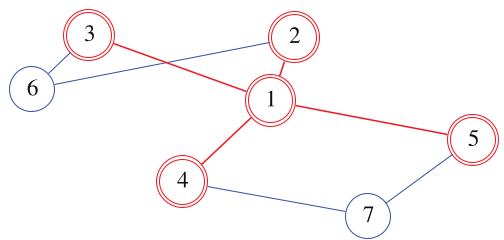
- Construction: The attacker creates a small group of accounts (a "fingerprint" graph, ) with a unique internal structure. Unlike previous methods, this construction is stochastic (randomized) so it blends into the natural "local community" patterns of the network, making it harder for defenders to detect.
- Recovery: Once the anonymized data is released, the attacker looks for this specific structural signature. Because the internal degree sequences are unique to the attacker’s secret design, they can find their planted nodes with near-certainty.
2. The Grow Stage: The Self-Reinforcing Ripple
After identifying the initial "seeds," the algorithm expands. It looks at the neighbors of known nodes and tries to match them with nodes in the attacker's background graph ().
- Dual Dissimilarity Metrics: Instead of a single score, the authors use two asymmetric metrics ( and ) to ensure that a match is the "best" choice for both the target and the background graph.
- Eccentricity & Revisiting: To avoid errors, the algorithm checks how much a potential match "stands out" from its peers (Eccentricity). Crucially, the Revisiting mechanism allows the algorithm to go back and correct earlier mistakes as more of the graph is revealed, preventing error propagation.
Experiments & Results: Precision at Scale
The authors tested their attack on the Livejournal dataset (5.2M nodes) and emailWeek data.
Key Findings:
- Effectiveness: From just 5 initial seeds, the algorithm accurately identified dozens of additional users, far outperforming the "conservative" versions of prior SOTA methods.
- Accuracy: In high-noise environments (where edge connections are perturbed by 0.5%), Seed-and-Grow maintained over 80% confidence, while previous methods dropped below 65% or failed to identify any new nodes.
- Seed Flexibility: The algorithm proved that the "interaction budget" (how many victims an attacker must link to) is the only real bottleneck, yet Seed-and-Grow minimizes this requirement through its efficient growth logic.

Critical Analysis & Conclusion
The Seed-and-Grow framework is a wake-up call for data privacy. Its primary contribution is the shift from "brute-force" structural matching to a more nuanced, heuristic approach that handles the inherent "noise" and "evolution" of social networks.
Takeaways:
- Privacy is not Parity: Removing labels is not enough when our social circles act as unique biometric identifiers.
- The Power of Revisiting: The inclusion of a feedback loop (revisiting) to correct initial mapping errors is what makes this attack robust enough for real-world application.
- Limitation: The attack still requires a small number of initial seeds. Future defense research should focus on identifying these "fingerprint" subgraphs before data is published.
In conclusion, as social networks become more integrated, the "structural traces" we leave behind become increasingly dangerous. Seed-and-Grow proves that with a little bit of math and a small foothold, an anonymous graph can be made to speak.