
TPDM: Maximizing Social Network Profits via Two-Stage Pricing and Strategic Discounts
Two-stage pricing strategy with price discount in online social networks
The paper proposes the Two-stage Pricing Discount Model (TPDM), a novel marketing framework for Online Social Networks (OSNs) that integrates product pricing with influence diffusion. Utilizing the Two-stage Discount Greedy (TSDG) algorithm, it optimizes profits by transitioning from a regular price stage to a discount stage, achieving over 20% profit increase compared to traditional benchmarks.
TL;DR
While classic "Viral Marketing" focuses on getting a message to as many people as possible, it often ignores a critical business reality: the price tag. This paper introduces the Two-stage Pricing Discount Model (TPDM), which recognizes that users have different price thresholds. By intelligently moving from an original price phase to a discount phase and selecting "seed" users more efficiently, the authors demonstrate a profit boost of over 20% on platforms like Amazon and Epinions.
Problem & Motivation: The Gap Between Influence and Income
In the world of Online Social Networks (OSNs), the standard goal has been Influence Maximization (IM)—finding the most "influential" people to start a trend. However, from a PhD-level economic perspective, influence does not equal profit. A user might be "influenced" (aware of the product) but refuse to "adopt" it because the price exceeds their internal valuation.
Existing models like the Independent Cascade (IC) or Linear Threshold (LT) often treat adoption as a binary state triggered by social pressure. This paper argues that User Valuation (Expected Price) is the missing link. Furthermore, static pricing is inefficient; it leaves money on the table from high-valuation users and ignores price-sensitive users who could be converted via discounts.
Methodology: The TPDM Framework
The authors propose a two-stage approach that mirrors real-world product lifecycles (e.g., clothing or electronics):
- Stage 1: Regular Price Period: The company sets an optimal approximate price (P). Users are reached via Advertising (AM) or Word-of-Mouth (WM). If , the user adopts the product and becomes an "Active" spreader.
- Stage 2: Discount Price Period: For users who were "Influenced" but found the price too high, the company introduces a discount . The new price triggers a second wave of activations and further social spreading.
The TSDG Algorithm
To solve this, the authors developed the Two-stage Discount Greedy (TSDG) algorithm. Its brilliance lies in its efficiency—it leverages the mathematical property of submodularity.
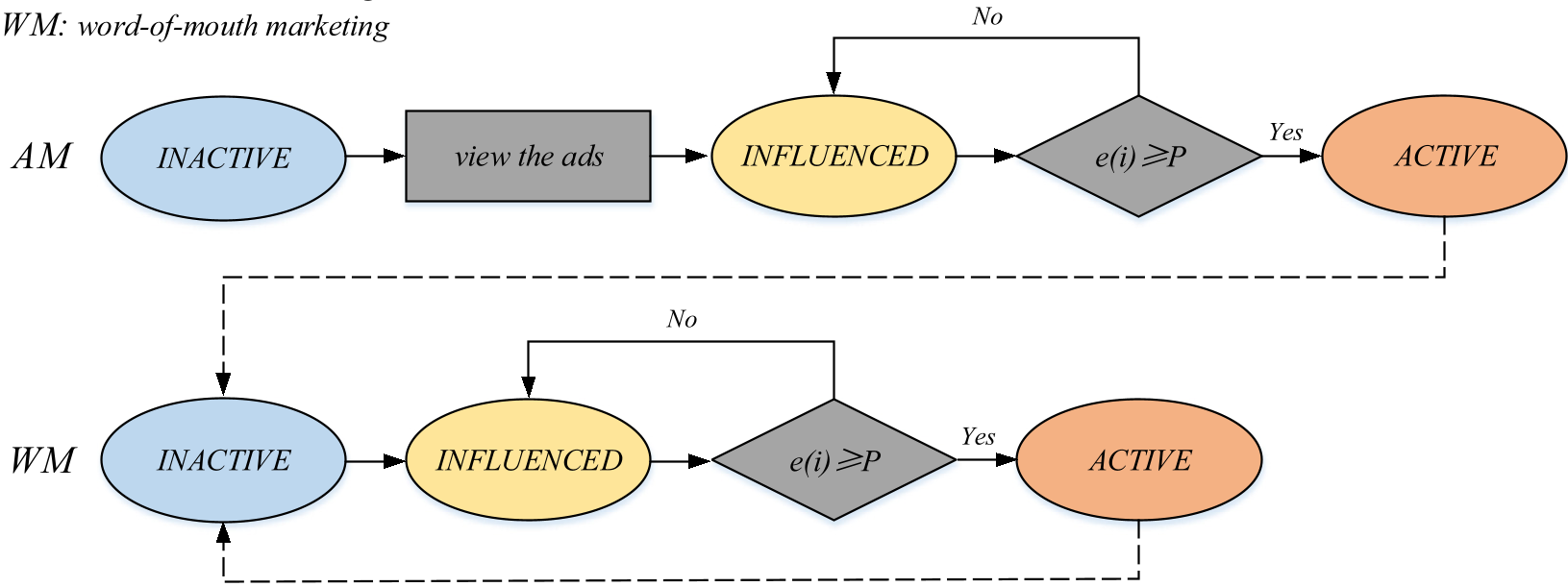
Fig 1: The diffusion process showing nodes moving from Inactive to Influenced, and finally Active based on the price threshold.
The algorithm performs "Pruning": it calculates the maximum marginal profit of nodes and immediately discards those that would cause a net loss, drastically reducing the search space compared to traditional greedy scripts.
Experiments & Results: Quantitative Superiority
The researchers tested TSDG against two industry standards:
- All-OMP: A single-price strategy.
- FFS (Free for Seeds): Giving the product away for free to influencers but charging everyone else a fixed price.
Performance Comparison
On the Amazon dataset (262K nodes, 1235K edges), TSDG achieved the highest profit across all cost () and expected price () distributions.
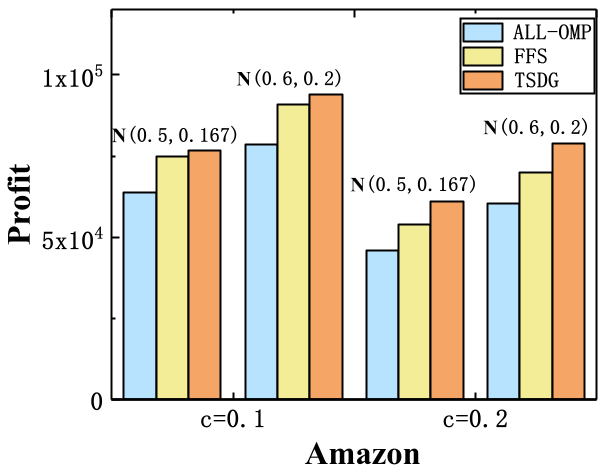 Fig 2: Profit comparison across different datasets. Blue bars (TSDG) consistently outperform the fixed-price (All-OMP) and seed-gift (FFS) strategies.
Efficiency Gains
Notably, TSDG is not just more profitable; it's faster. By pruning nodes with negative marginal gains, the running time on the P2P dataset was reduced to 1.85s, compared to 6.61s for the FFS algorithm.
Critical Analysis & Conclusion
Takeaway
The core insight is that temporal price discrimination (discounts over time) is more effective in social networks than user-based price discrimination (giving it free to some, expensive to others). The latter often causes "negative reactions" from buyers, whereas a timed discount is a standard, accepted market behavior.
Limitations & Future Work
- Monopoly Assumption: The model assumes a "single product, single oligarch" environment. In reality, competitors would react to a price discount.
- Deterministic Expected Price: While modeled as a normal distribution here, real-world valuations are dynamic and influenced by the number of friends already using the product.
In conclusion, the TPDM model offers a robust mathematical bridge between social network topology and classical price theory, providing a scalable blueprint for modern OSN marketing campaigns.