
TPDM: Bridging the Gap Between Influence and Profit in Viral Marketing
Two-stage pricing strategy with price discount in online social networks
2021-06-08
Summary
Problem
Method
Results
Takeaways
Abstract
The paper introduces the Two-stage Pricing with Discount Model (TPDM), a novel framework for maximizing profits in Online Social Networks (OSNs) by combining Advertisement Marketing (AM) and Word-of-mouth Marketing (WM). It leverages a Two-stage with Discount Greedy (TSDG) algorithm to optimize product pricing, discount rates, and the selection of influential seed nodes.
## TL;DR
While AI and social network research have long mastered *Influence Maximization*—the art of making things go viral—they often ignore the bottom line: **Profit**. This paper introduces the **Two-stage Pricing with Discount Model (TPDM)** and the **TSDG algorithm**, which optimize not just who to target, but at what price and when to offer discounts to maximize total revenue.
## The Motivation: Why "Viral" Isn't Enough
Most viral marketing research treats "influence" as a binary state—either you are influenced or you aren't. In the real world, a user might know about a product (Influenced) but refuse to buy it because the price exceeds their **Expected Price**.
Existing SOTA methods like "Influence and Exploit" (IE) often give products away for free to seeds. However, this creates price discrimination issues. The authors argue that a structured, two-stage approach (Regular Price followed by a Discount) aligns better with real-world retail cycles and consumer psychology.
## Methodology: TPDM and the TSDG Algorithm
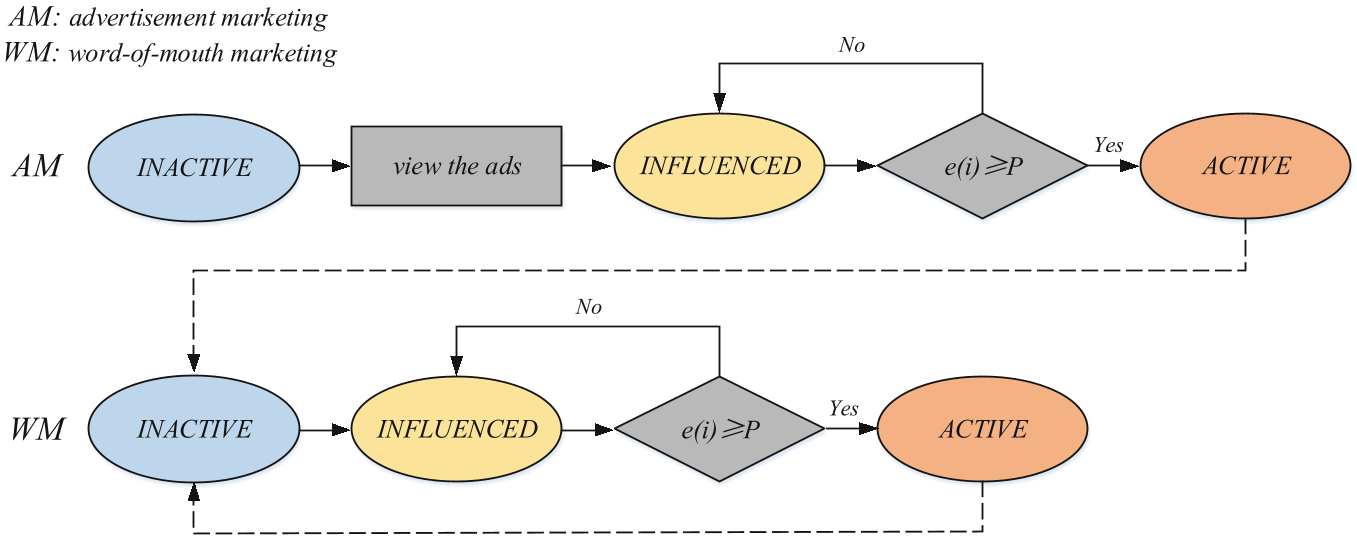
The TPDM model introduces a sophisticated state-machine for users in a network $G(V, E)$:
1. **INACTIVE**: Users unaware of the product.
2. **INFLUENCED**: Users aware (via Ads or Friends) but the price $P > e(i)$ (Expected Price).
3. **ACTIVE**: Users who adopted the product ($P \le e(i)$) and are now spreading the word.
### The Two-Stage Logic
* **Stage 1 (Regular Price)**: The company targets seeds and runs ads ($AM$). Users adopt if the regular price $P$ is acceptable.
* **Stage 2 (Discount Stage)**: The price drops to $P imes d$. This triggers a secondary wave of adoptions from users who were "stuck" in the INFLUENCED state during Stage 1.
### TSDG Algorithm
The **Two-stage with Discount Greedy (TSDG)** algorithm addresses the NP-hard nature of seed selection. It filters nodes by calculating "marginal profit" rather than just "marginal influence," ensuring that every seed selected adds more to the revenue than it costs in incentives.
## Experimental Insights
The authors tested their model on datasets like **Amazon (262K nodes)** and **Epinions (76K nodes)**.
### Key Findings:
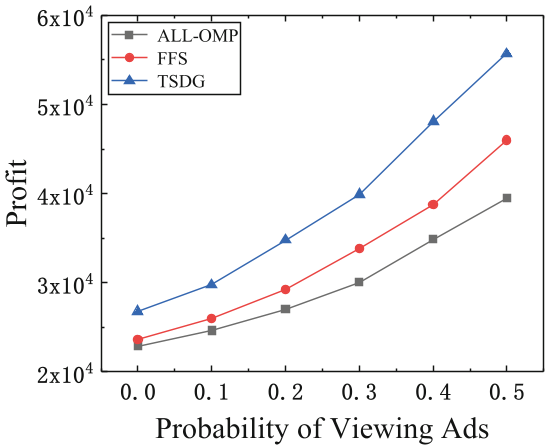
1. **Advertising is a Force Multiplier**: Even small increases in the probability of viewing ads ($q$) lead to non-linear profit growth.
2. **Superiority over OMP**: By allowing for a discount stage, TSDG recaptures market share that "Optimal Myopic Price" strategies lose by being too rigid.
## Critical Analysis & Takeaways
The core strength of this work lies in its **economic realism**. By acknowledging that propagation probability $p(i)$ is a function of the "price gap" ($e(i) - P$), it creates a feedback loop between the marketing department and the social graph.
**Limitations**: The model assumes users' expected prices are static and follow a normal distribution. In reality, expected prices are often anchored by social proof—if a user sees many friends buying a product, their own valuation might increase. Future work could incorporate this "socially augmented valuation."
**Industry Impact**: For OSN platforms and e-commerce companies, this research provides a blueprint for timing promotional campaigns and calculating the ROI of influencer seeding alongside traditional ad spend.