
From Spaghetti to Structure: A Two-Step Strategy for Educational Process Discovery
A Two-Step Clustering Approach for Improving Educational Process Model Discovery
This paper introduces a two-step clustering approach for Educational Process Mining (EPM) to simplify complex "spaghetti" process models. By combining performance-based indicators with structural trace similarity via the AXOR algorithm, it successfully discovers highly representative and comprehensible process models from heterogeneous educational event logs.
Executive Summary
TL;DR: Educational data is notoriously "messy," often resulting in process models that look more like a bowl of tangled noodles than a clear curriculum map. This paper presents a hybrid clustering framework that first segments learners by their career outcomes (employability) and then by their behavioral patterns (AXOR clustering). The result is a set of modular, high-fitness process models that instructors can actually use to optimize training.
Positioning: This work moves beyond purely algorithmic process mining by injecting domain-specific value (employability) into the pre-processing phase, effectively bridging the gap between Business Process Management (BPM) and Learning Analytics.
The "Spaghetti" Problem in Education
In modern e-learning, students have immense freedom. This flexibility is a nightmare for process mining. When you feed thousands of diverse student paths into a standard algorithm like the Heuristic Miner, the output is frequently a Spaghetti Model: a dense web of nodes and edges that obscures any meaningful pedagogical insight.
The root cause is heterogeneity. Treating a "high-performer" who finds a job in 10 days the same as a "struggling learner" leads to a generalized model that represents no one accurately.
Methodology: The Two-Step Refinement
The authors argue that to fix the model, we must first fix the data organization. Their methodology follows a top-down refinement:
Step 1: Performance-Based Partitioning
Instead of looking at the process first, the authors look at the outcome. They use K-means clustering based on:
- Employability Factor: A matching score between skills acquired in training and skills required by subsequent job missions.
- Unemployment Duration: The time gap between training completion and the next job placement.
This splits the log into three distinct populations: high performers, average learners, and low performers.
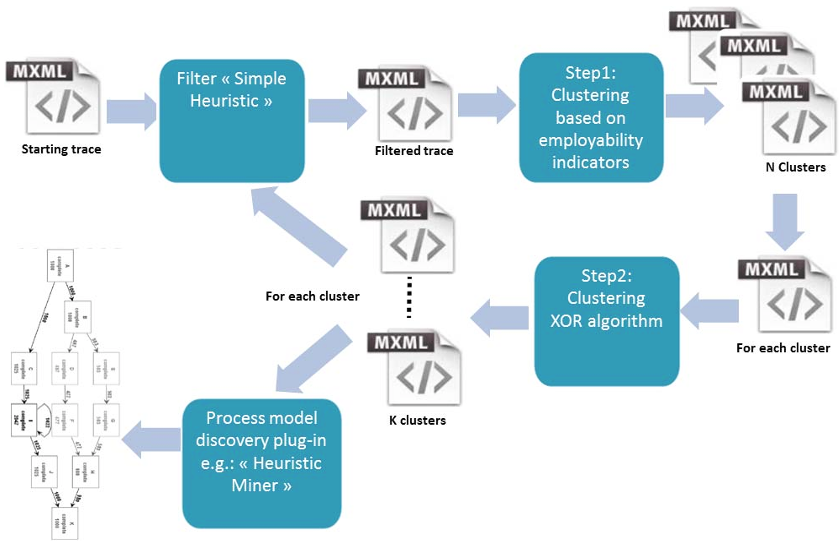
Step 2: Structural Refinement via AXOR
Once partitioned by outcome, each cluster is still somewhat noisy. The AXOR algorithm is applied to group students who took similar routes to those outcomes.
- Activity Profiles: Traces are converted into binary vectors (1 if activity exists, 0 otherwise).
- XOR Distance: The Hamming distance between these vectors identifies "behavioral twins."
Experiments and Visual Evidence
The approach was tested on a massive dataset from a global consulting firm (3,440 employees, 16,000+ training courses).
The transition is striking. In the original "high-performing" cluster, the model was still complex. After the second step of AXOR clustering, the models became linear and highly interpretable.
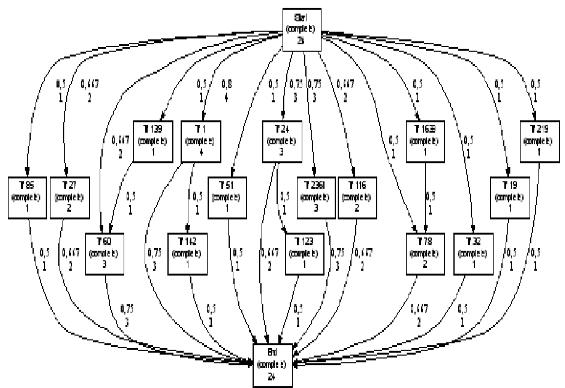 Figure: Simplified sub-clusters (2.1 and 2.2) derived from the high-performance group.
Results at a Glance:
| Metric | Before Two-Step | After Two-Step |
|---|---|---|
| Fitness | Varies (Low for complex groups) | 0.92 - 1.0 (Near Perfect) |
| Comprehensibility | Low (Spaghetti) | High (Fragmented & Clear) |
Critical Insight & Conclusion
Takeaway
The genius of this work lies in its hierarchical filtering. By using "employability" as a first-order filter, the authors ensure that the resulting process models aren't just statistically accurate, but vocationally relevant. It proves that in Educational Process Mining, the "What" (outcome) must precede the "How" (behavior).
Limitations & Future Work
While the AXOR algorithm is efficient, it uses a binary "Presence/Absence" logic for activities. It ignores the order and frequency of tasks. Future research should look into incorporating Sequence Alignment or Temporal Logic to capture the nuances of the learning journey even more deeply.
For educators, this research provides a blueprint for turning raw log data into a "GPS for Learning"—one that shows the most efficient paths to career success.