
Two-Stream CNN: Unmasking the Fingerprints of Social Networks in Digital Forensics
Two-stream Convolutional Neural Network for Image Source Social Network Identification
The paper introduces a novel two-stream Convolutional Neural Network (CNN) architecture designed to identify the source social network (Facebook, Flickr, or Twitter) of an image by analyzing artifacts left by platform-specific processing. It achieves state-of-the-art results, reaching up to 98% average classification accuracy across multiple datasets by fusing DCT-block encoding and Noiseprint-based noise residual features.
TL;DR
In the world of digital forensics, every social media platform leaves a hidden "fingerprint" on the images you upload. This paper proposes a high-precision Two-Stream Convolutional Neural Network that looks at both JPEG compression artifacts (DCT domain) and sensor-related noise patterns (PRNU domain) to identify whether an image came from Facebook, Twitter, or Flickr. By combining these two worlds, the researchers achieved a staggering 98% identification accuracy.
Background: The Digital "Paper Trail"
When you upload a photo to Instagram or WhatsApp, the platform doesn't just store it. It resizes, re-compresses, and optimizes the image to save space. These processes—while invisible to the human eye—distort the underlying mathematical distribution of the image data. Unlike metadata (which can be stripped), these artifacts are baked into the pixels. This paper moves the needle from "blind" identification to "expert" forensic analysis.
The Core Motivation: Why Single-Stream Isn't Enough
Previous methods usually focused on either the DCT (Discrete Cosine Transform) coefficients or PRNU (Photo Response Non-Uniformity).
- The Problem with DCT: Standard histograms often lose info on high-value coefficients.
- The Problem with PRNU: Extracting clean sensor noise typically requires many images from the same camera, which is a luxury forensic investigators rarely have.
The authors' insight? By fusing a compactly encoded DCT stream with a Noiseprint-enhanced noise stream, the model can identify the social network even when the image content is complex or the dataset is heavily unbalanced.
Methodology: A Tale of Two Streams
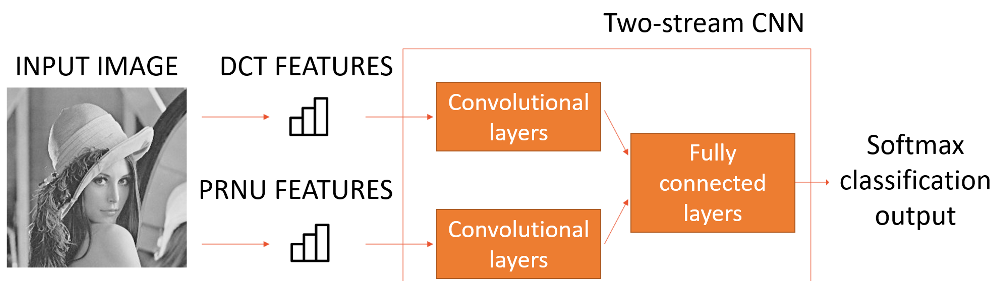
The architecture (shown below) splits the task into two specialized neural pathways.
1. The DCT Stream: Smarter Encoding
Instead of raw coefficients, the authors use a normalization formula: This focuses on the residual left after quantization. They test quantization factors (q) from 1 to 20, creating a robust 1980-value feature vector that makes the platform's specific JPEG "recipe" stand out to the CNN.
2. The Noise Stream: Leveraging "Noiseprint"
Rather than traditional denoising filters, they use Noiseprint, a SOTA pre-trained CNN that isolates camera-model fingerprints. This allows the network to see how the social network's processing has "smudged" the sensor's unique signature, even from a single image patch.
Experimental Results: SOTA Performance
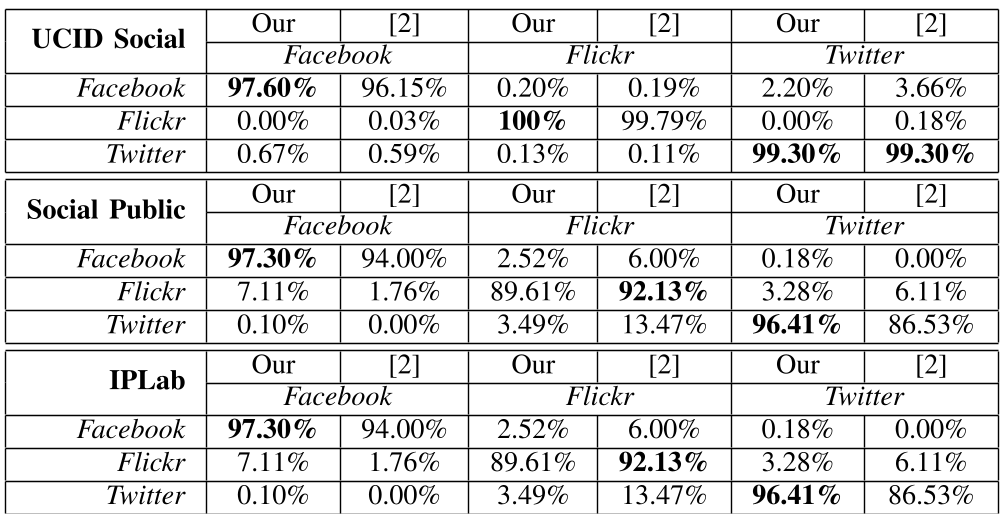
The model was tested against three major datasets: UCID Social, Social Public, and IPLab.
Patch-Level Dominance
In direct comparison with previous residual noise methods (Caldelli et al., 2018), the Two-Stream approach showed a massive leap in precision:
| Platform | Previous Work (Residual) | Two-Stream (Our) |
|---|---|---|
| 72.80% | 99.32% | |
| 72.49% | 97.83% |
Solving the "Unbalanced Dataset" Trap
A major contribution of this paper is the handling of unbalanced data. Because some sites resize images more aggressively, the number of available "patches" for training varies wildly between classes. The authors introduced Sample Weighting, which ensures every image has an equal "vote" in the training process regardless of its size. This technique alone boosted recall by up to 6% on uncontrolled datasets.
Critical Insight & Conclusion
This research proves that image forensics is moving toward multi-modal fusion. By looking at both the frequency domain (DCT) and the spatial noise domain (PRNU), the Two-Stream CNN creates a more holistic "biometric" for social media platforms.
Takeaway for the Industry: As cyber-crimes and misinformation spread via social media, these "blind" identification tools become essential. The next step for this tech? Multi-hop identification—tracing an image that was uploaded to Facebook and then shared on Twitter.
Limitations: While accurate, the model currently focuses on three major SNs. Expanding this to the dozens of smaller platforms and messaging apps (Telegram, Signal) remains a hurdle for future scalability.