
Not All Followers Are Created Equal: Decoding the Two Tribes of Twitter Celebrity
1565_Two types of Twitter users with equally many followers.
This study characterizes two distinct profiles of popular Twitter users by analyzing the relationship between followers and friends. It identifies "Type 1" (highly followed, low following) and "Type 2" (reciprocal following) users, revealing that the second group relies heavily on link reciprocity to maintain their popularity metrics.
TL;DR
Is a user with 10,000 followers truly influential? According to this research from the University of Tokyo, the answer depends on their "Friends" count. The study identifies two distinct species of popular users: Type 1 (Broadcast Influencers) and Type 2 (Reciprocal Networkers). While Type 1 users are the traditional celebrities we imagine, Type 2 users maintain their status through a strict "follow-back" culture, making their popularity a metric of social labor rather than natural reach.
The Problem: The Deception of the Follower Count
In the economy of social attention, the Follower Count is the primary currency. However, this currency is prone to inflation. Previous work has pointed out the "Million Follower Fallacy"—the idea that having a massive audience doesn't necessarily mean you have the power to influence their behavior or spread information.
The researchers noticed a strange phenomenon in certain datasets: a massive concentration of users who have almost exactly the same number of followers as the people they are following. If Twitter is a broadcast medium, why are so many people engaging in this symmetrical "tit-for-tat" behavior?
Methodology: Categorizing Social Behavior
The authors sampled over 1.5 million users across seven languages. To separate the "Icons" from the "Networkers," they defined two types:
- Type 1 (The Star): 2,500–7,500 followers, but follows fewer than 500 people. These are content creators or celebrities who others want to listen to.
- Type 2 (The Reciprocator): Follows almost exactly as many people as they have followers (kin ≈ kout).
They used a metric called Local Link Reciprocity to prove that Type 2 users aren't just "accidentally" followed; they are actively following back to keep their numbers high.
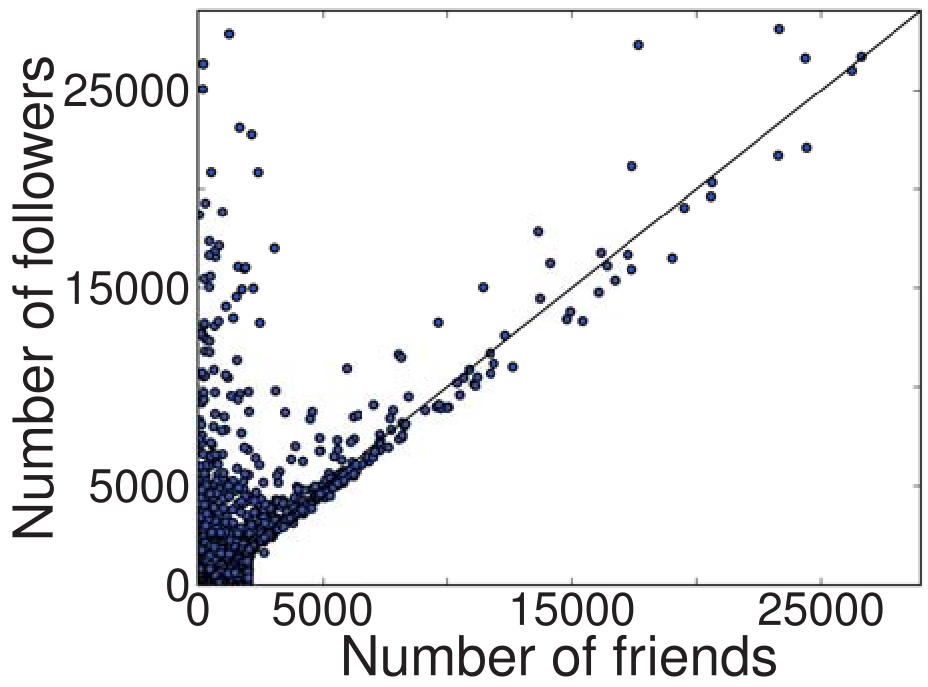 The "Identity Line": Notice the dense concentration of users exactly on the diagonal, representing Type 2 users who follow back everyone.
Key Insights: Cultural Differences in Influence
The most fascinating finding was that this behavior isn't universal—it's highly cultural.
- High Reciprocity Groups: Japanese, Russian, and Korean Twitter users showed a very high density of Type 2 users.
- Broadcasting Groups: Spanish, Portuguese, and French groups leaned more toward Type 1 (Celebrity-style) dynamics.
- The Middle Ground: English-speaking Twitter fell somewhere in between.
The researchers found that for Type 2 users, their "reciprocity" score was significantly higher. They don't have followers because their content is viral; they have followers because they promised a follow-back.
Experimental Evidence
By measuring the ratio (the minimum of in-degree and out-degree over the maximum), the study quantified how "balanced" a user's network is.
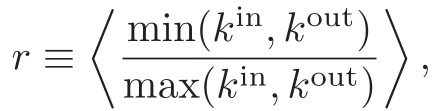
When this ratio and the density are high, it indicates a network built on mutual obligation rather than asymmetrical interest. In Japanese and Korean datasets, the correlation was striking, suggesting that "social etiquette" (the pressure to follow back) plays a massive role in net growth.
Critical Analysis & Conclusion
Takeaway
The number of people a user follows is just as important as the number of followers when assessing their true importance. If you want to find a real "Influencer," look for the gap between these two numbers.
Limitations
While the authors mention that bots and spammers might be included in Type 2, they argue the percentage is low. However, in the modern era of AI-driven bot farms, the line between an "etiquette-driven human" and a "reciprocal bot" has become even thinner than it was in 2013.
Future Outlook
This paper serves as a foundational warning for social media analytics: Contextualize the metrics. For platforms like LinkedIn or X today, understanding whether a user's growth is "Type 1" (organic) or "Type 2" (reciprocal) remains the key to identifying genuine social capital.