
Type-2 Fuzzy Envelopes: Modeling the Inherent Uncertainty of Human Language
Type-2 Fuzzy Envelope of Hesitant Fuzzy Linguistic Term Set: A New Representation Model of Comparative Linguistic Expression
This paper introduces a novel Type-2 Fuzzy Envelope for Hesitant Fuzzy Linguistic Term Sets (HFLTS) to represent Comparative Linguistic Expressions (CLEs). The method leverages Interval Type-2 Fuzzy Sets (IT2 FSs) to capture the inherent vagueness and uncertainty of human language in decision-making contexts.
TL;DR
In the realm of decision-making, humans often prefer expressions like "at least good" or "between bad and medium" over single numbers. While Hesitant Fuzzy Linguistic Term Sets (HFLTS) were designed to capture this, they often overlook a critical reality: words are inherently subjective. This paper introduces a Type-2 Fuzzy Envelope that uses Interval Type-2 Fuzzy Sets (IT2 FSs) to model both the fuzziness (vagueness) and hesitancy (indecision) of human expressions, offering a significantly more precise tool for Computing with Words (CW).
Background: Why Type-1 Is Not Enough
Traditional fuzzy linguistic models represent a word (e.g., "Good") as a single fuzzy set (Type-1). However, "Good" to one expert might mean a 70% score, while to another, it might mean 85%. This "uncertainty about uncertainty" is exactly what Type-2 fuzzy sets aim to resolve.
The authors point out that previous HFLTS models simplified these expressions into T1 envelopes, effectively discarding the "Footprint of Uncertainty" (FOU) that defines real-world linguistic nuances.
Methodology: The Three-Step Construction
The paper proposes a systematic approach to building a "Type-2 Fuzzy Envelope" for any comparative linguistic expression (CLE).
1. Generating the T1 Foundation
First, the CLE is transformed into an HFLTS and represented as a trapezoidal Type-1 fuzzy set. This acts as the "baseline" or the Upper Membership Function (UMF) of the final Type-2 set.
2. Measuring Uncertainty via Entropy
The heart of the method lies in how it quantifies uncertainty. It considers two dimensions:
- Fuzzy Uncertainty (): The distance of terms from the highest degree of fuzziness.
- Hesitant Uncertainty (): The number of terms the expert is choosing between.
The authors introduce a Comprehensive Entropy () formula:
The parameter is a dynamic weight. For example, if an expert hesitates between terms in the "middle" of a scale (where fuzziness is high), the model assigns a higher weight to hesitancy.
3. Creating the Footprint of Uncertainty (FOU)
By using the entropy to "shrink" the T1 envelope into a Lower Membership Function (LMF), the model creates a shaded region (the FOU) that represents the linguistic uncertainty.
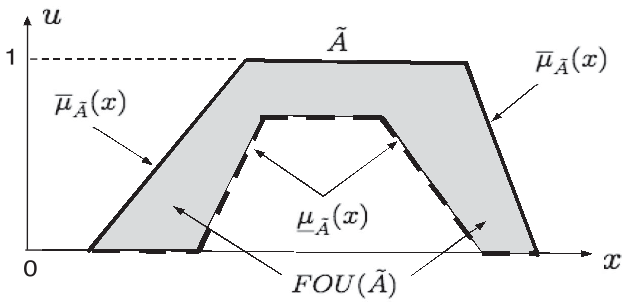 Figure 1: Illustration of an Interval Type-2 Fuzzy Set with its Footprint of Uncertainty (FOU).
Experimental Insights: Precision Matters
The researchers tested their model against traditional Type-1 TOPSIS (Technique for Order of Preference by Similarity to Ideal Solution) methods.
Key Finding: In a supplier selection problem, the Type-1 model ranked several suppliers equally (e.g., ). However, the Type-2 Fuzzy Envelope was able to distinguish between them by accounting for the specific levels of hesitancy in the expert's feedback, resulting in a clear winner: .
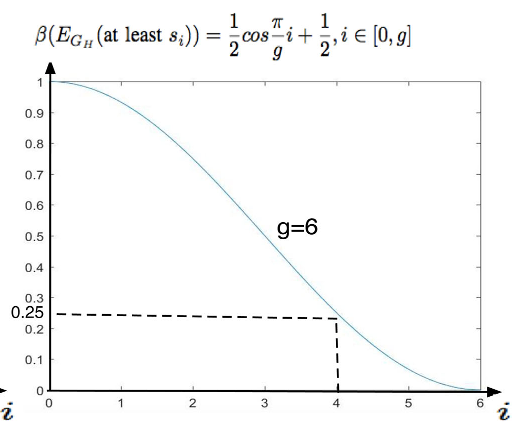 Figure 2: Comparative Footprints of Uncertainty for different linguistic expressions.
Critical Analysis
The strength of this work is its cognitive consistency. By allowing experts to use elaborate expressions ("at least," "between") and then modeling the subjective uncertainty of those expressions, the system moves closer to how humans actually think.
Limitations:
- Complexity: Calculating IT2 FSs is computationally more expensive than T1.
- Generalization: This paper focuses on Interval Type-2 sets; the extension to General Type-2 sets remains a future challenge.
Conclusion
This paper is a significant milestone for Decision Science. It proves that by embracing linguistic uncertainty rather than simplifying it, we can build decision-making systems that are not only more accurate but also more trustworthy for human experts.
Future Outlook: We expect to see this IT2 envelope applied to Large Scale Group Decision Making (LSGDM) and perhaps even integrated into AI interfaces that need to interpret "vague" human commands.