
UAVs as Social Guardians: Reinventing Security in the Social Internet of Vehicles (SIoV)
UAV-Enabled Social Internet of Vehicles: Roles, Security Issues and Use Cases
The paper proposes a UAV-enabled security framework for the Social Internet of Vehicles (SIoV). It introduces Unmanned Aerial Vehicles as versatile agents to enhance network connectivity, data processing through Aerial Fog Computing (AFC), and security verification in vehicular social contexts.
TL;DR
The Social Internet of Vehicles (SIoV) promises to turn our cars into social entities capable of autonomous interaction. However, security vulnerabilities and infrastructure gaps remain significant hurdles. This paper proposes a UAV-enabled security framework that leverages drones to provide high-altitude connectivity, localized "Aerial Fog Computing," and real-time visual verification to protect SIoV from malicious attacks.
Transitioning from IoV to SIoV: The Social Leap
The Internet of Vehicles (IoV) is essentially about connectivity—making cars "talk" to the internet. SIoV (Social Internet of Vehicles) takes this a step further by integrating social networking logic. In SIoV, vehicles aren't just data points; they are intelligent agents with "social lives," sharing infotainment and traffic data based on trust, routes, or vehicle types.
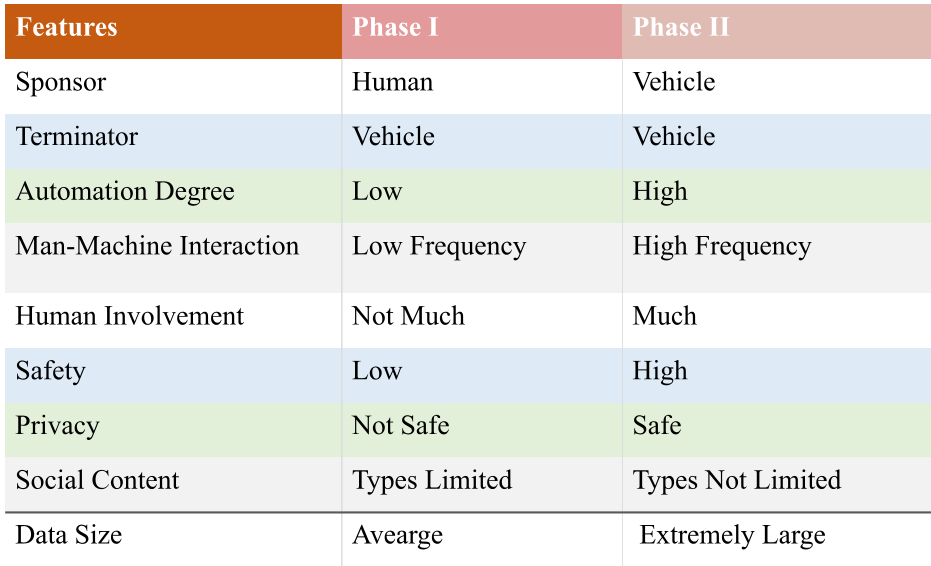
The authors divide this evolution into two phases:
- Phase I (Human-Vehicle oriented): Humans initiate social tasks via vehicle interfaces.
- Phase II (Vehicle-Vehicle oriented): Vehicles autonomously think, act, and socialize, requiring high degrees of automation and security.
The "Trust Gap" and Security Bottlenecks
Why hasn't SIoV taken over our roads yet? The paper identifies a critical "Trust Gap." Unlike Twitter or LinkedIn where users often have offline identities, SIoV nodes are often anonymous. This opens the door to:
- False Message Injection: A car claiming there is an accident to clear its own path.
- DoS Attacks: Jamming social channels with irrelevant data.
- Social Trust Disguise: Malicious nodes faking a high reputation to harvest private data.
The Solution: Why UAVs? (Methodology)
The core insight of the paper is that Unmanned Aerial Vehicles (UAVs) are the perfect "third-party observers." Because they operate in the air with better Line-of-Sight (LoS), they can fulfill roles that Roadside Units (RSUs) cannot.
1. Network Connectivity & Relay
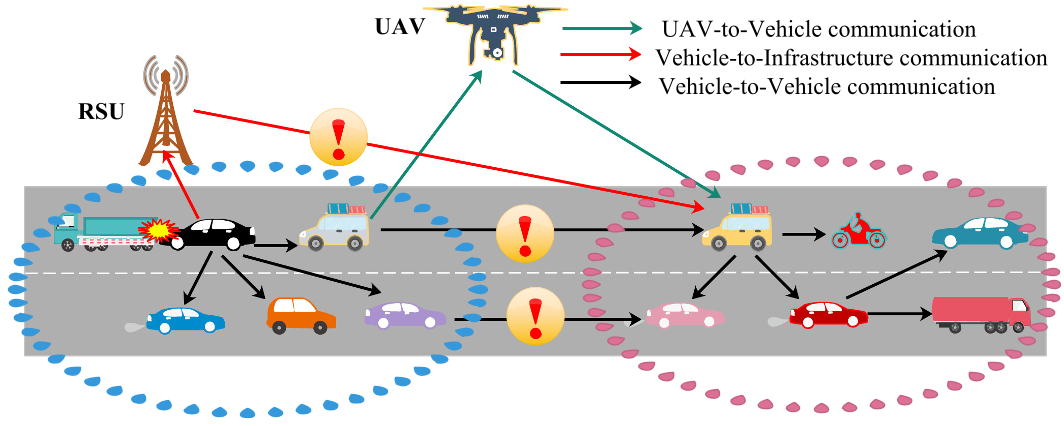
In areas with blind spots or damaged infrastructure, UAVs act as aerial base stations, extending the communication range so social messages can reach distal vehicles.
2. Aerial Fog Computing (AFC)
Social interactions require massive processing (Natural Language Understanding, Deep Learning). Instead of sending everything to a distant cloud (high latency), UAVs act as local processing hubs, reducing the "brain lag" of social vehicles.
3. The "Aerial Authority" for Security
This is the most innovative part of the framework. UAVs monitor the serving area to detect anomalies. If a vehicle broadcasts a "Car Accident" alert, a UAV can instantly use its cameras to verify the claim. If no accident is found, the UAV flags the node as malicious, protecting the rest of the social network.
Use Cases: From Theory to Asphalt
The paper illustrates the framework's value through two main scenarios:
- Traffic Jam Mitigation: UAVs capture global traffic flow (queue lengths, signal timing) and share this with the "social swarm" of vehicles to optimize route planning collectively.
- Attack Detection: When an attacker injects a false accident report to manipulate traffic, the UAV's visual verification serves as the "ground truth," preventing the network from believing the lie.
Critical Insight & Conclusion
While SIoV offers an enticing vision of human-like interaction on the road, it is inherently fragile due to its dynamic and anonymous nature. The authors successfully argue that high-altitude data collection is the missing link in vehicular security.
However, the framework introduces its own challenges—specifically the security of the UAVs themselves and the energy constraints of keeping drones aloft. Future research must address how to manage UAV handovers and ensure that the "Watcher" (the UAV) isn't compromised by the same social attacks it seeks to prevent.