
Beyond Utility: Why We Can’t Stop Checking Mobile Social Networks
Ubiquitous use of mobile social network services
This study investigates the ubiquitous use of mobile Social Network Services (SNSs) by integrating the Technology Acceptance Model (TAM) with social and contextual factors. Using Structural Equation Modelling (SEM) on a sample of 297 Chinese users (Tencent QQ), the research demonstrates that social influence, mobility, and habit are stronger predictors of usage than perceived usefulness.
TL;DR
Why do we check our phones hundreds of times a day? This research argues that for mobile social networks (SNSs) like Tencent QQ, traditional "usefulness" is irrelevant. Instead, the "Ubiquitous Use" of these services is driven by a powerful cocktail of Mobility, Social Influence, and Habit. In a study of Chinese users, social pressure and automatic behavior (habit) were found to be the true engines of actual usage, while functional productivity took a back seat.
The "Utility" Trap
For decades, the Technology Acceptance Model (TAM) has been the gold standard for predicting why people use new tech. It suggests that if a tool is Useful and Easy to Use, people will adopt it. While this works for Excel or corporate email, it fails miserably for social media.
The authors of "Ubiquitous use of mobile social network services" hypothesize that social media is human-oriented, not task-oriented. You don’t use Facebook or QQ to "increase productivity"; you use it because your friends are there, because you’re bored on the bus, and eventually, because you simply always do.
Methodology: Expanding the Horizon
To solve this, the researchers surveyed 297 regular SNS users in China and built a complex structural model. They added "Social" and "Contextual" layers to the standard TAM:
- Mobility: The "anywhere, anytime" factor.
- Critical Mass: The tipping point where so many friends use a service that it becomes mandatory.
- Use Context: Specifically focuses on "killing time" while traveling or when bored.
- Habit: The transition from conscious choice to automatic response.
 Figure 1: The proposed integrated model combining TAM with Social and Contextual factors.
Key Insights: Habit Trumps Usefulness
The results were striking. The structural equation model (SEM) revealed a reality that challenges many product management assumptions:
- The Death of Perceived Usefulness: In this study, Perceived Usefulness had no significant effect on the intention to use mobile SNSs (β = -0.004). Users simply don't care if the app "makes them more efficient."
- The Power of Habit: Habitual behavior was one of the strongest predictors of intention (β = 0.42). Use Context (boredom/traveling) directly feeds into this habit formation.
- The Critical Mass Engine: Critical mass doesn't just make an app "useful"; it creates Social Influence (β = 0.82), which then dictates behavior. If the "important people" in your life are on the app, you will be too.
- Mobility is about Ease, not Utility: Mobility makes an app feel easier to use (β = 0.69) because it removes the friction of needing a PC, but it doesn't necessarily make the service feel more "valuable" in a traditional sense.
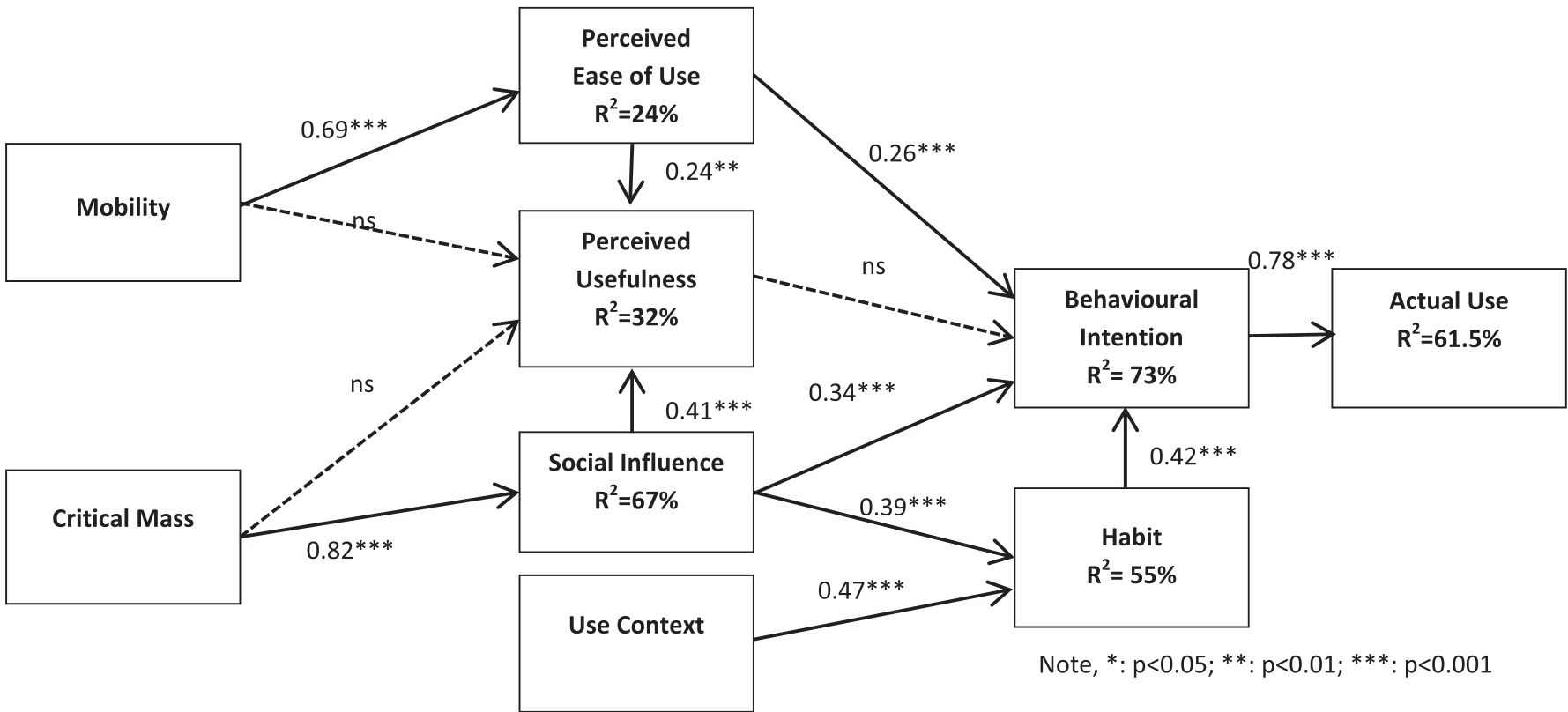 Figure 2: SEM Analysis Results showing the path coefficients and explained variance.
Critical Analysis & Takeaways
The study highlights a fundamental shift in digital consumption. For mobile SNS, the "Value" is the "Network" itself.
- Product Implication: If you are building a social app, ignore "productivity" features. Focus on Network Externalities (getting the right groups to join together) and Contextual Triggers (becoming the go-to solution for boredom).
- Cultural Context: This study was conducted in China, a "collectivist" society where social norms are incredibly strong. While the researchers suggest these findings are universal to young "digital natives," the intensity of social influence might vary in more individualistic cultures.
Conclusion
We are moving away from the era of "Tools" and into the era of "Environments." Mobile SNSs are ubiquitous not because they help us work, but because they have successfully integrated into our "dead time" (Use Context) and social obligations, eventually becoming a non-conscious reflex (Habit). As the study proves: it takes two to tango—adoption is a collective, habitual act rather than a rational, individual choice.