
UIContextListRank: Bridging User and Item Social Context for Superior Listwise Recommendations
UIContextListRank: A Listwise Recommendation Model with Social Contextual Information
UIContextListRank is a listwise learning-to-rank recommendation model that integrates social contextual information from both users and items using matrix factorization. By optimizing a cross-entropy loss function over ranked lists and implementing the system on Apache Spark, it achieves SOTA accuracy (NDCG) and high scalability for large-scale datasets.
TL;DR
UIContextListRank is a specialized "Learning to Rank" (LTR) framework that shifts the focus from individual ratings to the entire recommended list. Its secret sauce? It doesn't just look at who you trust; it also analyzes the "social" nature of items by looking at how they are co-rated across the platform. Built on Apache Spark, it offers a scalable solution to the cold-start and accuracy problems in modern social commerce.
Background & Motivation: Moving Beyond Pointwise Ratings
Traditional recommendation engines often treat items in isolation (Pointwise) or in pairs (Pairwise). However, the ultimate goal of a recommender is to provide a cohesive ranked list. Listwise methods are inherently more aligned with this goal but are mathematically more complex to optimize.
The researchers identified a critical gap: while social-aware recommenders exist, they almost exclusively focus on the User's Social Network (e.g., Who do I trust?). They ignore what the authors call Item Social Context (e.g., Which items are frequently co-selected under similar preferences?). By ignoring the item's context, models miss out on latent structural similarities between products.
Methodology: The Core Architecture
UIContextListRank leverages Matrix Factorization (MF) but extends the latent factor interaction. The predicted preference score is not just a simple dot product , but a weighted fusion of three components:
- Personal Preference: The standard user-item latent interaction.
- User Social Context: The average latent influence of a user’s trust circle ().
- Item Social Context: The average latent influence of concurrent items ()—items that have been rated similarly by the same set of users.

The model then maps these scores through a Logistic Sigmoid function and uses Cross-Entropy to minimize the distance between the predicted probability distribution of the list and the actual ground truth.
Scalability via Spark
To handle millions of ratings, the authors implemented a parallelized version of the model. They employed Alternating Stochastic Gradient Descent (ASGD), which decouples the updates of the User Matrix () and Item Matrix (), allowing them to be processed across a distributed Spark cluster without frequent synchronization bottlenecks.
Experiments & Performance
The model was validated on the Epinions and Flixster datasets, which are gold standards for social recommendation research.
1. Ranking Accuracy (NDCG)
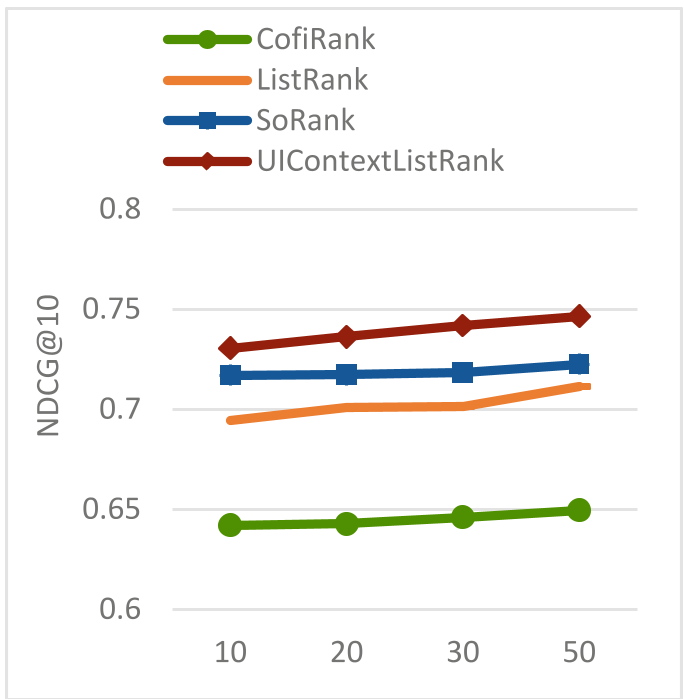
UIContextListRank outperformed CofiRank, ListRank, and SoRank. By adding Item Context on top of User Context (SoRank), the model achieved a notable lift in NDCG, proving that "item-side sociality" is a high-value signal.
2. Efficiency and Scalability
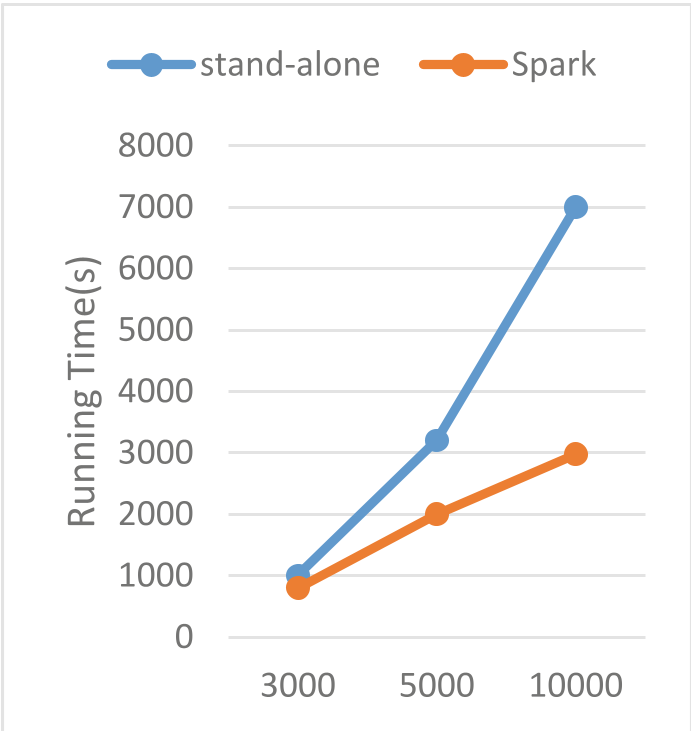
The distributed implementation on Spark demonstrated near-linear scaling advantages. On the Flixster dataset, the parallelized model ran 4x faster than the standalone version as the number of users increased, highlighting its readiness for "Big Data" production environments.
Critical Insight & Future Outlook
The primary contribution of this work is the formalization of "Item Social Context" within a listwise ranking framework. While many modern systems use Graph Neural Networks (GNNs) today, this paper provides a robust Matrix Factorization foundation for understanding how context propagates through latent spaces.
Limitations: The model relies on the existence of explicit social links and rating overlaps. In extremely sparse "Cold Start" scenarios where neither user social links nor item co-occurrences are known, the performance may degrade to standard MF.
Future Work: Integrating Deep Neural Networks (as suggested by the authors) to capture non-linear social relationships could be the next logical evolution of the UIContextListRank framework.