
Beyond Polarity: Crowdsourcing the Multivalued Nuances of Human Emotion
A ultivalued motion exicon reated and valuated by the rowd
The paper introduces a crowd-centric workflow for creating a multivalued emotion lexicon based on Plutchik's eight basic emotions. By leveraging crowdsourcing for both annotation and peer evaluation, the authors developed a high-quality sentiment resource that captures emotional diversity beyond simple binary polarity.
TL;DR
Researchers have developed an automated, crowd-driven workflow to build a multivalued emotion lexicon. Moving beyond simple "positive vs. negative" sentiment, this work captures the complexity of human language by allowing words to carry multiple emotional weights. Most notably, it proves that the crowd can effectively peer-evaluate itself, rivaling the accuracy of expert linguists at a fraction of the cost.
Problem: The "Gold Standard" Fallacy
In the world of Sentiment Analysis, we often treat human emotion as an objective fact to be "correctly" labeled. Traditional lexicons rely on experts to define a Gold Standard, where any annotator disagreement is treated as an error and discarded.
However, language is inherently subjective. A word like "Brexit" (the primary data source for this study) doesn't just have one emotion; it evokes a spectrum of trust, fear, anger, and anticipation. By forcing a "one-word-one-emotion" rule, we lose the emotional diversity that makes NLP models truly understand human context.
Methodology: The Crowd-Centric Workflow
The authors propose a system that eliminates the need for expensive experts while maintaining high data integrity.
1. The Pipeline
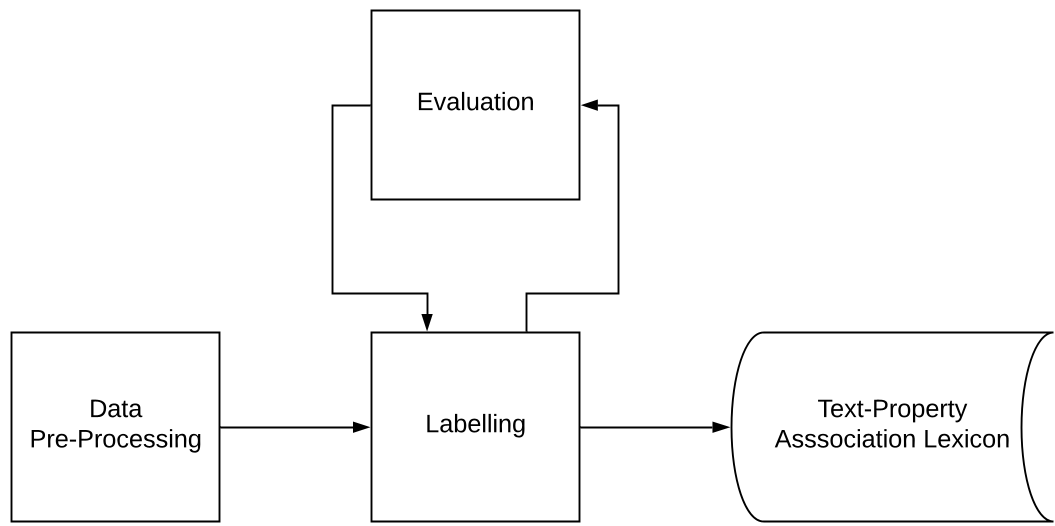
The architecture follows a three-step cycle:
- Preprocessing: Using stemming and NLP tools (NLTK) to group words by their roots, reducing costs by 40%.
- Multivalued Labeling: Instead of choosing one label, contributors identify primary emotions (Plutchik’s 8 basic emotions) and linguistic modifiers (Intensifiers and Negators).
- Peer Evaluation: A novel step where a second group of crowd contributors validates the annotations of the first group.
2. High-Dimensional Emotion
The study utilizes Plutchik’s Circumplex Model. This allows for "Emotional Dyads"—combinations like Joy + Trust = Love or Joy + Anticipation = Optimism. By storing the raw distribution of annotations, the lexicon becomes a probabilistic map of how people actually perceive words.
Experimental Results: Crowd vs. Experts
One of the paper’s most provocative findings is the comparison between expert linguists and crowd contributors in evaluating the validity of labels.
Key Findings:
- Strictness: Crowd contributors were actually stricter than PhD-level linguists, often assigning lower validity scores to questionable labels.
- Agreement Trends: As the number of annotations increased (Redundancy), the validity scores from both the crowd and experts converged upward, justifying the crowdsourcing model.
- Scalability: The cost of hiring two experts was equivalent to 19 crowd contributors, yet the crowd provided results in a matter of hours.
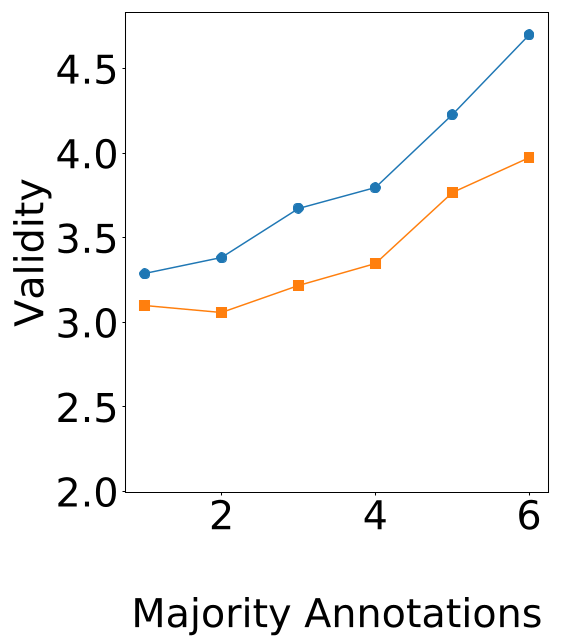 (Note: The graphs show a clear correlation between the number of annotations and the validity perceived by both experts and the crowd.)
Comparison with NRC Lexicon
When compared to the industry-standard NRC Word-Emotion Association Lexicon, the researchers found 60% new terms and a significant increase in "Any common emotional annotation" as the density of data grew, proving that their method captures labels that traditional binary systems miss.
Critical Insight: Why This Matters
The real value of this paper isn't just a new list of words; it’s the validation of the peer-evaluation model. By showing that non-experts can judge the quality of other non-experts effectively, the authors provide a blueprint for building massive, high-fidelity datasets in any subjective domain—from medical diagnosis descriptions to political stance detection.
Future Outlook
While the current lexicon focuses on political terms like "Brexit," the workflow is domain-agnostic. Integrating this "multivalued" data into Deep Learning models (like Transformers) could significantly reduce the "bluntness" of current sentiment bots, allowing for more empathetic and nuanced AI interactions.
Takeaway
Truth isn't a single point; it's a distribution. By embracing the variance in human opinion through crowdsourcing, we can create AI tools that better reflect the complex reality of human emotion.