
UMEME: Unmasking Emotion Perception Through the "Emotional McGurk Effect"
UMEME: University of Michigan Emotional McGurk Effect Data Set
This paper introduces the University of Michigan Emotional McGurk Effect (UMEME) dataset, a novel multimodal resource containing both emotionally congruent and incongruent (mismatched) audio-visual stimuli. By applying a McGurk-style paradigm to dynamic emotional expressions, the authors establish a new benchmark for understanding how human perception integrates conflicting facial and vocal cues in both categorical and dimensional (Valence, Activation, Dominance) spaces.
TL;DR
Researchers from the University of Michigan and UT Dallas have developed UMEME, the first dynamic, sentence-level dataset that pairs mismatched emotional faces and voices (e.g., an angry voice with a happy face). By creating "emotional noise," they forced human evaluators to reveal the hidden weightings and interaction patterns we use to decode feelings, proving that while we are biased by visual valence, our perception of intensity is a complex cross-modal negotiation.
The "Why": Why Break Emotion to Understand It?
In a typical conversation, your face and voice usually agree. This redundancy is great for communication but terrible for science. If a person looks happy and sounds happy, how do we know which cue the brain prioritized?
Inspired by the classic McGurk Effect—where hearing "ba" while seeing "ga" results in perceiving "da"—the authors hypothesized an Emotional McGurk Effect. By purposefully mismatching modalities, they aimed to "uncloud" the perception process. The goal isn't just to see what we perceive, but how the brain integrates conflicting signals—a vital insight for building AI that can handle the ambiguity of real-human affect.
Methodology: The Art of the Mismatch
Creating realistic "emotional noise" is non-trivial. You can't just slap an audio track onto a different video; the lip movements won't match the phonemes, ruining the illusion.
1. The Warp Factor
The team used Video Warping instead of audio warping to maintain the integrity of vocal emotion. They force-aligned phoneme boundaries and added or dropped video frames to ensure the "Happy" face moved in perfect sync with the "Angry" voice.
2. The UMEME Dataset Structure
- OAV (Original Audio-Visual): Congruent, natural expressions.
- RAV (Reconstructed Audio-Visual): The mismatched "McGurk" clips.
- Unimodal: Audio-only (OA) and Video-only (OV) for baseline comparison.
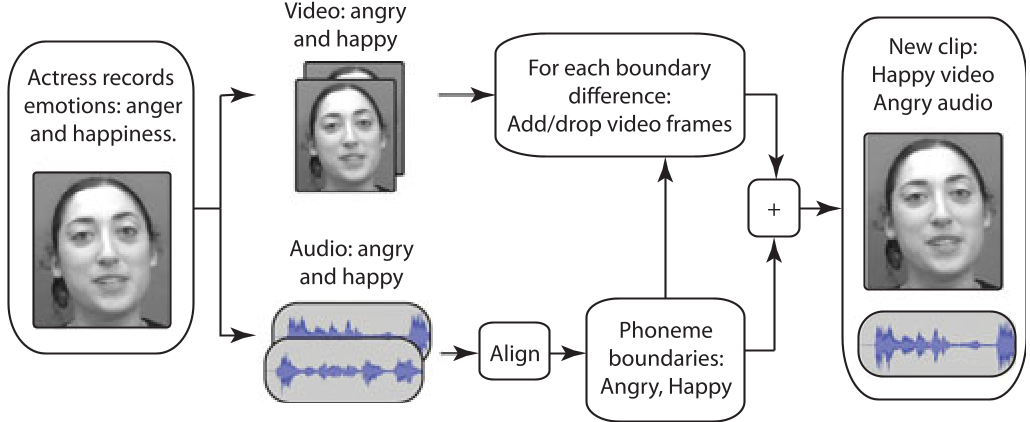 Figure 1: The pipeline for creating Reconstructed Audio-Visual (RAV) stimuli, involving phoneme alignment and video frame manipulation.
Key Insights: Who Wins the Tug-of-War?
Through extensive Mechanical Turk evaluations and regression modeling, the study yielded several high-impact findings:
1. Video Rules Valence, Audio Rules Activation
When a happy face was paired with a sad voice, evaluators almost always rated the Valence (positivity) as high. However, the Activation (energy level) was a middle-ground compromise.
- Happy Video most strongly biased perception towards positivity.
- Angry Audio was more effective at conveying high arousal than angry video.
2. Consistent Mathematical Patterns
The researchers found that multimodal perception is remarkably predictable. Using Model 2 (predicting the combined effect from unimodal VAD scores), they reached an R² of 0.85 for valence. This suggests our brains use a consistent "weighted average" logic when processing emotions.
3. The "Interaction" exists, but it's subtle
In congruent stimuli (OAV), a simple additive model worked. But in mismatched stimuli (RAV), the researchers found significant interaction terms in Activation and Dominance. This is the "McGurk" signature: the modalities don't just add up; they change each other's meaning.
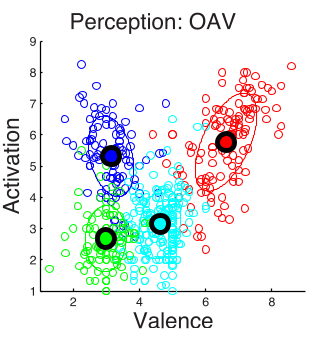 Figure 4: The shift in emotion perception in the Valence-Activation space across different presentation types.
Experimental Results: Table of Bias
The study provided a detailed breakdown of how specific emotions bias the final perception.
| Audio Emotion | Video Emotion | Valence Change | Activation Change |
|---|---|---|---|
| Angry | Happy | ↑ Large Increase | ↑ Slight Increase |
| Happy | Sad | ↓ Large Decrease | ↓ Large Decrease |
Note: Arrows indicate the shift in perception compared to the audio-only baseline.
Critical Analysis & Future Outlook
UMEME proves that we don't need "natural" stimuli to study "natural" perception. By pushing the boundaries of what is possible (the mismatched clips), we see the underlying mechanics of the human social brain.
Limitations
- Video Warping: While effective, warping can degrade the perception of "subtle" emotions more than "stereotypical" ones.
- The "Third Emotion": Unlike the phonetic McGurk effect (where A+B = C), the emotional version seems more like a weighted blend (A+B = 0.7A + 0.3B) rather than a completely new category.
Why It Matters for AI
For engineers building virtual assistants or healthcare monitors, this research is a goldmine. It tells us which features to prioritize: if you want your AI to seem "positive," focus on the visual cues; if you want it to seem "engaged" or "alert," focus on the vocal acoustics. The UMEME dataset provides the map for navigating this multimodal landscape.