
Phased UMTS Deployment: Balancing 3G Architecture with Economic Reality
Implementation options and economics of phased UMTS deployment
This paper provides a comprehensive technical and economic framework for the phased deployment of UMTS (Universal Mobile Telecommunication System) networks, transitioning from GSM/Rel-99 to All-IP systems. It introduces a multidimensional business plan methodology that correlates architectural choices with Net Present Value (NPV) to optimize rollout strategies for mobile operators.
TL;DR
The transition from 2G to 3G wasn't just a technical upgrade; it was a high-stakes financial gamble. This paper outlines the technical roadmap from 3GPP Release 99 to the All-IP Release 5 and provides an economic framework—anchored in Net Present Value (NPV)—to help operators decide when to upgrade and what services to prioritize to ensure profitability.
Problem & Motivation
In the early 2000s, mobile operators stood at a crossroads. Moving to UMTS (3G) required massive investments in new radio spectrum and infrastructure. However, the market demand for "multimedia" was largely unproven. The core challenge was: How do we deploy a modular network that scales with demand while minimizing the "valley of death" where costs exceed returns?
The authors argue that technical planning cannot exist in a vacuum. A successful rollout requires a feedback loop between architectural flexibility (Radio and Core networks) and economic sensitivity (Tariff erosion and service penetration).
Methodology: The Technical-Economic Bridge
1. Evolution of the Core and RAN
The paper breaks down the UMTS evolution into three distinct functional phases:
- Release 1999: A consolidation of GSM with a new W-CDMA radio access (UTRAN).
- Release 4: Introduction of "Bearer Independent" architecture, separating control from switching.
- Release 5: The shift toward the Internet Multimedia (IM) concept and All-IP connectivity using SIP.
2. The Multi-Stage Planning Process
Planning a UMTS network involves a two-stage process for RAN:
- Cell Dimensioning: Initial coverage determination based on environment (Urban/Rural).
- Fine-tuning: Adjusting for real-world interference in CDMA systems, which is highly dependent on instantaneous bitrate and source activity.
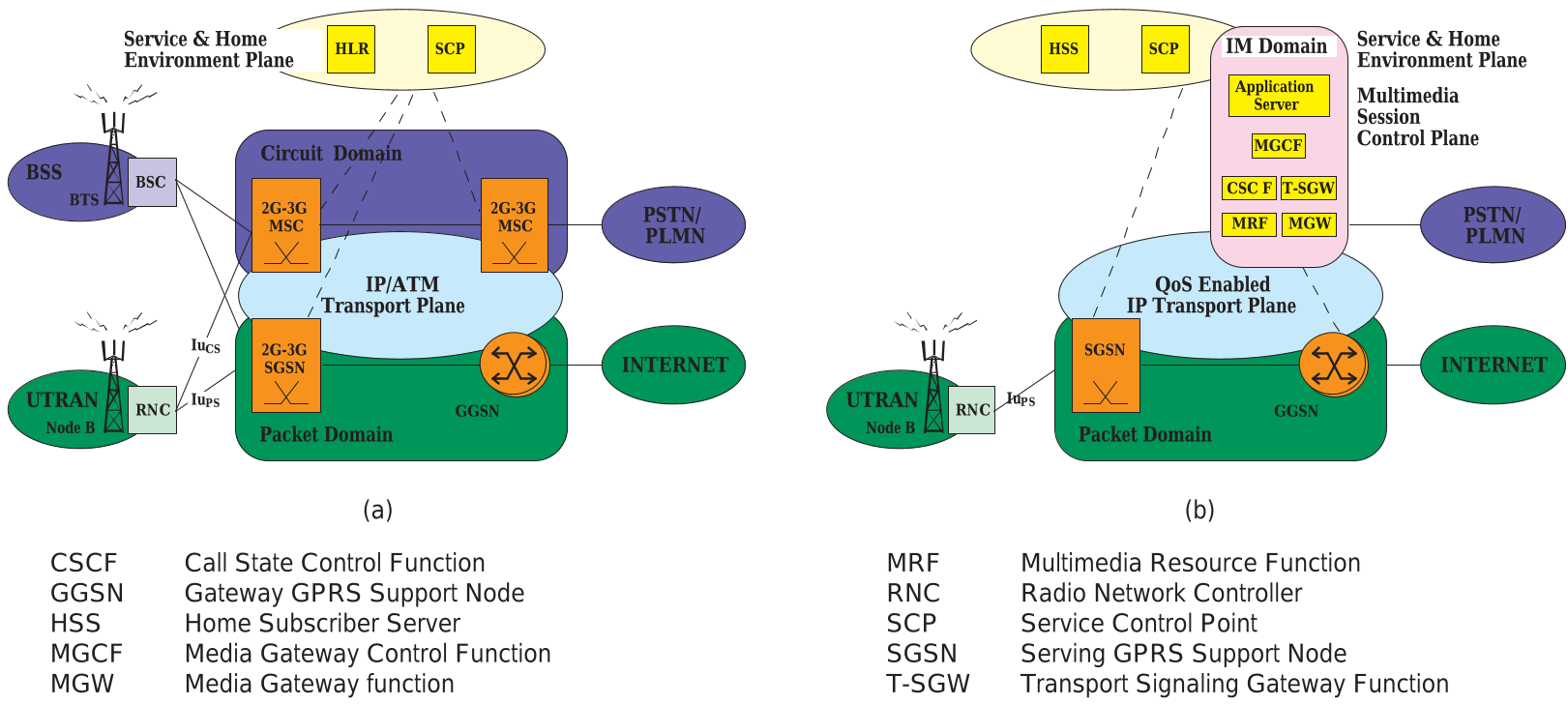 Fig 1. Architectural transitions from legacy GSM to All-IP UMTS.
3. Economic Modeling (NPV)
The methodology integrates technical metrics (Node B count, RNC allocation) into a financial model. The researchers used Net Present Value (NPV) as the primary metric, calculating the cumulative discounted cash flow over a 10-year period.
Experiments & Results: What Actually Drives Profit?
The paper conducts a critical sensitivity analysis to determine which factors most heavily influence the Bottom Line. They compared four variables:
- Traffic Demand
- Service Penetration
- Tariff Erosion
- Service Offering (The Mix of services provided)
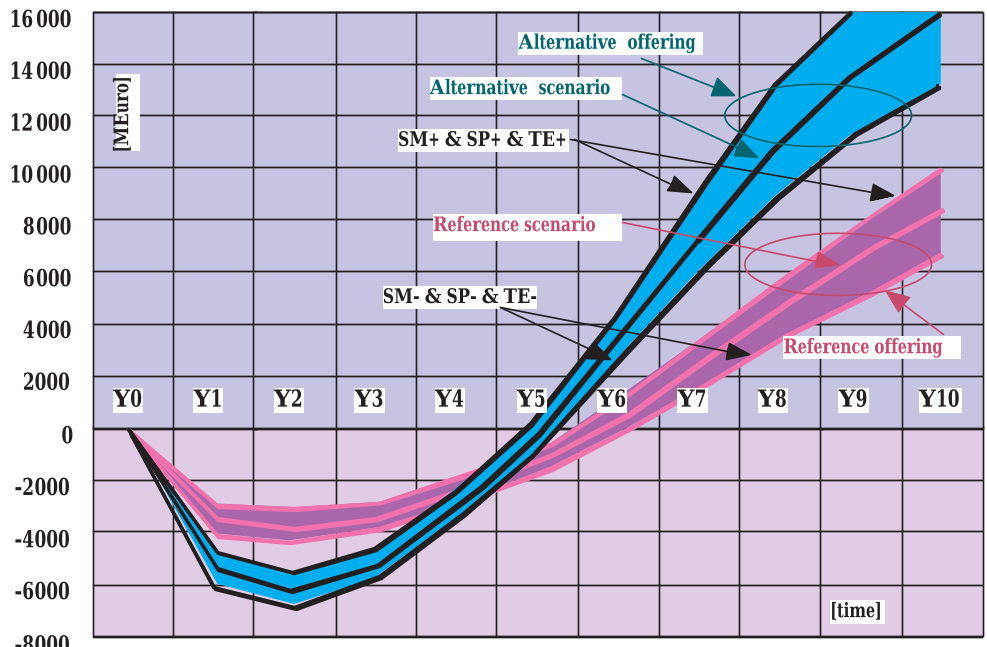 Fig 2. NPV trends over a 10-year life cycle, showing the impact of service-offering choices.
Key Findings:
- The Break-even Point: For a typical UMTS deployment, returns on investment only start to exceed initial capital expenditure after year 5 or 6.
- Service Mix is King: Changing the "service offering" (e.g., aggressively pushing Mobile Internet Access over traditional voice) has a significantly higher impact on NPV than fluctuations in user demand or price drops.
- Modular Advantage: Using modular equipment in the Core Network (Table 2) allows operators to upgrade from Rel-99 to Rel-5 with minimal site disruption, preserving capital.
Critical Insight & Conclusion
The historical value of this work lies in its realization that network architecture is a financial instrument. The transition to 3G was not just about "Faster Data"; it was about "Flexible Scaling."
Takeaways for Modern Deployment:
- Agility over Capacity: It is better to have an "upgradeable" network than an "oversized" one. In UMTS, this meant moving toward MGW (Media Gateways) and MSC Servers.
- The Content Factor: Operators cannot rely on voice and basic SMS. The data shows that the "Aggressive Service" scenario (Multimedia/Internet) is the only path to a healthy NPV in a competitive market.
While the paper focuses on UMTS, its methodology remains the foundation for modern 5G business cases, proving that technical SOTA must always be validated by economic sustainability.