
TrUE-Net: Mastering Uncertainty in Genomic Predictions for Alzheimer’s Disease
Uncertainty-Aware Genomic Classification of Alzheimer's Disease: A Transformer-Based Ensemble Approach with Monte Carlo Dropout
The paper introduces TrUE-Net, a transformer-based ensemble framework designed for the genomic classification of Alzheimer’s Disease (AD). By integrating Monte Carlo Dropout for Bayesian uncertainty estimation and combining transformer layers with random forests, the model achieves a more reliable classification of whole-genome sequencing (WGS) data.
TL;DR
Existing AI models for Alzheimer’s Disease (AD) often guess blindly without knowing their own limitations. Researchers have developed TrUE-Net, a Transformer-based ensemble that doesn't just predict if you have AD risk—it tells you how much it trusts that prediction. By using Monte Carlo Dropout to measure uncertainty, the model filtered out ambiguous cases, boosting classification accuracy by over 10%.
Background: The "Black Box" of Polygenic Risk
Predicting Alzheimer’s from Whole-Genome Sequencing (WGS) is notoriously difficult. Unlike rare familial mutations, the more common late-onset AD involves dozens of genetic variants (SNPs), each with a tiny effect. Conventional deep learning models reach a "glass ceiling" because they provide a hard binary answer even when the genomic evidence is muddy. In a clinical setting, an overconfident wrong answer is worse than no answer at all.
Methodology: Fusing Transformers and Bayesian Uncertainty
The core innovation of TrUE-Net lies in its dual-stream ensemble and its method of "self-doubt."
1. The Transformer Stream (Sequence-Aware)
Genomic data is treated as a sequence. The model segments SNPs into windows (tokens) and uses a Transformer Encoder to capture long-range dependencies between different genetic loci.
- The Bayesian Twist: During inference, the model uses Monte Carlo (MC) Dropout. Instead of turning off dropout after training, it stays active. The model runs the data through the network multiple times; if the results vary wildly, the model is "uncertain."
2. The Random Forest Stream (Global Patterns)
Simultaneously, a Random Forest operates on flattened genotypes. While the Transformer looks at the structure, the Random Forest looks at the aggregate presence of variants.
3. The Ensemble and Uncertainty Filtering
The results from both are merged using a weighting factor (). Crucially, the model calculates an Ensemble Variance. If this variance exceeds a specific threshold, the sample is flagged as "Uncertain."
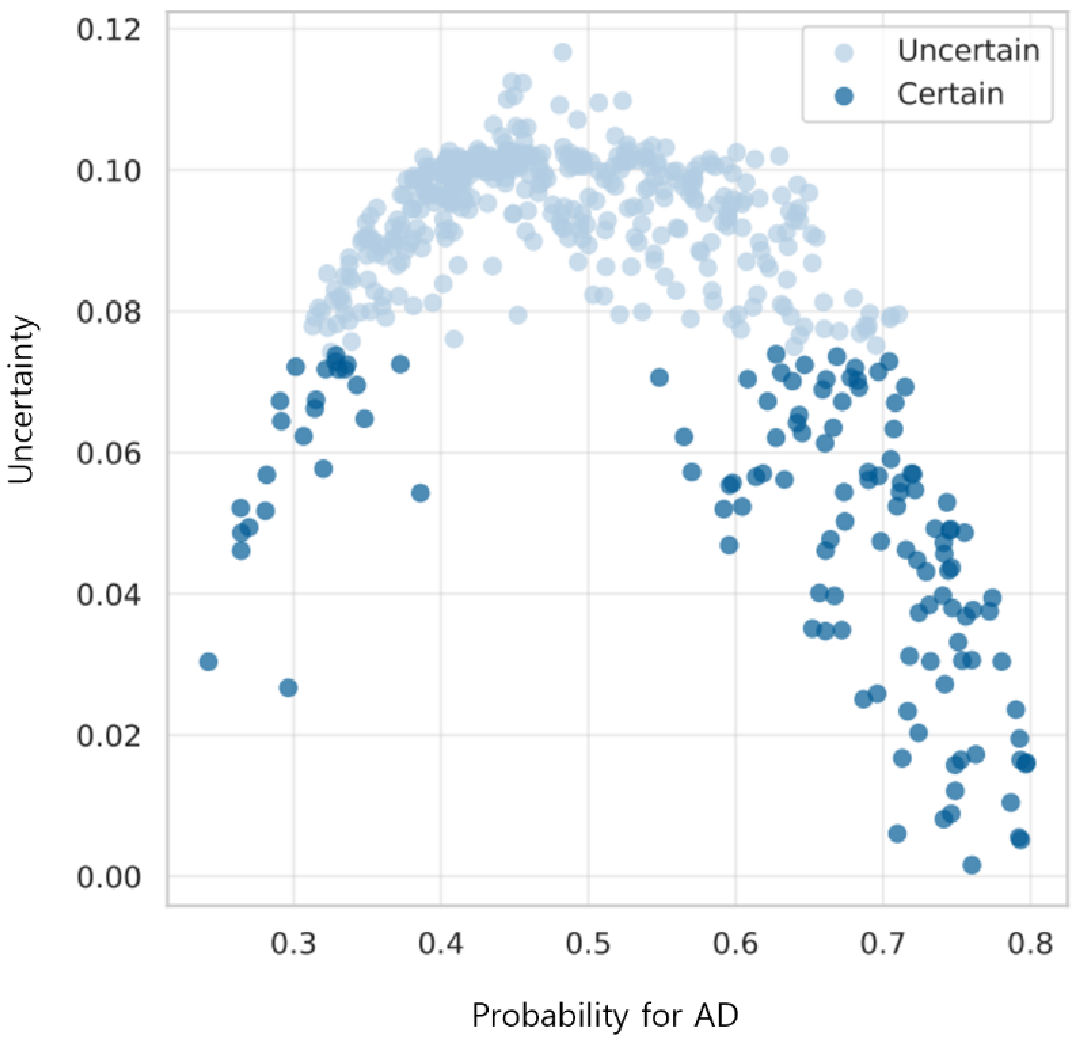 Figure 1: Comparison between predicted AD probability and model uncertainty. High-variance points represent cases where the AI is "confused."
Experimental Results: The Power of Saying "I Don't Know"
The researchers tested TrUE-Net on 1,050 individuals. The baseline performance across all samples was moderate (AUC ~0.66). However, the real magic happened when they separated the samples based on uncertainty.
- Separation of Clusters: Uncertain samples clustered around the 0.5 probability mark (the "toss-up" zone), whereas certain samples were pushed toward the 0.1 or 0.9 extremes.
- The "Certain" Boost: By focusing only on the 24.6% of samples where the model was confident, Accuracy jumped from 62.6% to 72.8% and the F1-score soared by 23.6%.
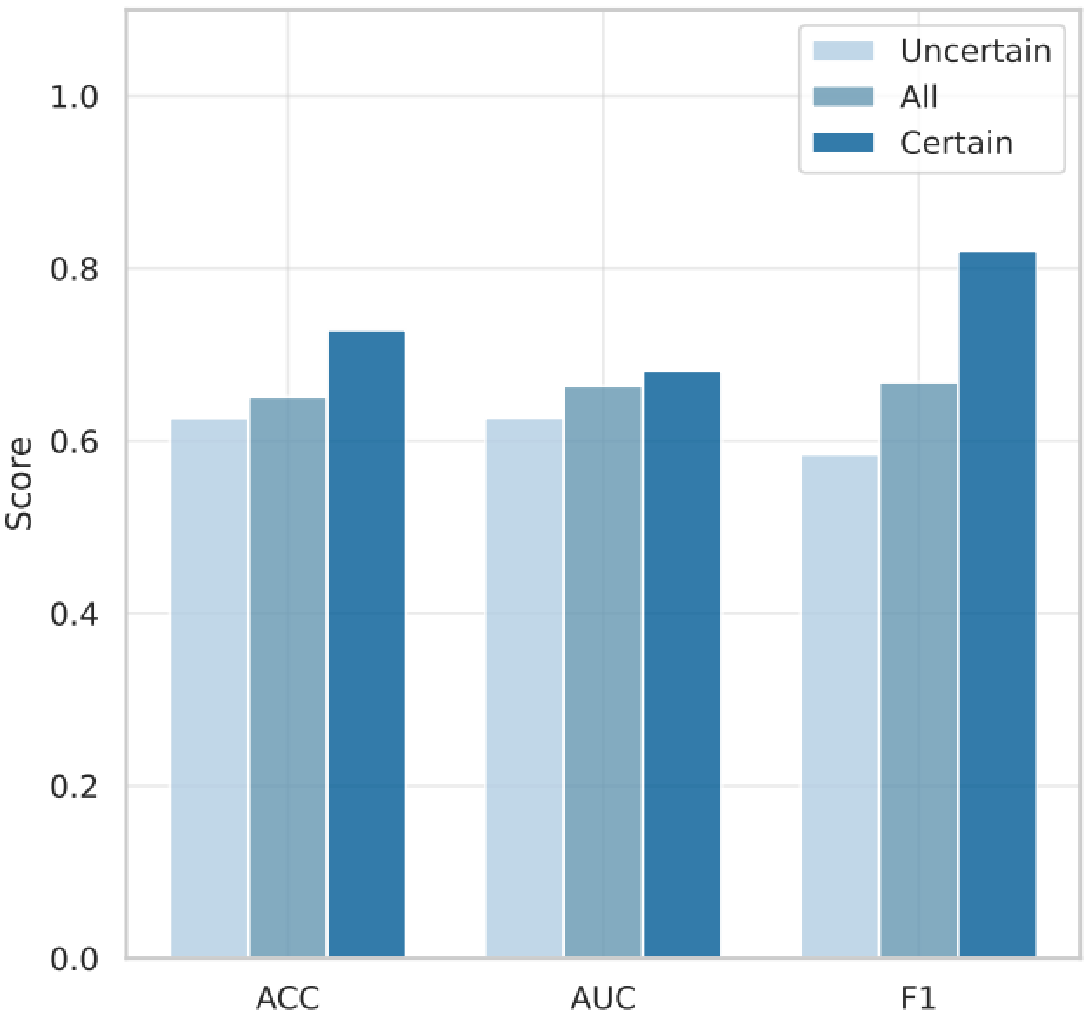 Figure 2: Performance metrics for Certain vs. Uncertain groups. Filtering for certainty dramatically stabilizes the model's reliability.
Deep Insight: Why This Matters
In the real world, medicine isn't about getting 100% of cases right; it's about knowing which cases need a human expert. TrUE-Net provides a "safety valve."
If the model labels a patient as "Uncertain," a clinician knows not to rely on the AI alone and can order further tests like PET scans or cerebrospinal fluid (CSF) biomarkers. This reduces the risk of misdiagnosis in the high-stakes environment of neurodegenerative disease.
Critical Analysis & Conclusion
While TrUE-Net is a significant step forward in trustworthy AI, it has limitations:
- Diversity Gap: The dataset was mostly of European descent, leaving questions about its performance in more diverse populations.
- The Exclusion Trade-off: Improving accuracy by filtering out 75% of "uncertain" samples means the model can only provide high-confidence labels for a quarter of the population.
Future Outlook: The next frontier for TrUE-Net will be integrating "multi-omics"—combining WGS with blood-based proteins and transcriptomics to lower the uncertainty threshold and bring high-confidence predictions to a broader patient base.
Takeaway: In genomic medicine, the measure of a model's intelligence is not just its accuracy, but its awareness of its own ignorance.