
Logic in the Shadows: How Uncertainty Drives Gossip in Social Networks
On Studying the Impact of Uncertainty on Behavior Diffusion in Social Networks
This paper investigates behavior diffusion in social networks by modeling humans as rational agents under uncertainty via a Mixed Logit Model (MLM). It characterizes how gossip spreads as a coordination game, demonstrating that scale-free networks facilitate diffusion more easily than other topologies.
TL;DR
Why do rumors spread even when it seems irrational to share them? This paper moves beyond mechanical "virus" models to show that human uncertainty—the "noise" in our decision-making—is actually the catalyst for large-scale behavior cascades. By modeling gossip as a coordination game, the authors prove that in scale-free networks (like the real world), a tiny bit of uncertainty allows information to jump from low-degree users to "hubs," ultimately engulfing the entire network.
The "Mechanical" Myth versus Rational Reality
Most classic diffusion models (like SIS or SIR) treat us like biological cells: if you touch an infected person, you have a fixed probability of catching the "virus." But humans are rational explorers. We weigh costs (risk of being penalized) against benefits (reputation, social bonding).
The problem? Perfection doesn't exist. Humans face two types of uncertainty:
- Incomplete Knowledge: We don't fully know what our friends are thinking.
- Behavioral Noise: We are inherently stochastic; sometimes we just make a "mistake" or follow a gut feeling.
The Research Intuition
The authors argue that if everyone were perfectly rational and the "threshold" for spreading a rumor was high, gossip would die instantly. To explain why it doesn't, we must account for the "Logit" response—where a higher utility makes a choice more likely but not certain.
Methodology: Mixing Game Theory with Physics
The authors build a framework with two pillars:
1. The Mixed Logit Model (MLM)
Inspired by economic choice theory, the utility of a behavior is defined as: The parameter (Uncertainty Factor) is the dial. Set it to zero, and you have a cold, calculating machine. Turn it up, and you get "bounded rationality" where agents might pick a sub-optimal path.
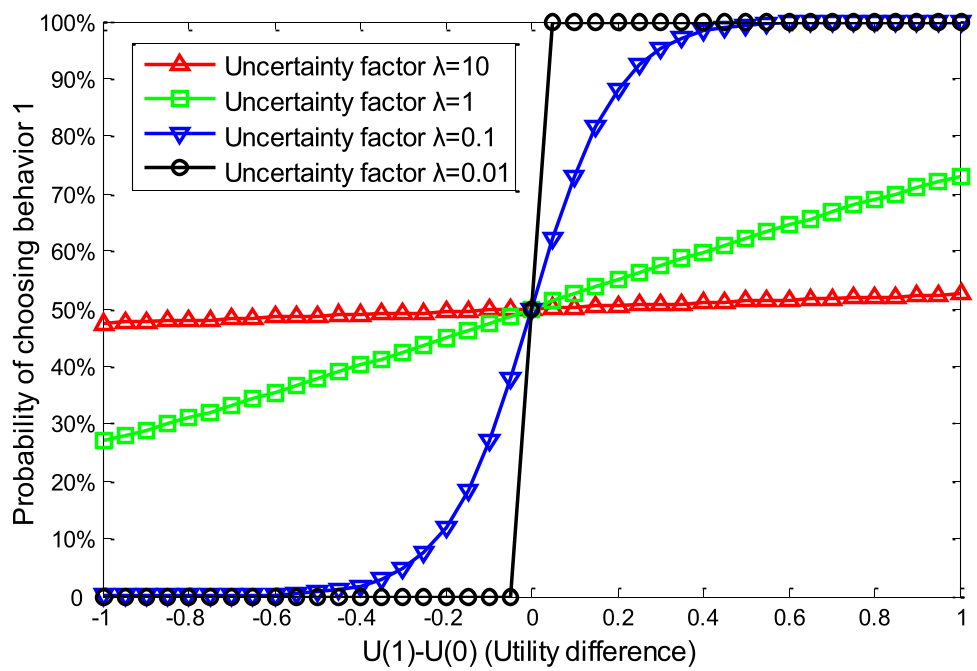 In the figure above, a low creates a sharp step-function (purely rational), while a high flattens the curve toward a 50/50 random choice.
2. Mean Field Approximation
To solve the math for millions of nodes, the authors use Mean Field Theory. Instead of tracking every individual connection, they assume agents respond to the "average" state of their neighbors based on their degree (). This translates complex network dynamics into a solvable stationary equation.
Key Finding: The Scale-Free Advantage
The paper compares three network types: Regular (grids), Poisson (random), and Scale-Free (the "Internet" model).
The "Easy Come, Easy Go" Principle
- Scale-Free Discovery: These networks are the most sensitive to uncertainty. Why? Because they contain "hubs."
- The Sequence: Low-degree nodes (the "long tail") are influenced by uncertainty first. They hit a hub. The hub, connected to thousands, then amplifies the signal back to the masses.
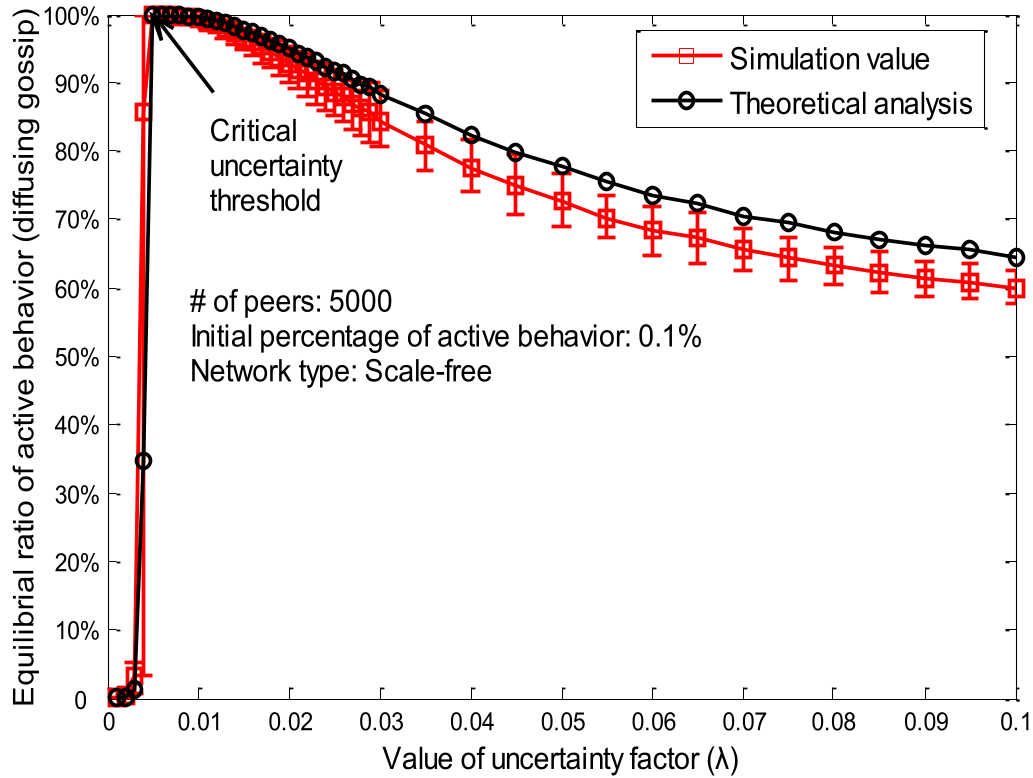 Fig 4 & 6: Notice how the Scale-Free network reach (circles) peaks faster and at lower uncertainty levels than the more uniform Poisson or Regular networks.
The "Long Tail" of Activation
The researchers observed a power-law relationship in how users activate. In early rounds, the "hubs" wait, but once they flip, the diffusion becomes unstoppable. However, if uncertainty is too high, the "hubs" stop being reliable transmitters because they start flipping back to inactivity just as randomly.
Critical Analysis & Real-World Impact
The study validates its model using the Arxiv Astro Physics collaboration network. While the theoretical Mean Field Theory slightly overestimates real productivity (likely due to "clustering" in real-world groups that the theory ignores), the trend is unmistakable.
Takeaway for Tech & Society:
- Marketing & Vitality: To start a trend in a rational world, you don't need a better product; you need to increase "perceived uncertainty" or lower the barrier for the first few users.
- Network Design: If you want a network resilient to rumors, you must reduce the "hub" structure—making the network more "Regular" slows down the catalytic effect of uncertainty.
Conclusion
As the authors eloquently put it, rumor diffusion is "easy come, easy go." Uncertainty acts as the friction-reducer that lets a spark turn into a forest fire, particularly in the highly-connected, hub-centric social world we live in today.