
Unmasking the Like Farms: A Data-Driven Approach to Detecting Fake Likers
Uncovering Fake Likers in Online Social Networks
This paper presents a comprehensive framework for detecting "fake likers" on Facebook—users who provide illegitimate Likes for commercial gain. By collecting a large-scale dataset from "Like farms" (Fiverr and Microworkers), the authors develop a supervised learning model (XGBoost) using profile, posting, and behavioral features that achieves a SOTA accuracy of 0.871.
TL;DR
In the multi-million dollar economy of "social proof," fake Likes have become a ubiquitous commodity. This paper provides a rigorous analysis of "Fake Likers"—users paid to manipulate engagement—and introduces a high-accuracy detection model. By bypassing the need for expensive temporal tracking and focusing on behavioral fingerprints like Category Entropy, the researchers achieved a 0.871 accuracy, significantly outperforming existing industry baselines.
The "Like" Economy and Its Flaws
Digital marketing thrives on engagement metrics. However, the rise of platforms like Fiverr and Microworkers has created a "shadow market" where thousands of Likes can be purchased for a few dollars.
The challenge? Unlike a spam comment (which contains text) or a Sybil (which is a fake account), a fake Like looks identical to a real one. Previous attempts to solve this involved:
- CopyCatch: Looking for lockstep behavior (groups liking the same thing at once).
- SynchroTrap: Clustering based on time-sync.
The authors argue these are limited because they require constant temporal snapshots and are easily defeated by "smart" fake likers who stagger their actions.
Methodology: Insights from the Honeypot
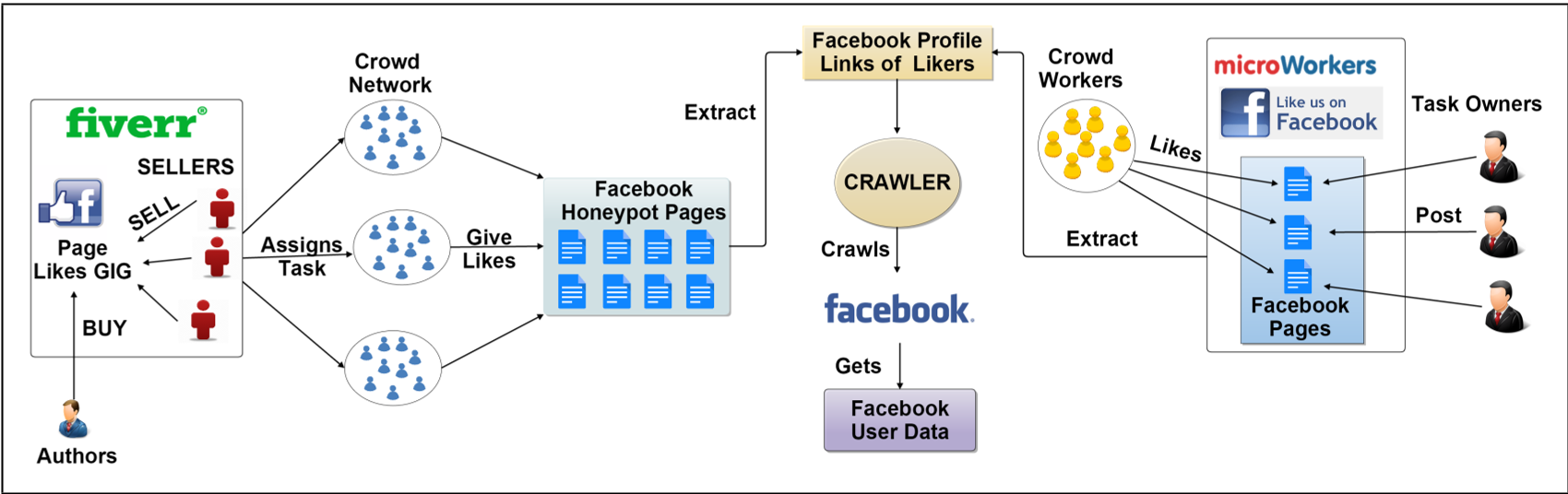
To catch a thief, the researchers set a trap. They created Facebook "Honeypot" pages with a clear warning: "This is a fake page. Please do not like this." They then purchased Likes from Fiverr and Microworkers. Anyone who liked the page was, by definition, a "fake liker."
1. Data Collection Architecture
The researchers combined linkage methods (tracking tasks on Microworkers) and honeypots to build a ground-truth dataset of over 13,000 users.
2. The Smoking Gun: Category Entropy
The most profound insight from the paper is the concept of Category Entropy.
- Legitimate Users are picky. They like tech, or cooking, or sports. Their categorical footprint is concentrated.
- Fake Likers are mercenaries. They like whatever they are paid to like. Consequently, their Likes span dozens of unrelated categories (e.g., a car dealership in Dubai, a bakery in Paris, and a cat fan page).
The authors mathematically proved that fake likers have significantly higher entropy in their "Like" distributions compared to real users.
Experimental Results & Performance
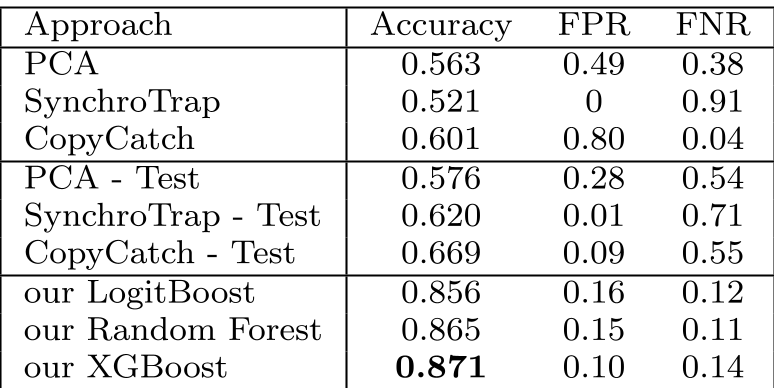
The study compared their supervised learning approach (specifically XGBoost and Random Forest) against three major baselines.
Key Findings:
- Accuracy Boost: The XGBoost model reached 87.1% accuracy, while baselines like SynchroTrap struggled (near 52%) when temporal data was scarce.
- Demographics: Interestingly, 73% of fake likers came from developing nations, and most were males aged 18–34.
- Robustness: Even when "fake likers" tried to mimic real ones (Individual/Coordinated Attack Models), the classifier's accuracy remained above 82%, proving that "mercenary behavior" is hard to hide perfectly.
Critical Analysis & Future Outlook
The beauty of this work lies in its feature efficiency. By moving away from temporal monitoring, the method becomes viable for 3rd-party auditors who don't have access to the real-time backend streams of Facebook or Instagram.
Limitations: The study was conducted on Facebook. In 2024 and beyond, fake engagement has moved toward short-form video platforms (TikTok/Reels) where "view time" is more important than "Likes." Extending this entropy-based detection to "watch patterns" would be the logical next step.
Final Takeaway
Commercial deception in social media is a cat-and-mouse game. This paper proves that while attackers can hide their timing, they cannot easily hide their lack of authentic interest. Diversity of behavior (Entropy) remains the ultimate forensic tool in social network security.