
Beyond Point Detection: Building Fraud Cases with Reinforcement Learning
Uncovering Fraud in Direct Marketing Data with a Fraud Auditing Case Builder
The paper introduces an automated fraud auditing case builder that replicates human auditor workflows by combining outlier detection (Benford’s Law/Normal distributions) with Reinforcement Learning (RL). By modeling database records as states and attributes as actions, the system navigates complex datasets to link anomalies into comprehensive fraud cases, achieving up to 20.22% accuracy in real marketing data.
TL;DR
Detection is not Auditing. While most AI tools flag a single suspicious transaction, this paper proposes an automated Fraud Auditing Case Builder. By combining Benford’s Law with Reinforcement Learning (RL), the system doesn't just find outliers—it "walks" through database tables to link related records, mimicking a human investigator to build a complete case of fraud.
Background: The Gap Between Anomaly and Fraud
In the academic and industrial world, "Fraud Detection" is often a misnomer. Most systems are actually anomaly detectors. They identify a data point that looks "weird" according to a distribution, but they cannot answer the crucial question: Is there an unjustified gain or loss?
A human auditor bridges this gap by manually linking a suspicious receipt to a specific vendor, then to a specific employee, and finally to a series of unusual payouts. This "linkage" is the heart of auditing. This paper asks: Can we automate the auditor's intuition?
Methodology: RL as a Search Engine for Evidence
The author frames the database as an environment where:
- States (): Individual database records (e.g., a specific purchase).
- Actions (): Record attributes (Store, Location, Payment Method) used to navigate to the next related record.
- Rewards (): The "suspiciousness" of a record, calculated via statistical deviations.
1. The Reward Signal: Benford’s Law
The system uses Benford’s Law, which predicts the frequency of leading digits in natural datasets. Fraudsters often invent numbers that violate this law (e.g., having too many digits starting with '7'). The reward is defined by how much a record deviates from this expected frequency.

2. The Search Mechanism: SARSA
Unlike a Greedy Search, which only looks for the next biggest outlier, Reinforcement Learning looks for long-term rewards. This is vital because a fraud case might involve several "normal-looking" records that serve as bridges between two highly fraudulent ones.
 In the example above, the agent moves from State 2 (a suspicious hat purchase) to State 4 via the 'StoreB' attribute, building a chain of evidence.
Experimental Performance
The paper compares the RL-based approach against three baselines: Random selection, Greedy search, and Standalone Benford detection.
Key Result: RL vs. Greedy Search
The results were stark. In a dataset of 227,156 records:
- Greedy Search (Benford): 0.48% Accuracy.
- RL (Benford): 20.22% Accuracy.
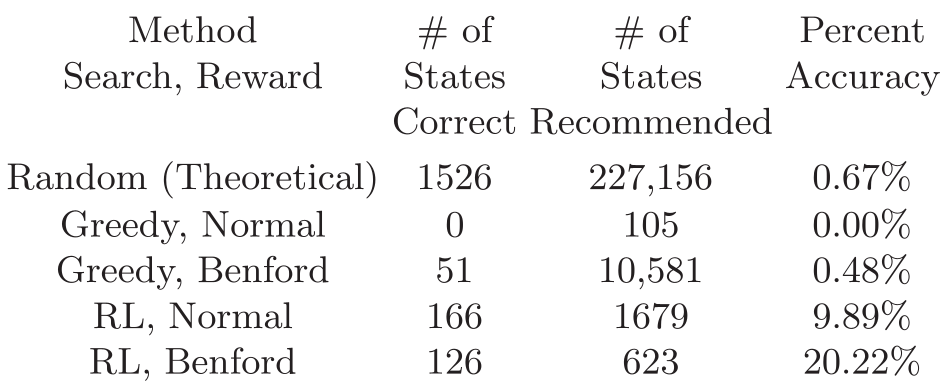
The failure of the Greedy Search proves that fraud is rarely about the single "most suspicious" record; it is about the pathway of entries. The RL agent successfully learned to prioritize "trajectories" of data that represent a consistent pattern of deception.
Deep Insights & Critical Analysis
The brilliance of this work lies in its use of the Markov Property. By requiring that the "next state" be determined by the current record's attributes, the author ensures the RL agent mimics how a human follows a "paper trail."
Strengths:
- Online Learning: The system can update its policy as new records are added, making it suitable for real-time industrial marketing data.
- Explainability: Because the system "navigates" through attributes, the resulting case provides a clear audit trail for human review.
Limitations:
- Attribute Dependency: The system's success depends entirely on the quality of database schema linkage. If tables aren't indexed properly, the agent has no "paths" to follow.
- State Space Complexity: While it works for tens of thousands of records, hyper-scale databases (billions of rows) might require more advanced Deep RL architectures (like DQN) instead of basic SARSA.
Conclusion: The Future of Autonomous Auditing
Fletcher Lu’s work shifts the paradigm from "finding anomalies" to "investigating leads." By treating data relationships as a navigable environment, this system demonstrates that machine learning can do more than classify—it can synthesize complex evidence into a coherent story. For the future of fintech and direct marketing, this is a major step toward truly autonomous compliance systems.