
Uncovering Media Bias: Why Your Follower List Says More Than Your Words
Uncovering Media Bias via Social Network Learning
This paper introduces Bootstrapping-SNEA, the first systematic approach to uncover latent media bias (e.g., Democrat vs. Republican) by learning from social network structures rather than just news content. By leveraging a Hybrid Sampling Strategy (HSS) and a semi-supervised iterative framework, the authors achieved SOTA performance on a custom large-scale Twitter dataset featuring 300,000 users and 5 million connections.
TL;DR
Researchers from Xiamen and Jinan Universities have developed Bootstrapping-SNEA, a framework that predicts the political leanings of media outlets (like CNN or FOX) by analyzing the social network structure of their followers. By treating media bias as a network embedding problem rather than a text classification task, they achieved superior accuracy and bypassed the need for complex NLP context.
Background Positioning: This is a pioneering work that bridges Social Science theory—specifically the concept of Homophily (people follow those with similar views)—with modern Deep Learning on graphs (Network Embedding).
The Problem: The Implicit Nature of Modern Bias
Why is it so hard to "calculate" bias?
- Implicit Expression: Professional journalists rarely use overt partisan language; bias is often found in what they choose to cover or what citations they use.
- Linguistic Complexity: Short texts (like Tweets) lack the semantic depth for traditional NLP to accurately pin down ideology.
- Data Scarcity: Manual labeling of millions of articles is unsustainable.
The authors' core insight: You are known by the company you keep. If a media outlet is predominantly followed by users within a specific ideological cluster, that outlet likely reflects that cluster's bias.
Methodology: Bootstrapping-SNEA
The framework tackles two "sparsity" problems—missing network links and missing user labels—through a clever three-stage process.
1. Hybrid Sampling Strategy (HSS)
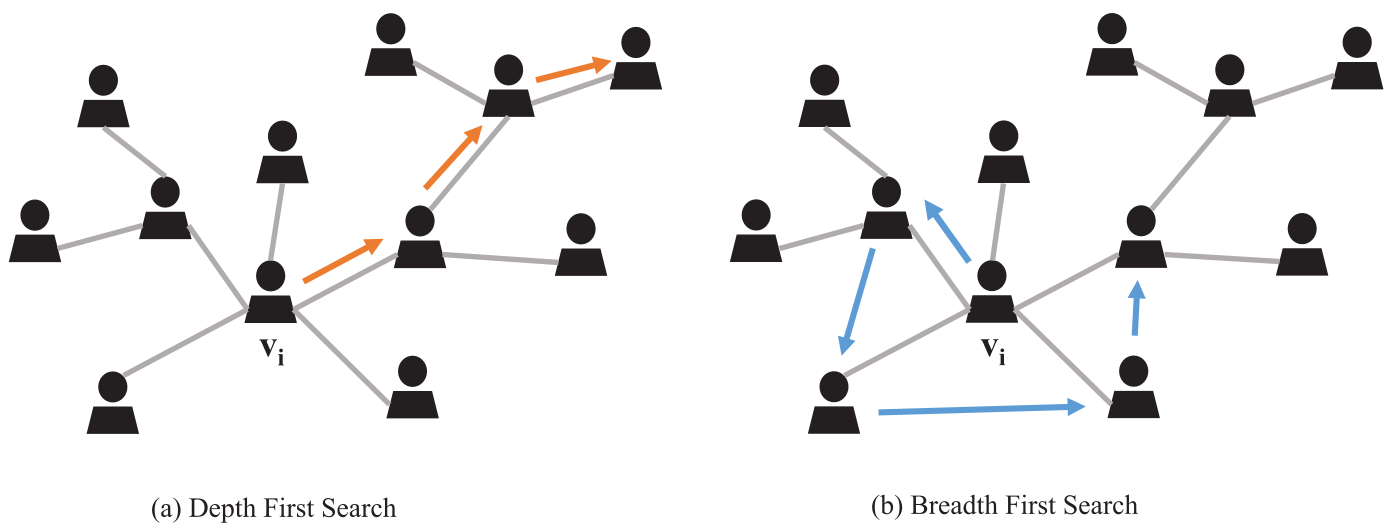
Unlike DeepWalk (which uses uniform random walks) or LINE (which focuses on local edges), HSS combines Breadth-First Search (BFS) and Depth-First Search (DFS).
- BFS captures "homophily": nodes that are immediate neighbors (local).
- DFS captures "structural equivalence": nodes that play similar roles in the global network (macro).
2. Semi-Supervised Logic
The model doesn't just learn structure; it uses a Linear Discriminant Analysis (LDA) constraint. It forces the embeddings of known Democrats and known Republicans to stay far apart in the vector space, ensuring the learned features are highly "discriminant."
3. The Bootstrapping Loop
This is the "secret sauce." Since only ~5% of users have known labels, the model:
- Learns embeddings (SNEA).
- Propagates labels to neighbors using a -NN graph.
- Takes the most confident predictions and turns them into "pseudo-labels."
- Retrains the embedding with this new, larger dataset.
Experiments: Network vs. Text
The authors pitted their network-based method against traditional text-based approaches (Bag-of-Words and Doc2Vec). The results were stark:
- Doc2Vec failed significantly, often predicting that all media were Democrat-leaning.
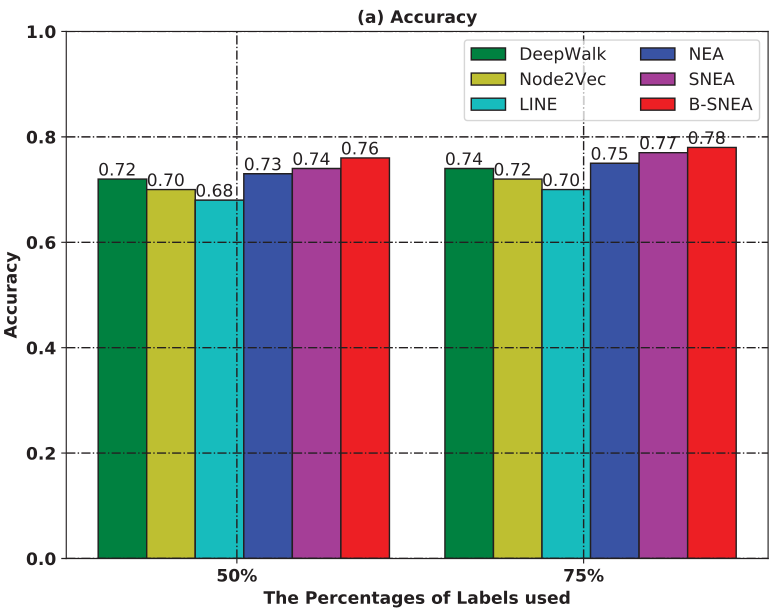
- Bootstrapping-SNEA outperformed SOTA network models like Node2vec and DeepWalk, proving that HSS + Bootstrapping is a more robust pipeline for sparse social graphs.
The Bias "Spectrum"
The model produced bias scores (0 to 1, where higher is more Democratic):
- CNN (0.58): Leaning Democrat.
- FOX News (0.36): Leaning Republican (1-0.64 calculation).
- Wall Street Journal (0.52): Notably neutral. The authors suggest that while WSJ's editorials are right-wing, its news coverage remains objective enough to attract a balanced follower base.
Critical Insight & Conclusion
This research confirms that social signals are often more "honest" than textual signals. While a news outlet might try to appear neutral in its writing, its audience composition is a physical manifestation of its true brand identity and latent bias.
Limitations: The model currently treats the network as undirected and static. In the fast-moving world of social media, accounting for temporal shifts—how a medium's bias changes during an election cycle—remains an exciting frontier for future work.