
Uncovering Social Network Sybils: Why the "Community Assumption" Fails in the Wild
Uncovering social network Sybils in the wild
The paper "Uncovering Social Network Sybils in the Wild" presents a large-scale measurement study of Sybil (fake) accounts on Renren, China's largest OSN at the time. The authors developed a real-time detection tool based on behavior features that identified over 100,000 Sybils, ultimately debunking the long-held academic assumption that Sybils form tightly-knit communities.
TL;DR
For years, the academic consensus was that Sybil (fake) accounts are easy to spot because they hang out together in tightly-knit "communities." This paper, a landmark study on the Renren network (120M+ users), proves this assumption is dead wrong. By analyzing 660,000 banned accounts, the researchers discovered that the most effective Sybils don't connect to each other—they integrate seamlessly into the main social fabric, making traditional graph-based defenses obsolete.
The Problem: The Ivory Tower vs. Reality
Traditional defenses like SybilGuard and SybilLimit operate on a mathematical intuition: an attacker can create thousands of fake names, but they can't force thousands of real people to trust them. Therefore, there should be a "bottleneck"—a thin bridge of edges between the Sybil cluster and the "honest" cluster.
While elegant in theory, these models were often validated on synthetic graphs. The problem is that in the "wild" (real-world OSNs), attackers aren't trying to build a parallel society; they are trying to sell products, steal data, or spread malware. Their survival depends on not looking like a cluster.
Methodology: From Graph Theory to Behavior
To move past theoretical graph models, the authors collaborated with Renren Inc. to establish a ground-truth dataset of 1,000 Sybils and 1,000 normal users. They identified four "smoking guns" of Sybil behavior:
- Invitation Frequency: Sybils are aggressive. They send requests at a rate normal humans don't.
- Acceptance Ratio (Outgoing): Normal users friend people they know (high acceptance). Sybils friend strangers (low acceptance).
- Acceptance Ratio (Incoming): Sybils are "friend-sluts"—they almost always accept 100% of incoming requests to boost their own numbers.
- Clustering Coefficient (CC): This is the killer metric. Normal friends form triangles (your friends are friends with each other). Sybils reach out across the graph like a starburst, resulting in a CC near zero.
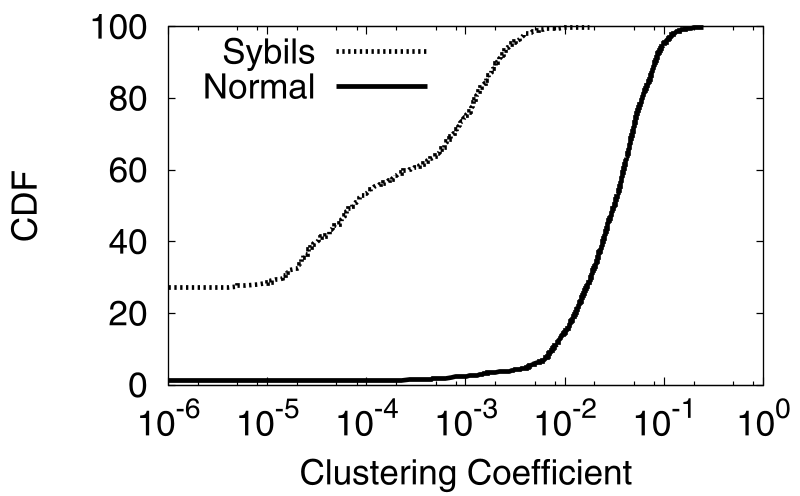 Figure: The Clustering Coefficient (CC) clearly separates normal users (high mutual connections) from Sybils (low mutual connections).
The Deep Insight: Accidental Communities
The most shocking discovery was the topology of Sybil nodes.
- 80% of Sybils had NO links to other Sybils.
- The remaining 20% formed a loose community, but not by choice.
Using temporal analysis (tracking when links were made), the authors found that Sybil-to-Sybil links happened at random times. Why? Because automated Sybil tools use snowball sampling to find "popular" targets. If a Sybil account successfully gains many friends, it becomes a popular target, and other Sybil bots accidentally send it friend requests.
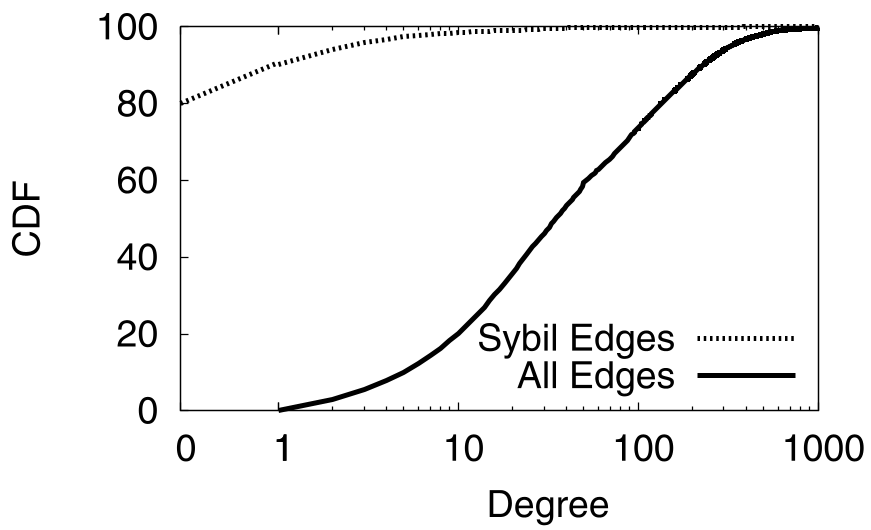 Figure: Degree distribution shows that even when Sybils connect to each other, they don't form the dense clusters required for traditional detection algorithms to work.
Why It Matters: SOTA is Broken
The authors tested the "Largest Sybil Component" (63,000+ nodes) and found it had nearly 10 million "attack edges" (links to real users) but only 134,000 internal links.
In every single case, the number of attack edges far outweighed the internal links. This is the exact opposite of what SybilGuard and SumUp expect. Consequently, these SOTA algorithms would fail to detect the very Sybils that are causing the most damage in the wild.
Critical Analysis & Conclusion
This paper was a wake-up call for the security community. It shifted the focus from Graph Topology (where the nodes are) to Interaction Behavior (what the nodes do).
Takeaway: If you are building a defense system today, do not rely on the structure of the social graph alone. Modern attackers are savvy; they use "Social Engineering" to blend in.
Limitations: The study primarily targets "commercial" Sybils (spammers). It may not fully account for "Stealth Sybils" used in state-sponsored influence operations or those that use more sophisticated AI to mimic human trialing patterns. However, it remains a foundational text in understanding the gap between mathematical models and adversarial reality.